Korea’s renewable energy leader seeks new industries and infrastructure to put clean power to work at scale
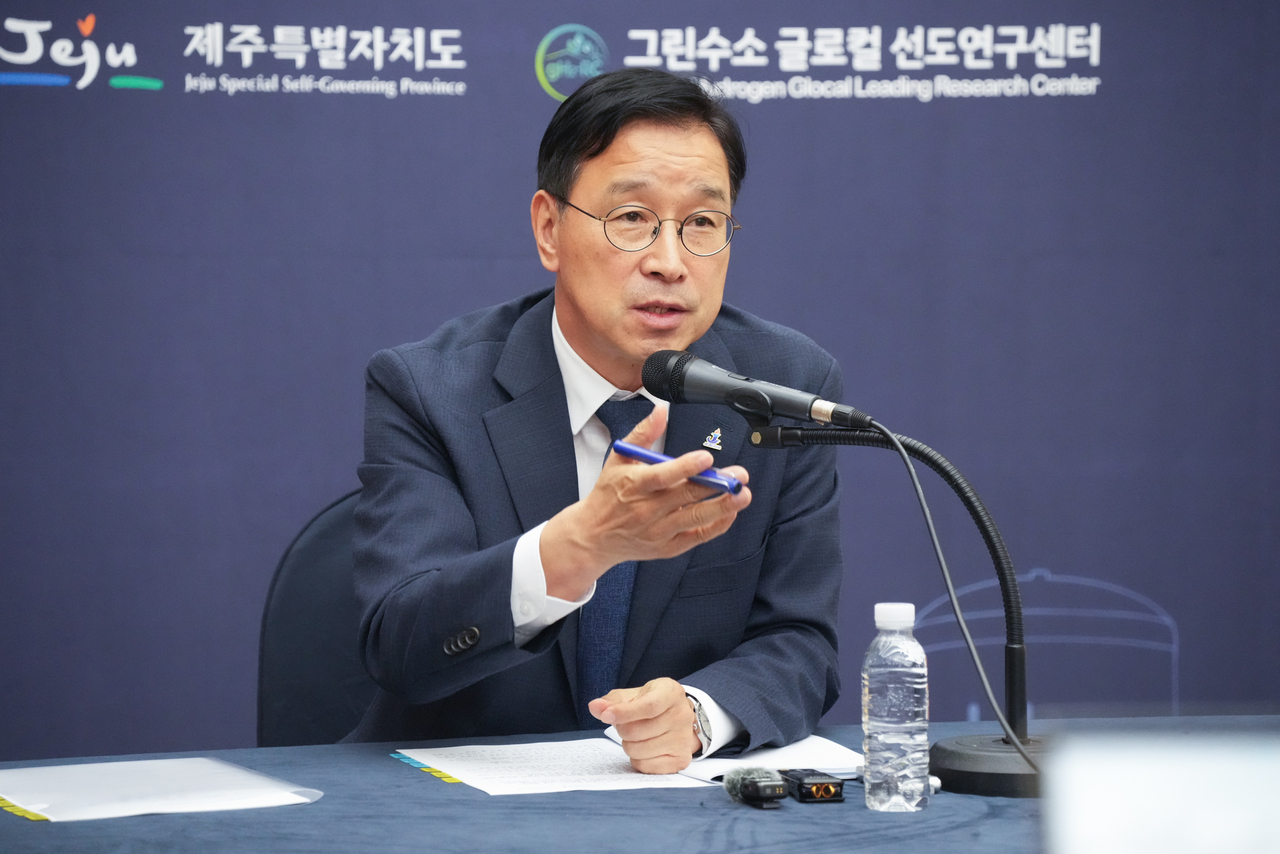
SEOGWIPO, Jeju Island — Jeju must move beyond expanding wind and solar capacity by building the infrastructure and industries needed to put its clean power to work, Gov. Wi Seong-gon said Tuesday.
Jeju aims to achieve net-zero emissions by 2035, 15 years ahead of Korea’s national target. Since taking office July 1, Wi has put climate policy at the center of his administration, creating the island’s first deputy governor post dedicated to climate and the economy.
During an interview with a media pool attending the 2026 Green Hydrogen Global Forum in Seogwipo, Wi said Jeju’s abundant renewable resources could be used not only to cut emissions but also to reshape the island’s economy.
“We are aiming to create a system where we can store and make use of as much renewable energy as possible, and that is key to achieving our 2035 net-zero goal,” Wi said.
Jeju has led Korea's renewable energy transition since it began developing commercial wind power in the late 1990s. Wi said renewables are expected to account for more than 30 percent of electricity generated on the island this year, compared with a national share of 10.69 percent in 2024.
But renewable generation has at times grown faster than local electricity demand. Wind and solar facilities have repeatedly been ordered to reduce output when supply threatened to exceed the capacity of the island’s grid.
“In the short term, we are introducing energy storage systems and other flexibility resources to better manage surplus renewable energy,” Wi said.
“In the medium and long term, we are working to expand large-scale electricity demand, such as green hydrogen production and the deployment of heat pumps for households, to make good use of that energy.”
Jeju’s energy strategy is also intended to reduce the island’s dependence on tourism and agriculture.
Services accounted for 79.9 percent of Jeju’s economy in 2024, compared with 58 percent nationwide, according to government data. Agriculture, forestry and fishing made up 10.3 percent of Jeju’s economy, far above the national figure of 1.5 percent.
Wi said Jeju wants to attract climate technology companies and other businesses that need access to carbon-free electricity or sites for demonstrating emerging technologies.
“We are thinking about climate-related technology companies and companies that need to conduct demonstrations using artificial intelligence,” he said.
He pointed in particular to companies developing technology to maintain grid frequency and balance supply and demand as renewable output fluctuates.
“While we are going to foster such companies in Jeju, we also plan to create a large-scale industrial complex, as we currently have only a few industries concentrated in limited sectors,” Wi said.
Wi said he wanted Jeju to become more than a test bed and instead serve as a base for Korea’s climate and environmental industries.
Achieving that goal will require closer links between Jeju and the mainland power grid, he said. The island is connected to the mainland through subsea high-voltage direct-current lines, but Wi said further investment would be needed as renewable capacity continues to expand.
“Jeju has good resources. The only issue is that it is about 50 kilometers from the mainland. That is not a very long distance,” Wi said. “We need to push the central government to strengthen the connection between our grid and the mainland grid.”
Wi also proposed allowing public institutions and companies in Seoul to invest in community-participatory renewable energy projects on Jeju and purchase the electricity through long-term contracts. Such arrangements could generate revenue for local communities while helping companies meet their clean-energy targets, he said.
Another priority is securing greater local control over electricity pricing.
Electricity rates are largely determined at the national level by the state-run Korea Electric Power Corp., leaving Jeju with limited ability to encourage consumers to shift electricity use to periods of abundant wind and solar generation.
“A price difference of 10 to 20 won per kilowatt-hour is not enough to encourage behavioral changes,” Wi said.
“We want to develop pricing schemes through research by creating a much wider price gap and examining the level of participation that could be achieved.”
forestjs@heraldcorp.com