Civic groups and politicians in North Jeolla Province are calling for major semiconductor projects planned near Seoul to be relocated to their region, reviving a long-running dispute over the location of Korea's next generation of chip facilities, including those whose construction is well underway.
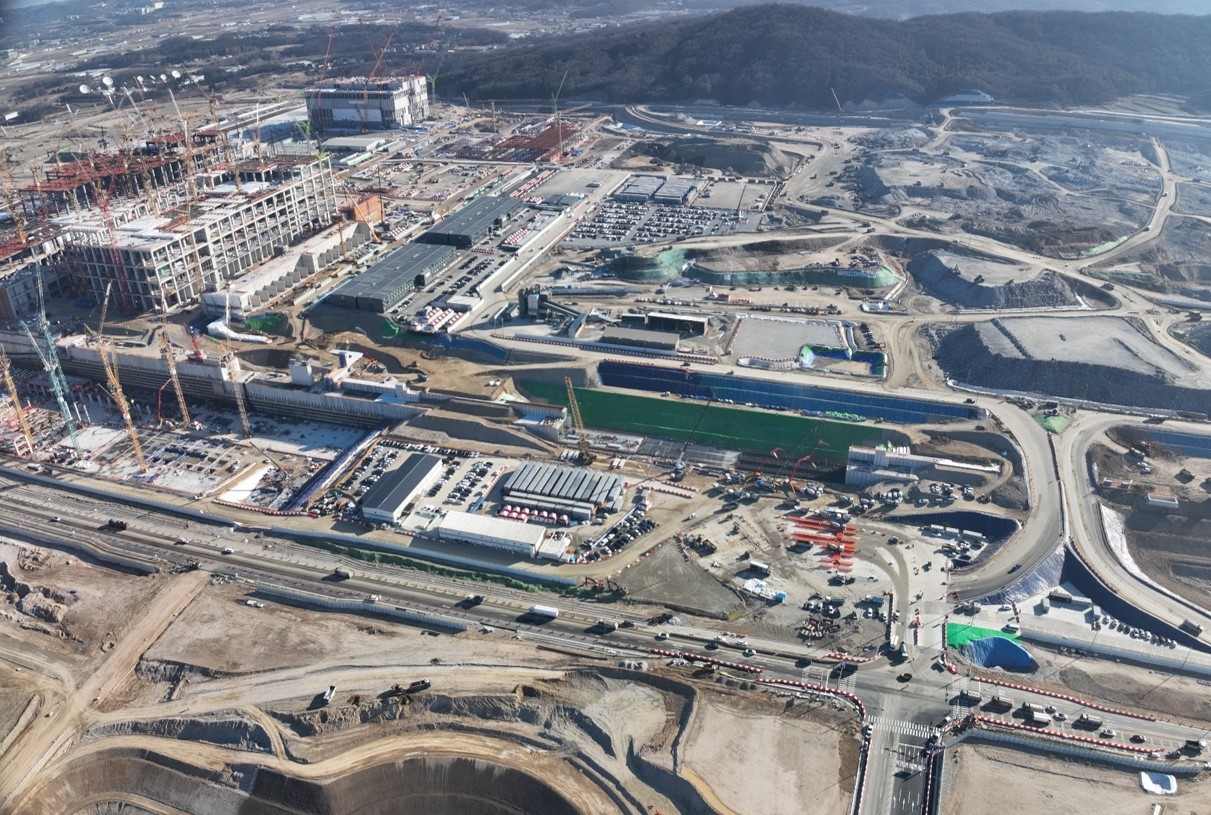
The projects include SK Hynix’s semiconductor cluster and the Samsung Electronics-led national semiconductor industrial complex, both located in Yongin, Gyeonggi Province.
Campaigners argue that the southwestern region's renewable energy resources should not be diverted to already well-developed areas. Instead, local leaders say at least some of the facilities should be relocated to Saemangeum, North Jeolla Province, the nation's largest area of reclaimed land.
Comments by central politicians stressing the need for balanced national development, have placed companies proceeding under the existing plans in an awkward position.
On Monday, civic groups in North Jeolla Province began collecting signatures demanding that an under-construction semiconductor complex be relocated to the province.
The campaign aims to collect 100,000 signatures opposing the transmission of locally generated renewable power and the construction of high-voltage lines through the region, to be submitted to President Lee Jae Myung.
“Naturally, semiconductor facilities planned for Yongin should come to Saemangeum, where the electricity is actually produced,” said Rep. An Ho-young of the government-aligned Democratic Party of Korea, who represents the province and is playing a leading role in the campaign.
Although the demand has existed since the planning stage, it recently gained traction following remarks by the president and Environment Minister Kim Sung-hwan.
On Dec. 10, President Lee urged major chipmakers, including SK Hynix and Samsung Electronics, to “turn their attention to southern provinces rich in renewable energy,” citing the need to address the development gap between the Greater Seoul area — the capital, Gyeonggi Province and Incheon — and other regions.
Kim echoed similar views in an interview with a local radio program Friday, expressing skepticism about the concentration of semiconductor facilities far from power sources.
“I am not sure they should be located there,” he said. “The situation is concerning. We need to change the system so companies are located as close to energy sources as possible, relying on transmission grids only when unavoidable.”
The ministry later issued an explanation denying that it was considering relocating the Yongin semiconductor projects.
The projects represent some of the largest private investments in Korea. SK plans to invest 600 trillion won ($417.8 billion) in the semiconductor cluster in Yongin, while Samsung Electronics is in the early stages of its 360 trillion-won investment plan in the city. However, the projects have faced strong criticism from other provinces and environmental groups, as they require extensive high-voltage transmission lines crossing multiple regions.
According to the Environment Ministry, the peak power demand of the new facilities is expected to reach 15 gigawatts, equivalent to the generating capacity of 15 nuclear power plants.
A significant portion of this power is expected to come from solar and wind farms concentrated in North and South Jeolla provinces, located 150-400 kilometers from Yongin.
North Jeolla Province has emerged as one of the strongest opponents. Thirteen of its 14 cities and counties would be affected by the transmission project, and residents argue that the transmission network, handling voltages of up to 345 kilovolts, would harm living conditions and raise safety concerns.
There are also fears that the Yongin projects would use up most of the province’s renewable energy output.
“While the use of clean energy in manufacturing is becoming increasingly important for exports, our local industrial complexes could struggle to survive,” said an official from a coalition of environmental groups in North Jeolla Province. “That would further deepen the already skewed regional development in Korea.”
The semiconductor industry views relocation as unrealistic. Beside the obvious sunk costs and delays, it points out that energy is not the only resource the clusters need, and that it could be difficult to secure skilled labor and water, which is currently to be sourced from the Han River.
“Every semiconductor industry official I have met says this idea would push Korea’s semiconductor industry backward,” said Yongin Mayor Lee Sang-il. “Semiconductors depend on an ecosystem in which materials, components and equipment firms cluster together, requiring policymakers to listen carefully to industry voices and proceed cautiously.”
forestjs@heraldcorp.com