Summit yields 13 agreements, including investment protection pact signed after 16-year push
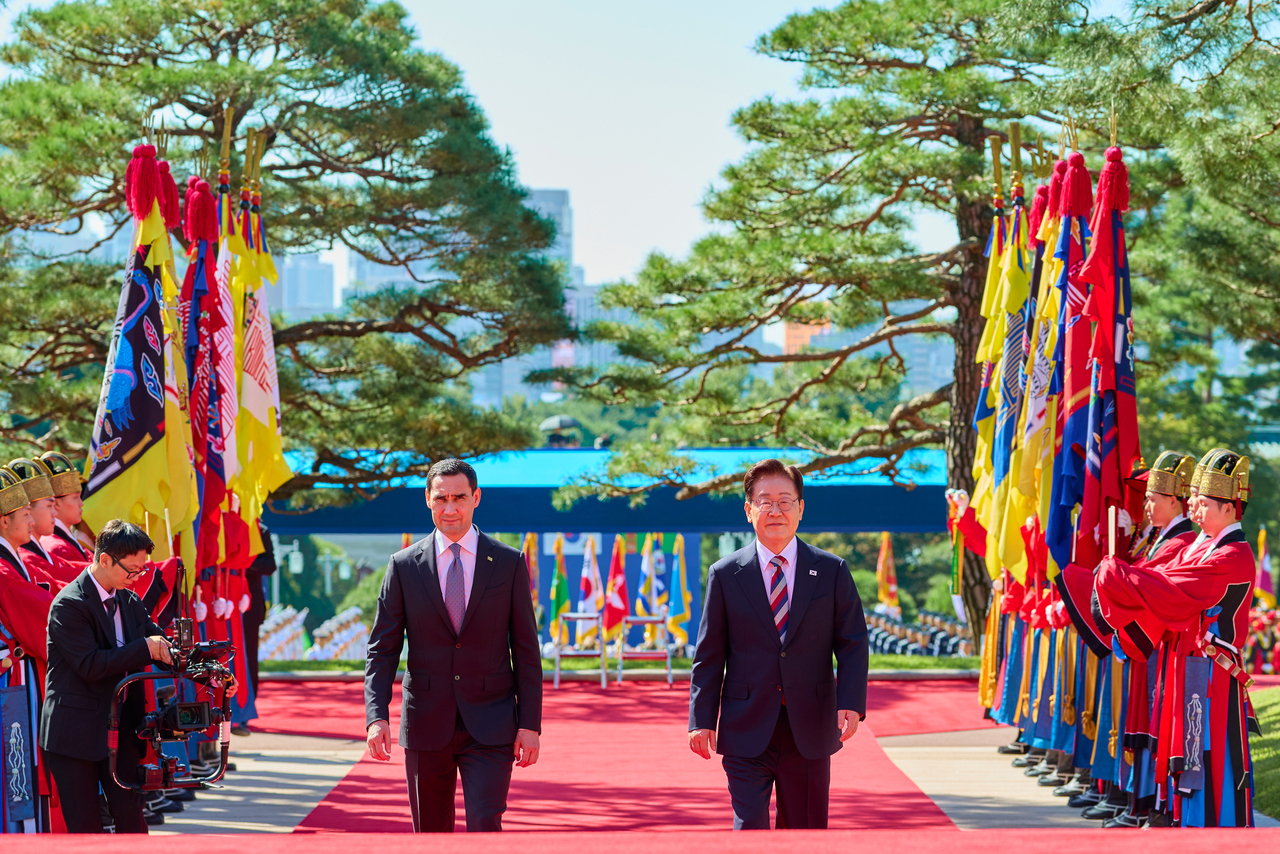
President Lee Jae Myung and Turkmen President Serdar Berdimuhamedov agreed to expand a partnership long anchored in energy and industrial plants to include infrastructure, shipbuilding, urban development and beyond.
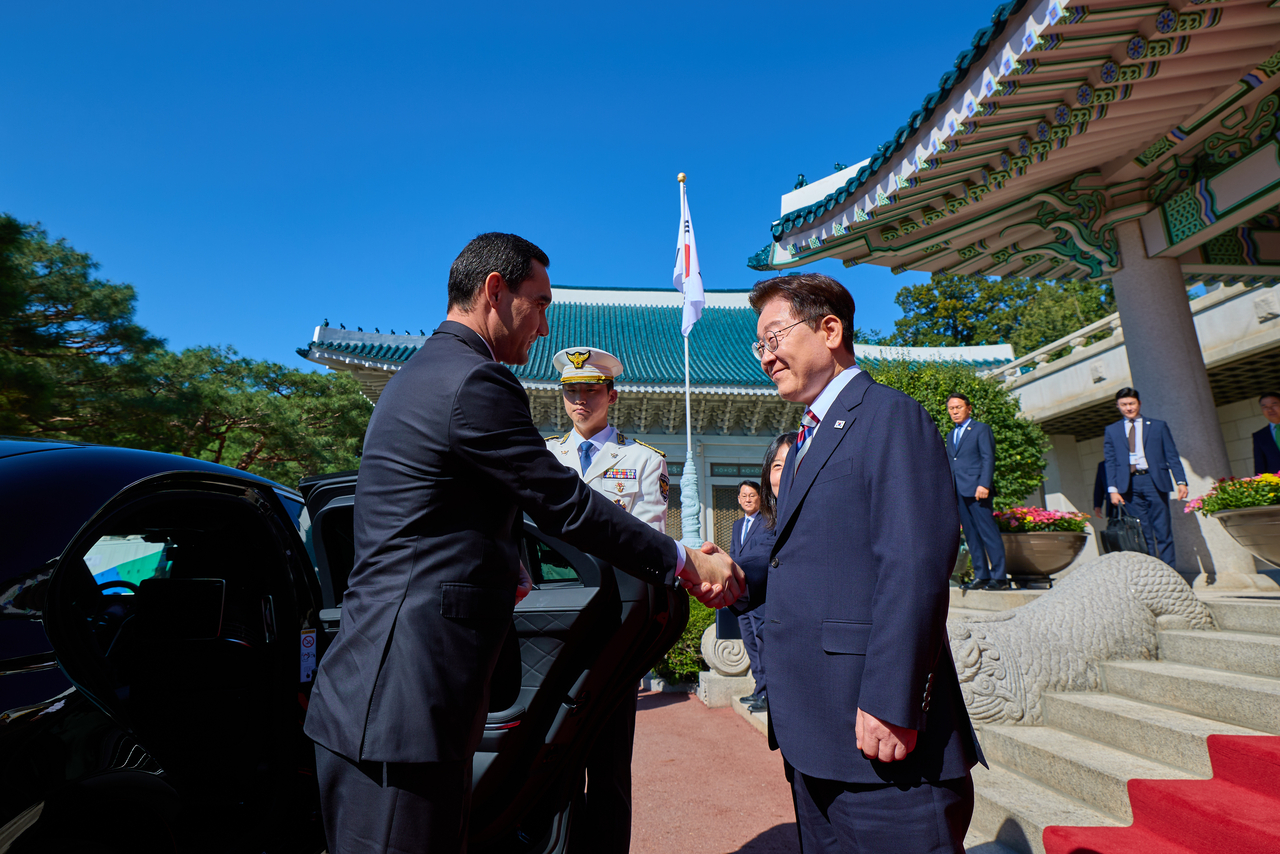
Lee welcomed Berdimuhamedov with an official ceremony Tuesday morning as he continued a second day of bilateral summit diplomacy with the five Central Asian leaders on the sidelines of the inaugural Korea-Central Asia summit to be held Wednesday.
During their talks, Lee and Berdimuhamedov discussed the direction of bilateral ties, ways to deepen substantive cooperation, and a range of regional and international issues, according to Cheong Wa Dae in Seoul.
The two leaders agreed to “build on the progress made in cooperation centered on energy and industrial plants since the two countries established a mutually beneficial partnership in 2008,” senior presidential spokesperson Kang Yu-jung said in a statement.
Lee and Berdimuhamedov further committed to “broadening bilateral cooperation into a wide range of areas, including railways and other infrastructure, shipbuilding, new city development, water management, forestry, artificial intelligence, and science and technology.”
Kang further explained that the two leaders agreed to “translate the potential for bilateral cooperation in areas such as railways and new city development into tangible outcomes.”
Lee and Berdimuhamedov shared the view that Turkmenistan’s “Revival of the Great Silk Road” vision — aimed at turning the country into a logistics hub linking Central Asia with the Caspian Sea and broader east-west trade routes — could serve as a new engine of growth for the region.
Against that backdrop, the two leaders agreed to step up cooperation in developing logistics and transportation infrastructure.
They also agreed to expand “mutually beneficial cooperation” in shipbuilding, including a model under which South Korean engineers and Turkmen workers jointly construct vessels in Turkmenistan, Kang added.
Trust deepens, partnership expands
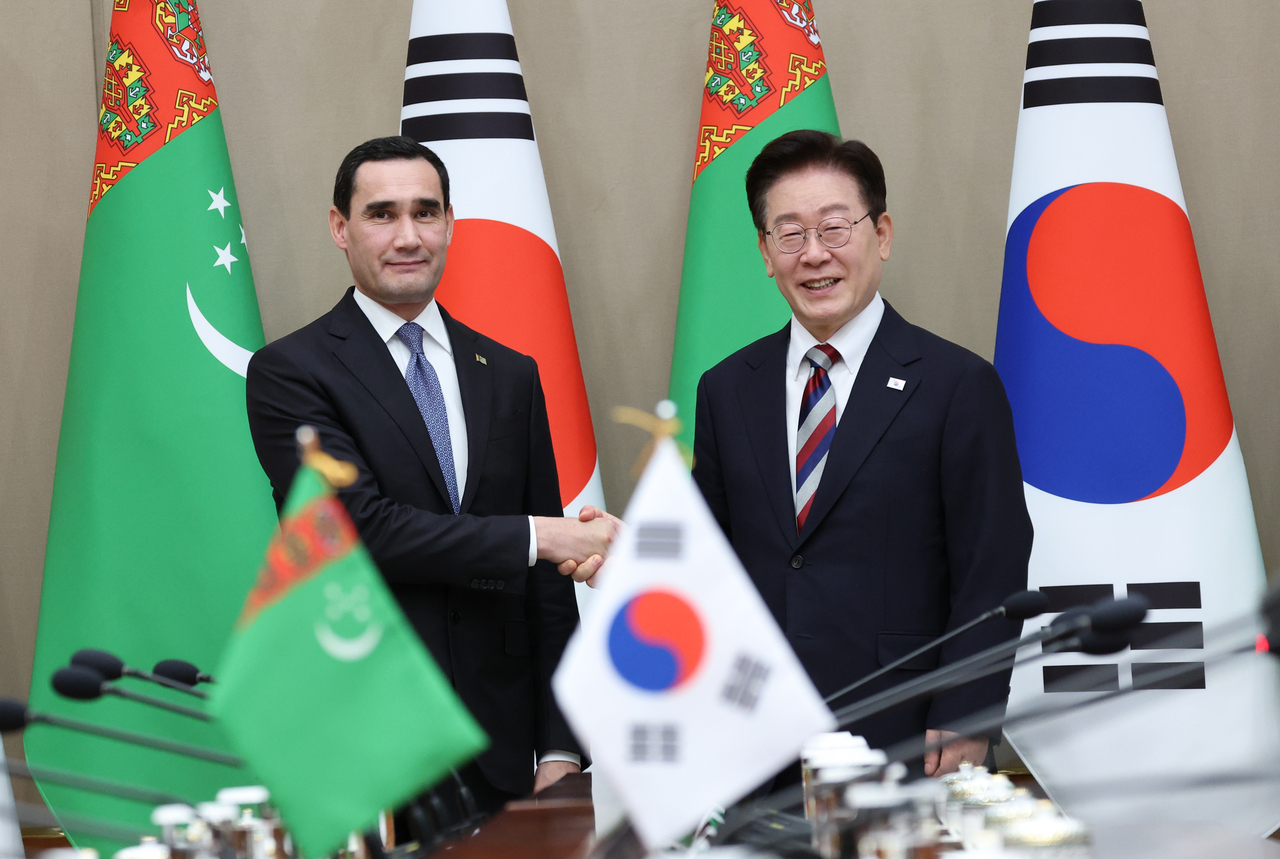
Berdimuhamedov highlighted the significance of his first trip to South Korea since taking office in March 2022.
“This is my first state visit to the Republic of Korea, and it will serve as a very meaningful opportunity to further advance cooperation between our two countries,” Berdimuhamedov told Lee in an expanded meeting, referring to South Korea by its official name.
Lee said he hoped the summit would mark “a new starting point for strengthening cooperation between our two countries across a wide range of areas.”
Lee concurrently noted that Seoul and Ashgabat “have steadily built a solid foundation for substantive cooperation over the years since establishing a mutually beneficial partnership in 2008.”
“Building on that cooperation, I hope our two countries will work together to produce tangible results that contribute to the growth of both countries and that our people can feel in their everyday lives,” he said.
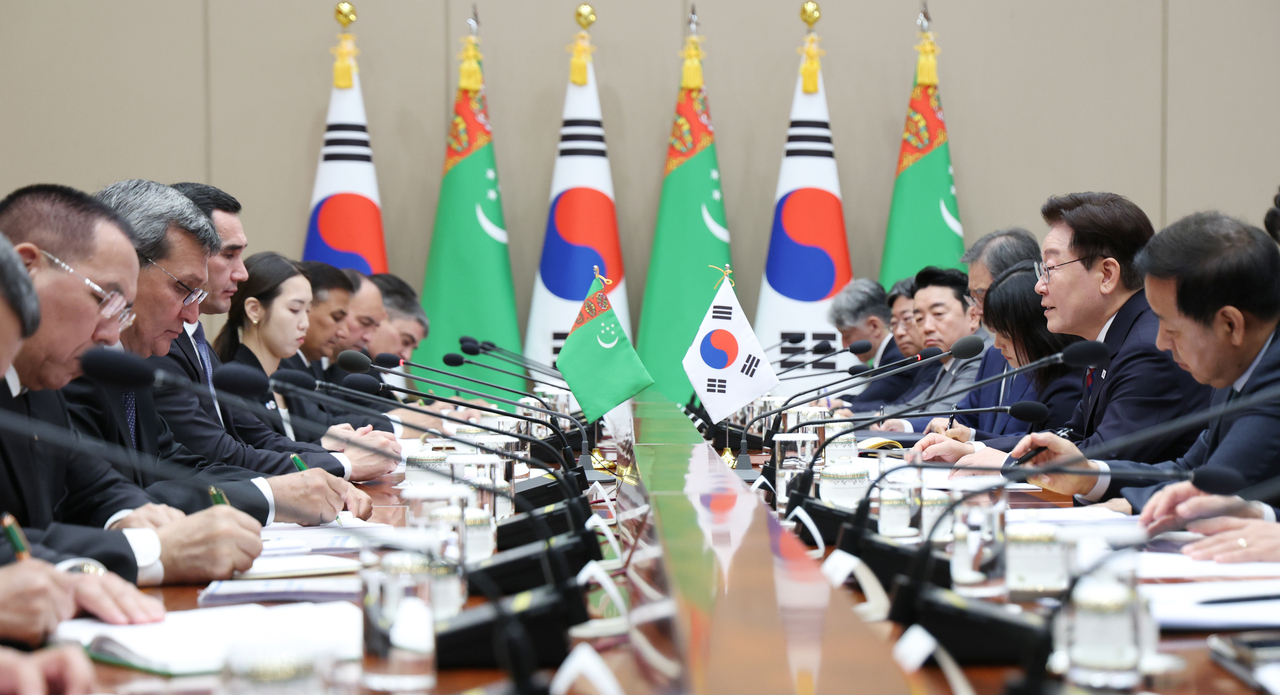
Lee also pledged South Korea’s support for Turkmenistan’s economic development.
“The Republic of Korea will work alongside Turkmenistan so that its abundant resources can lead to high-value-added industries and jobs, and so that its land linking the Caspian Sea and Central Asia can become a new hub for logistics and trade,” Lee said.
Turkmenistan holds the world’s fourth-largest natural gas reserves, and bilateral economic cooperation has traditionally centered on energy and chemical plant projects that combine Turkmenistan’s development needs with South Korea’s engineering, procurement and construction expertise.
Lee also thanked Berdimuhamedov and the Turkmen government for helping South Korean nationals and their families evacuate Iran through Turkmenistan amid heightened tensions in the Middle East this year and last year.
“The warm gesture of support extended to us at a difficult moment clearly demonstrated the deep trust and friendship between our two countries,” Lee said.
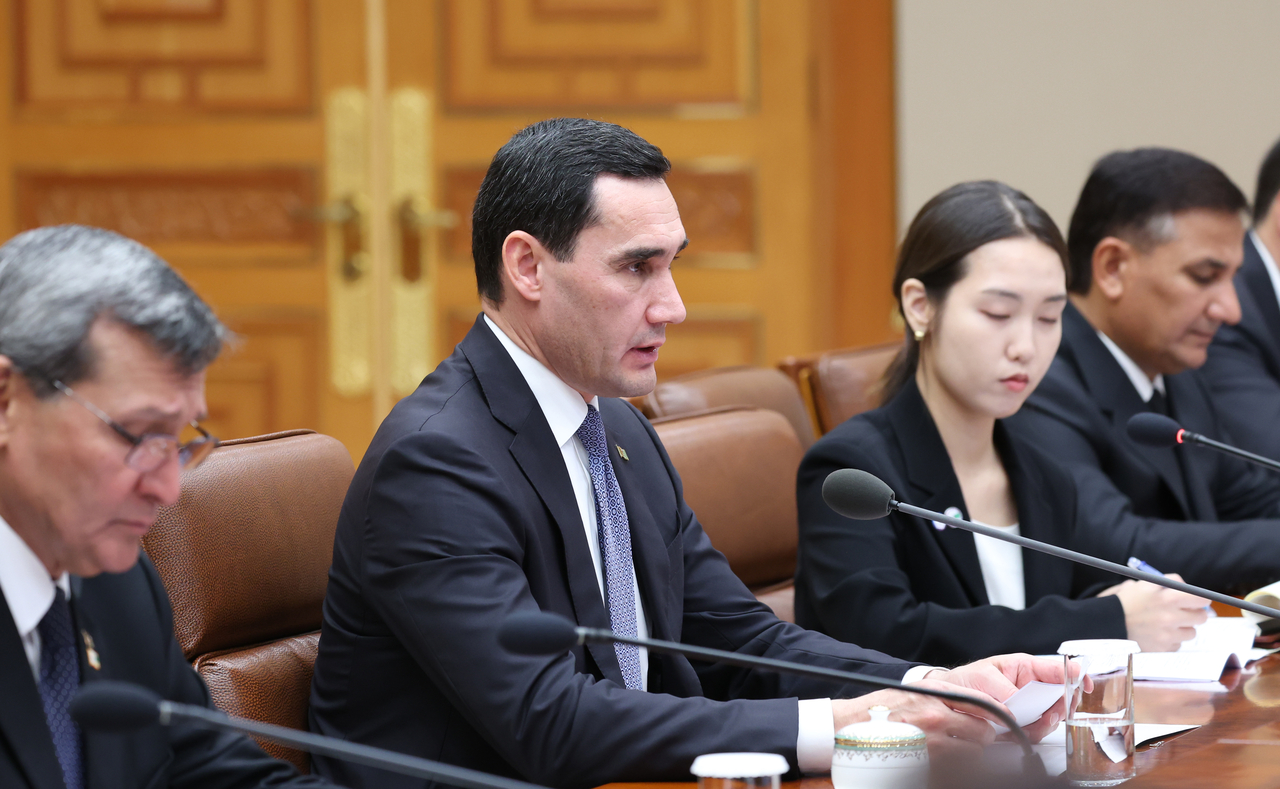
Berdimuhamedov, for his part, emphasized closer diplomatic coordination, highlighting the two countries’ mutual support on the international stage, including the UN.
“Turkmenistan is pursuing cooperation with Korea in a number of priority areas, and one area to which we attach particular importance is diplomacy,” he said.
Berdimuhamedov reiterated Ashgabat’s backing for Lee’s “E.N.D. Initiative” — short for Exchange, Normalization and Denuclearization — aimed at moving the Korean Peninsula away from hostility and confrontation toward peaceful coexistence and shared prosperity.
“We have consistently maintained that all issues concerning the Korean Peninsula should be resolved through peaceful dialogue and diplomatic means, and we will continue to uphold that position.”
Pacts lay ground for shared growth
The two leaders oversaw the exchange of 13 agreements and memorandums of understanding after the summit, spanning a range of fields.
A key outcome was the signing of an investment protection agreement aimed at strengthening safeguards for investors and promoting bilateral investment. The two countries began pursuing the pact 16 years ago.
Seoul and Ashgabat signed memorandums to expand cooperation in chemical and industrial plants as well as infrastructure, covering areas including energy, construction, transport, logistics, smart cities and digital infrastructure. The two sides also established a government-to-government framework for railway cooperation to identify new projects and expand opportunities for Korean companies in Turkmenistan.
The summit also produced three separate memorandums on law enforcement and legal cooperation, including working-level channels to combat transnational organized crime.
A memorandum between South Korea’s National Police Agency and Turkmenistan’s Ministry of Internal Affairs established a formal law enforcement cooperation channel. Another between the two countries’ justice ministries created a formal framework for legal cooperation.
The two sides also agreed to strengthen cooperation in customs, intellectual property rights and water management, including modernizing the Karakum Canal using Korean smart water technologies.
Following the summit and signing ceremony, Lee hosted a state luncheon attended by about 50 government, political and business figures from both countries.
The Korean side included Daewoo Engineering & Construction Chairman Jung Won-ju, Hyundai Corporation President Chang Ahn-seok, Export-Import Bank of Korea President Hwang Ki-yeon and Korea National Railway Chairman Chung Jin-hyuk.
The Turkmen delegation included Deputy Prime Minister and Foreign Minister Rashid Meredov; Deputy Prime Minister for Economy and Finance Hojamyrat Geldimyradov; Deputy Prime Minister for Oil and Gas Guvanch Agajanov; Chairman of the Turkmenhimiya State Concern Resul Myradov; and Chairman of the State Bank for Foreign Economic Affairs Rahimberdi Jepbarov.
dagyumji@heraldcorp.com