More than 300 imported food products flagged since 2021 over pesticides, veterinary drugs and other safety violations
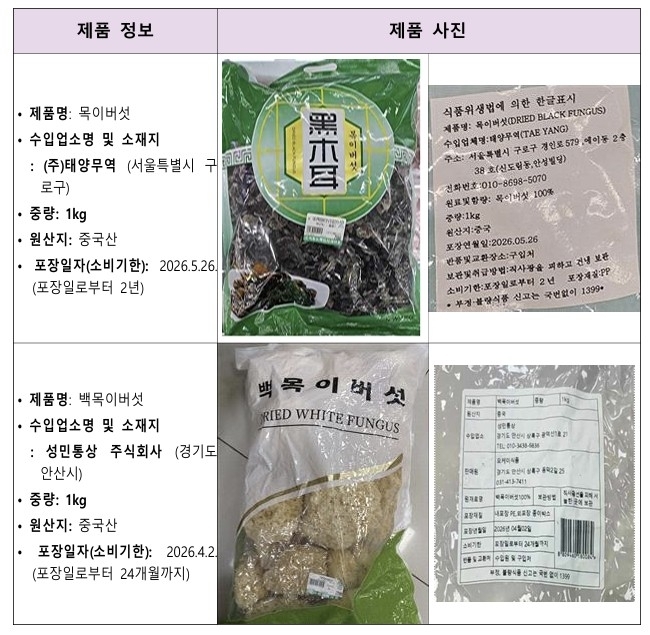
Multiple imported food products were found to violate South Korea's safety standards in the first half of this year, including cases involving excessive pesticide residue and veterinary drugs, according to government data released Monday.
There were 18 such cases between January and June, according to data from the Ministry of Food and Drug Safety obtained by Rep. Seo Mi-hwa of the ruling Democratic Party of Korea. Six cases involved pesticide residue, while four involved violations of veterinary-drug standards, including antibiotics.
Similar cases have continued in the second half of the year.
Earlier in September, Chinese wood ear mushrooms were found to contain carbendazim, a pesticide used to prevent fungal diseases, at 0.24 milligrams per kilogram — 24 times the permitted level of 0.01 mg/kg. The MFDS ordered sales of the product suspended and recalled 8,350 kilograms.
In May, frozen whiteleg shrimp imported from Vietnam was found to contain doxycycline at 0.11 mg/kg, 11 times the permitted level, prompting the ministry to order a sales suspension and recall.
Of the 18 cases recorded in the first half, eight involved products imported from Vietnam, five from the United States, three from China and one each from Canada and Sweden.
Products found to violate safety standards can be subject to measures including sales suspension, recall, return or disposal, while importers may face administrative sanctions.
According to Seo's data, 329 cases of imported food were found unsuitable for domestic distribution between 2021 and 2025, for reasons including excessive pesticide or veterinary drug residues, mycotoxins, microorganisms, heavy metals and foreign matter. The annual number ranged from 87 cases in 2022 to 53 in 2024.
Food import safety has drawn renewed attention following controversy in China last month over the use of formaldehyde on cabbage to preserve freshness.
The MFDS tightened inspections of Chinese cabbage imports after the reports emerged. It later said the cabbage implicated in China had not been exported to Korea and that tests on 15 shipments of Chinese cabbage and 124 shipments of kimchi found no formaldehyde.
"The MFDS must reinforce its safety management system for imported food," Seo said. "It should tighten inspections of high-risk products and take swift measures, including halting distribution and recalling or disposing of products, to prevent unsafe food from reaching consumers."
minsikyoon@heraldcorp.com