Driving in a foreign country requires learning more than its traffic laws. In Korea, hazard lights, horns and even phone numbers left on dashboards carry meanings that may not be immediately obvious to newcomers.
Here are some of the unwritten rules and practical habits to know before getting behind the wheel.
What hazard lights mean when driving in Korea
A quick double flash of hazard lights in Korea may mean “thank you,” “sorry” or “watch out.”
The meaning depends on the situation. While traffic laws and signs govern how motorists must drive, Korean roads also have their own informal language. Understanding it can make driving here a little less confusing — and safer.
Hazard lights can say more than “emergency”
The large button marked with a red triangle activates a vehicle’s hazard warning lights, causing both turn signals to flash at once.
Korean drivers commonly flash them once or twice to thank another motorist for letting them merge or to apologize after an abrupt lane change. This is an informal courtesy, not a rule of the road.
Drivers also use hazard lights when stopping temporarily to pick someone up or unload something. But switching them on does not make it legal to stop or park in a prohibited area.
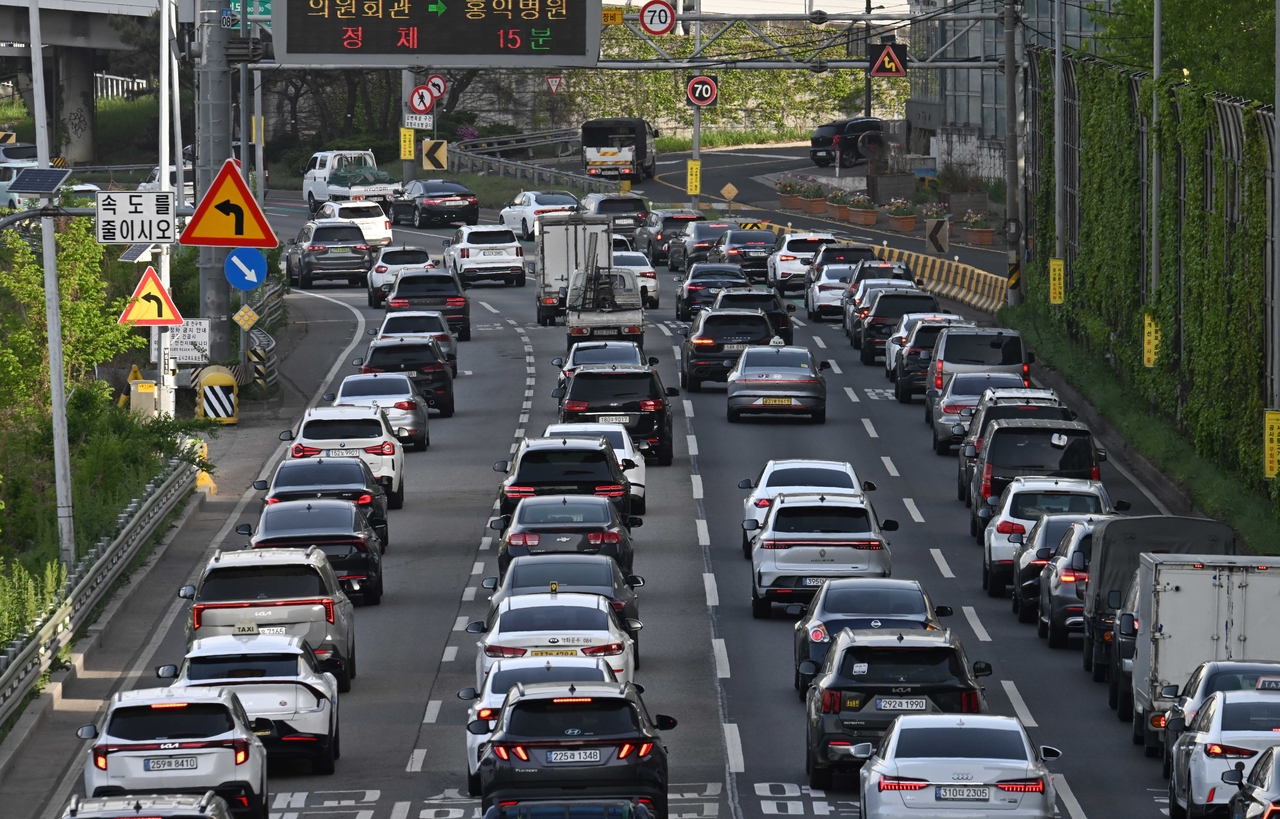
On expressways and other fast-moving roads, several cars suddenly activating their hazard lights often signals congestion, a crash or another obstruction ahead. Slow down and increase the distance from the vehicle in front.
Hazard lights are also commonly used during torrential rain or dense fog. More importantly, drivers are legally required to reduce their speed in poor weather. The speed limit must generally be reduced by 20 percent on wet roads and by 50 percent when visibility falls to 100 meters or less because of heavy rain, snow or fog, unless variable speed-limit signs provide different instructions.
Use the horn for danger, not conversation
Horns were once used more liberally on Korean roads, sometimes even to thank other drivers. Hazard lights have largely taken over that role.
A horn should primarily be used to warn someone of an immediate danger, such as a pedestrian entering the road or a vehicle reversing without appearing to notice another car. It may also be useful on a narrow alley where approaching vehicles cannot see each other.
Some drivers still use the horn to express frustration, but repeated or continuous honking without a legitimate reason is prohibited under Article 49 of the Road Traffic Act.
Know the rules before entering an expressway
The standard minimum speed on Korean expressways is 50 kilometers per hour, unless signs indicate otherwise. Drivers may travel more slowly when congestion, bad weather or another unavoidable circumstance makes it necessary.
Driving on the shoulder is generally prohibited. Exceptions include vehicle breakdowns and other unavoidable emergencies, as well as situations in which signs or police officers direct motorists to use the shoulder. Article 60 of the Road Traffic Act sets out the restrictions.
Korean expressways have full-size service areas with restaurants, gas stations, restrooms and convenience stores. They also have smaller rest stops specifically intended for drivers who need an immediate break.
Known as "joreum suimteo," or drowsy driver rest areas, these facilities were first introduced on expressways in 2011. They typically provide parking spaces but have fewer amenities than full service areas, and some do not have restrooms.
They serve an important safety purpose. Police data show that 252 people died in drowsy driving crashes nationwide from 2020 through 2024, an annual average of about 50.
Phone numbers and double parking
Many motorists in Korea display their phone number on the dashboard so they can be reached if their vehicle is blocking another car or becomes involved in a parking-related problem.
This is particularly common in older apartment complexes and densely populated neighborhoods where parking spaces are scarce. Leaving a number, however, does not excuse illegal parking or blocking pedestrians and traffic.
In crowded parking lots, drivers may sometimes be instructed to leave their vehicles in neutral so another person can push them out of the way. This is known as double parking.
Do this only where the parking facility permits it and on level ground. Procedures differ by vehicle, particularly for cars with electronic parking brakes or shift-lock systems, so check the owner’s manual if necessary. Never leave a vehicle in neutral on or near a slope.
When possible, using a designated parking space is the safest option.