Rank-and-file members of the ruling party back pro-Lee faction leaders in primaries
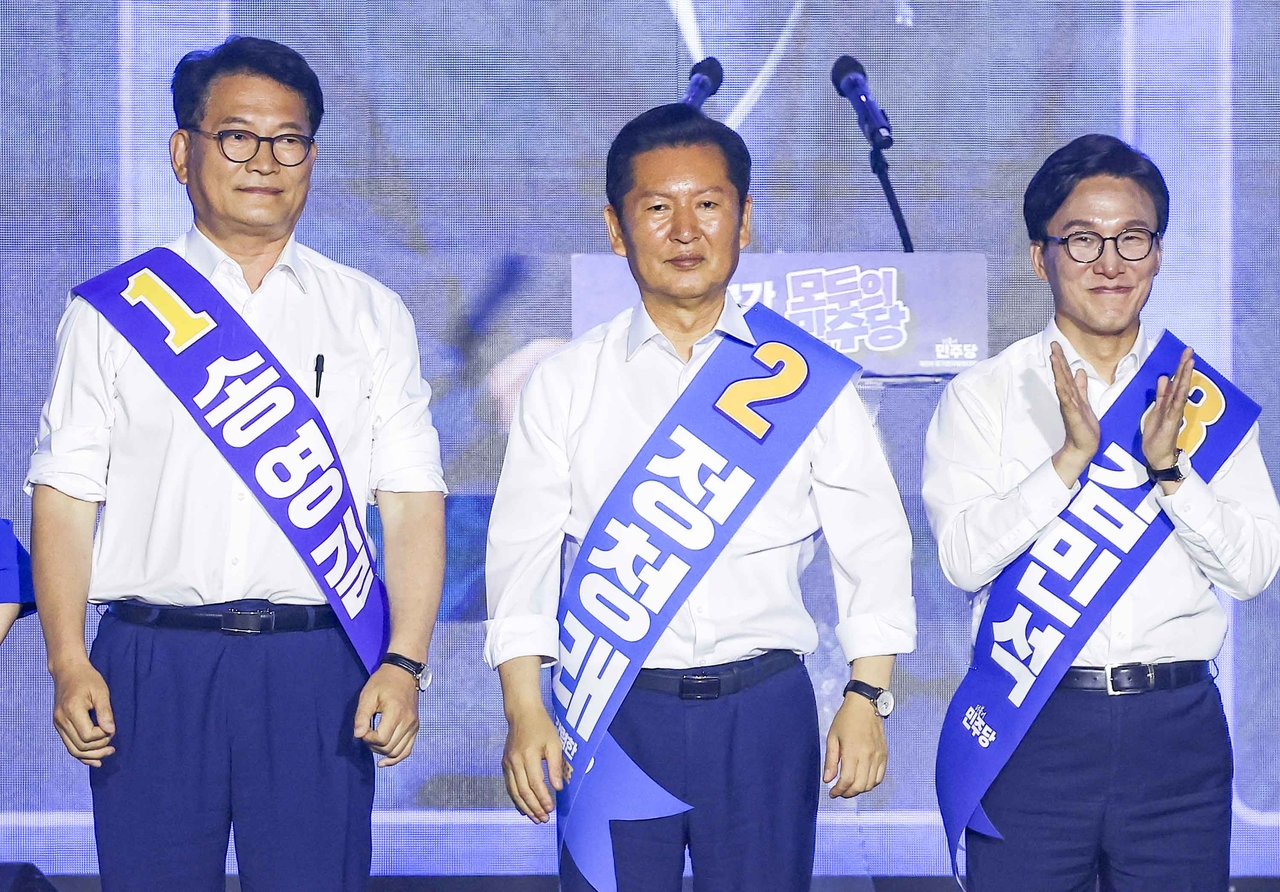
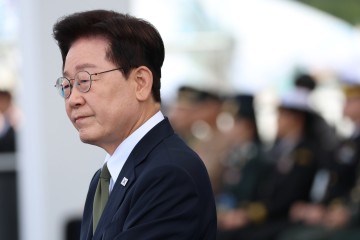
DAEJEON ― President Lee Jae Myung stands to gain a firmer grip over the ruling Democratic Party of Korea as the party's ongoing leadership race wraps up, with the votes tallied so far pointing to a stronger pro-Lee presence in its top decision-making body.
The changing balance of power would give Lee greater latitude in steering the ruling bloc and reduce the friction with Cheong Wa Dae that surfaced under the outgoing party leadership.
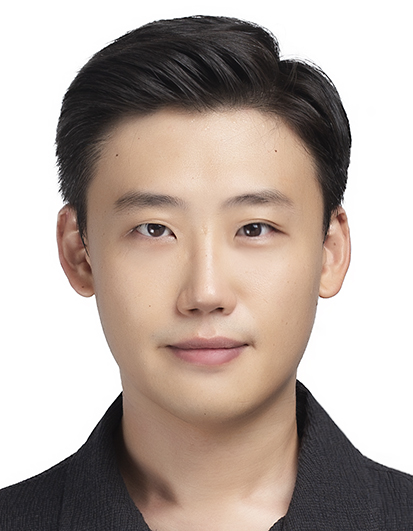
Rep. Kim Min-seok, a four-term lawmaker and the former prime minister in Lee's administration, is leading in the election for the chair post after winning primaries nationwide.
The new leader will be elected at the party convention in Daejeon on Monday. The total outcome had yet to be announced as of press time.
About half of the party's 1.52 million dues-paying members participated in the primaries through Sunday, and their votes will be aggregated with over 17,000 party delegates' votes and opinion poll results at the national convention.
Primaries across the nation show that Kim has won 49.91 percent of the vote among all dues-paying members, or 383,373 votes, through Sunday, while his rival in the opposing faction, Rep. Jung Chung-rae, another four-term lawmaker who is seeking reelection, secured 41.51 percent of the vote, or 318,806 votes.
Kim widened his lead against Jung over the weekend in primaries in Seoul, Gyeonggi Province and the left-wing stronghold of the country's southwest, home to about two-thirds of all rank-and-file members registered nationwide.
The gap between Kim and Jung widened from 1.48 percentage points the previous weekend to 8.4 percentage points.
Rep. Song Young-gil, who is considered Kim's ally in the three-way race for the chairship, won 65,874 votes. This amounts to 8.58 percent of all rank-and-file Democratic Party members. Song is a six-term lawmaker who formerly chaired the party.
If he prevails, Kim will also gain majority control over the ruling party's nine-member decision-making body, the Supreme Council.
The Supreme Council consists of the party chair, the floor leader, five elected members and two members appointed by the chair.
There are five Supreme Council seats up for grabs, and pro-Lee lawmakers Reps. Park Sun-won and Seo Mi-hwa were comfortably ahead of candidates clustered around the cutoff for the fifth and final spot.
That would leave the pro-Lee camp with at least five of the nine Supreme Council seats if Kim Min-seok won the chairmanship, even if longtime Lee aide Kim Yong fell short. In that scenario, if Kim Min-seok were elected chair, and Park and Seo were elected to the council, the other two members would be appointed by the new chair. If Kim Yong also secured a seat, the bloc would expand its majority to six.

The emerging pro-Lee majority would in some ways restore the balance of power that existed before Lee left the party leadership for the presidency.
"We are desperate (for change) as we are concerned that the Democratic Party, the government, and the relationship between the party, the government and President Lee could be shaken," Kim said in his convention speech, adding, "The fate of the party hangs in the balance."
Jung, in his speech, denied speculation that his faction was at odds with the Lee administration, raising doubts about Kim's logic that his win would guarantee Lee's success.
At the party’s 2024 national convention, Lee Jae Myung won reelection as chair — becoming the first Democratic Party leader in more than two decades to secure a consecutive term — while the politicians aligned with him swept all five elected Supreme Council seats. Kim Min-seok topped the council race and became its senior elected member, effectively the party's No. 3 figure.
That dominance began to unravel after Lee Jae Myung won the presidency in June 2025. Two months later, pro-Lee candidate Park Chan-dae lost the party chair by-election to Jung.
With more pro-Lee candidates including Kim departing from the Supreme Council to advance to the Cabinet or to run in the June 3 local elections, some of the posts were filled with those not aligned with the pro-Lee faction, such as Reps. Lee Sung-yoon and Moon Jeong-bog.
This allowed Jung to strengthen his control over the ruling party over the past year, raising speculation that Lee's grip on the ruling party has loosened under Jung's leadership.
The pro-Lee faction has accused Jung of his "self-serving" politics, which cost the party's relationship with the incumbent president.
Among the examples under Jung's leadership are the party's unilateral push for prosecutorial reform last year despite the presidential office's request for a slowdown, and his proposal to merge with the minor liberal Rebuilding Korea Party.
Adding fuel to speculation of the factional feud were Lee's rejection of Jung's declaration that the party won the June 3 local elections, Jung's remarks that no administration would outlast its people, in an apparent reference to the Lee administration, and Cheong Wa Dae's decision not to have Jung appear at a ceremony to send off the president as he departed for Europe.
Most recently, the factional feud revolved around whether to change the convention election rules and adopt ranked-choice voting.
The pro-Jung faction is largely rooted in those sympathizing with former liberal Presidents Roh Moo-hyun or Moon Jae-in.
Infighting erupted back in 2021 when Lee Jae Myung, who was then a dark horse in South Korean politics, squared off against Lee Nak-yon, who was the prime minister in the Moon administration, to vie for the Democratic Party candidacy in the 2022 presidential election.
Song claimed in a media interview in March that some in the pro-Moon faction "did not join the campaign for Lee Jae Myung" after Lee Nak-yon’s defeat in the 2021 primary, which led to his narrow loss in the 2022 election against the conservative People Power Party's Yoon Suk Yeol.
consnow@heraldcorp.com