As contenders highlight loyalty and connection to liberal icons, fight is not just over claims to their legacy, but what that legacy is
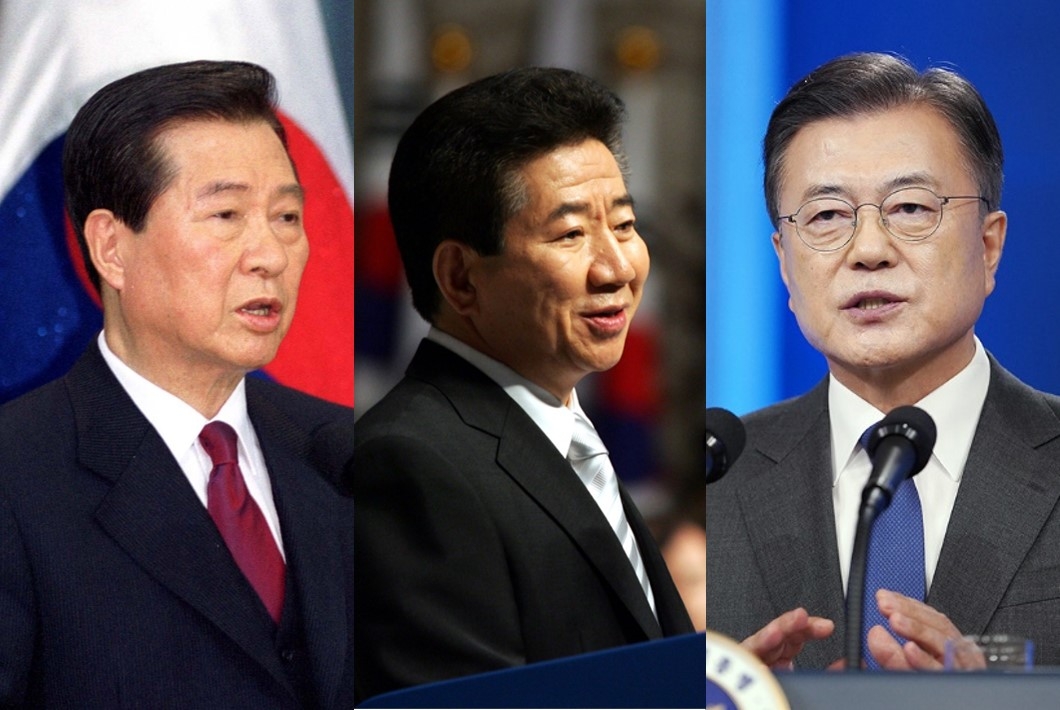
Inside the Democratic Party of Korea chair's office at the National Assembly, photographs of former Presidents Kim Dae-jung, Roh Moo-hyun and Moon Jae-in take pride of place.
These leaders are displayed as symbols of Korea's democratic struggle and the advancement of democracy.
But that symbolic weight is being fought over as the Democratic Party's leadership race heats up with the national convention less than a week ahead.
Candidates for the party chair often choose to appropriate these leaders' names to claim political legitimacy. But even as the candidates put forward competing claims to be their one true "heir," questions are growing as to whether the liberal icons’ spirit truly endures to this day.
'Loyalty' as strategic tool
In this year's party leadership election, the outcome of which could determine the party's level of alignment with President Lee Jae Myung, three lawmakers are vying for the top post: former Prime Minister Kim Min-seok, and former party leaders Jung Chung-rae and Song Young-gil.
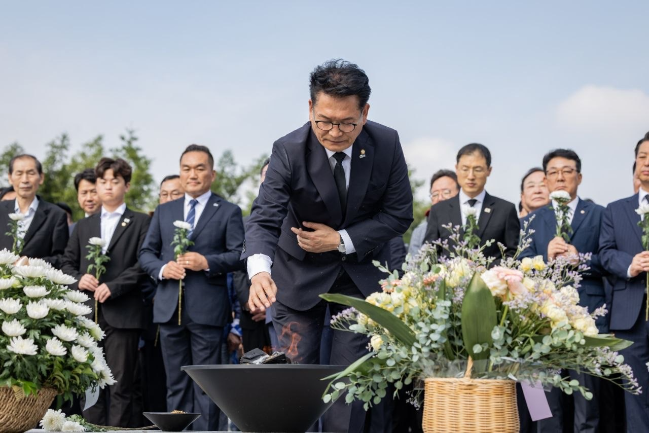
To reinforce their claims to past leaders' legacies, the candidates mention the former presidents in their campaign speeches as often as they talk about their policies. Party chair contenders also take turns visiting the tombs of the two late former leaders, Kim and Roh.
"Figures such as Kim Dae-jung and Roh Moo-hyun are closely associated with South Korea's democratic transition,” Hannah Kim, associate professor of political science at the Graduate School of International Studies at Sogang University, told The Korea Herald.
“So referencing them ... evokes a sense of nostalgia and emotional attachment among supporters, reminding voters of the party's role in the country's democratic development."
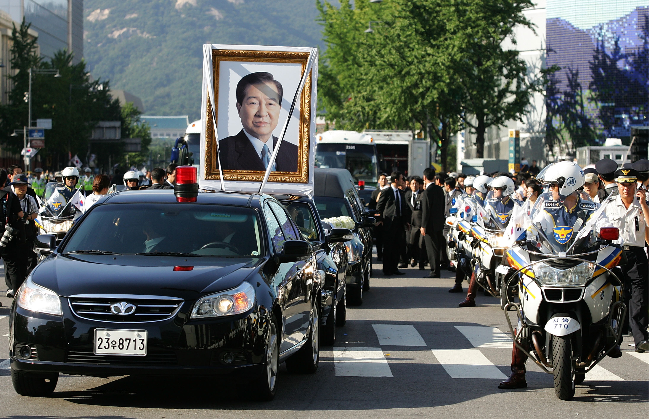
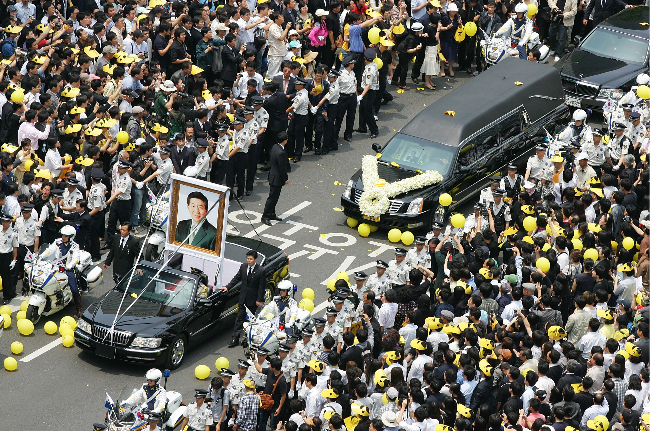
Kim Dae-jung, South Korea's only president born in the southwestern Jeolla region, became an icon of liberal leadership after enduring political persecution, abduction, imprisonment and exile under successive authoritarian regimes before the country’s democratization in 1987.
Kim was succeeded by Roh, who was the Oceans Minister in the Kim administration. Before entering politics, Roh was a human rights lawyer who defended protesters against military dictatorship. Moon was Roh's top presidential aide and eventually became president eight years after Roh's death by suicide following the prosecution's corruption probe.
While the significance these leaders hold in the modern history of South Korea cannot be ignored, some say the party's continued attachment to past leaders contributes to divisions within it.
Citing factional splits among Joseon's Confucian scholars, Lee Jong-eun, an assistant professor of political science at North Greenville University, said that rooting for revered leaders is nothing new in South Korea's politics.
"It has been common for a political group to seek legitimacy through claiming to be disciples of a revered public figure," said Lee Jong-eun, an assistant professor of political science at North Greenville University. "That tradition appears to still continue in contemporary politics."
Lee noted that the former liberal leaders remain well respected.
"I also think the enduring popularity of these past presidents is important. If Kim and Roh were deeply unpopular, today’s Democratic Party figures would not actively claim to be heirs," Lee said.
Ugly flip side
But as candidates campaign as “true heirs,” they also argue that their rivals are not, often labeling them as "traitors."
Jung, a liberal firebrand who is effectively seeking reelection as party chair, often accuses Kim, the incumbent president's former prime minister, of betraying Roh and his supporters.
"In Korean political culture, 'loyalty' is an important reputation. ... A political figure is evaluated by his past connection with the former president, invoking loyalty," said Lee of North Greenville University.
Jung invokes Kim’s 2002 decision to part ways with Roh in the run-up to the presidential election.
At the time, Kim chose to join a smaller party led by the then-presidential candidate Chung Mong-joon — departing from the predecessor of today's Democratic Party.
A month after Kim's defection, Chung conceded his candidacy to Roh, only to withdraw his support a day before the election in December 2002. Roh ultimately won the election.
The event decades before gave Kim Min-seok the reputation of "a migratory bird," a term used in Korea to refer to politicians who move parties when the political weather changes.
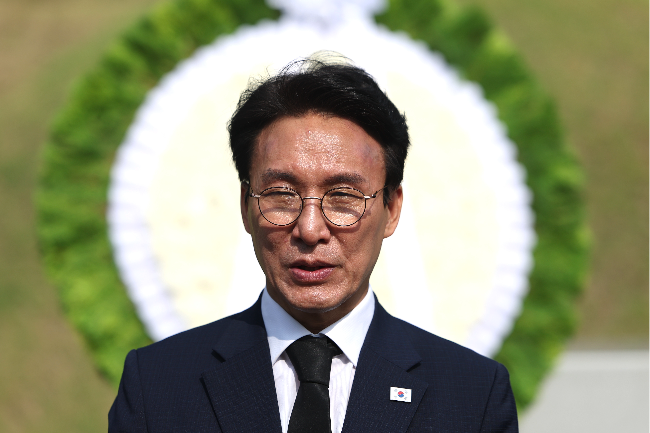
Fast forward to today, and Jung repeatedly uses Roh’s name to undermine Kim, while highlighting his own history of never having defected to another party.
"Those seen as 'traitors' often face rejection from party members," said Lee, adding that prominent political figures such as former lawmaker Yoo Seong-min, former Prime Minister Lee Nak-yon, former People Power Party Chair Rep. Han Dong-hoon faced major crises in their political careers after leaving their parties.
In response, another pro-Lee Jae Myung candidate, Song, accused Jung of betraying the incumbent president, arguing that Jung and his faction are often at odds with Lee and his supporters, while Kim apologized for his past during the election period.
"Labeling rivals as ‘traitors’ deepens factional conflict, reinforces polarization and frames political competition in moral rather than substantive terms," Kim of Sogang University said.
"When historical legacies are used primarily as political weapons, they can undermine constructive debate and make compromise more difficult."
Is liberal icon's legacy distorted?
The heated leadership race, coupled with the ruling party's recent push to pass unpopular bills, invited criticisms that the liberal icons' legacies are being selectively appropriated.
One of the latest examples is the leadership contenders' claims that the prosecutorial reform was carried in the spirit of Roh.
Since President Lee Jae Myung took office, multiple controversial bills have been passed, including a recent change to the Criminal Procedure Act. The changes are aimed at reducing the prosecution's investigative power.
This was aligned with the Moon administration's move to limit the prosecutors' scope of investigation and establish an independent investigative body for criminal allegations concerning high-ranking officials, including prosecutors.
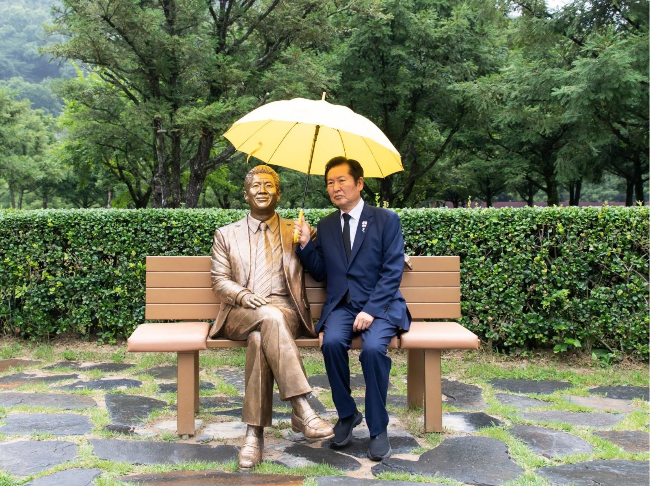
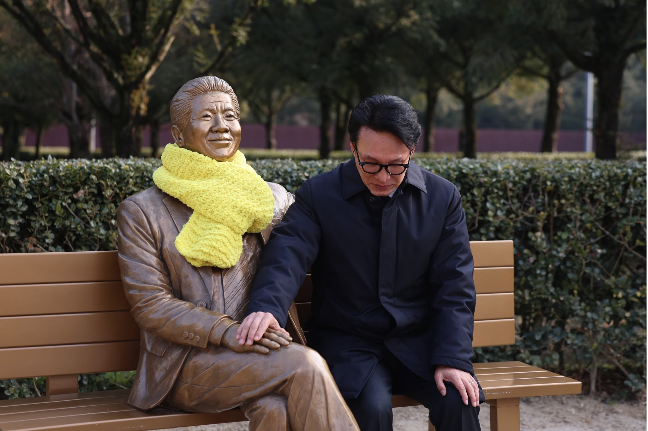
Pro-reform Democratic Party lawmakers including Jung and Kim have claimed that they are striving to uphold Roh's vision through the legislation to strip prosecutors of any chance to intervene in a criminal investigation, effective in October.
Former conservative lawmaker Yoo criticized Jung for his reference to Roh, saying the late president wanted to keep the prosecution in check, not remove its power entirely. Jung responded that Yoo should refrain from interfering in the party convention.
Along with Yoo, Rep. Kwak Sang-eon, a Democratic Party lawmaker who is also Roh's son-in-law, denied claims that the recent bill is aligned with Roh's vision.
"Stop distorting Roh's will and his politics to seek your own political gains and interests, or to deceive the people," said Kwak on Aug. 2, who was the only Democratic Party lawmaker to have voted against the bill in July.
"Do not consume Roh's death as a symbolic means for your own political gains or own arguments."
According to Lee of North Greenville University, contemporary political figures tend to "'cherry-pick' a particular aspect of the former leader’s politics that fits their current political interest, while ignoring or even mischaracterizing the other parts of the leader’s policies and beliefs."
"Such 'selective memory' distorts evaluation of the past political history and uses past political figures as convenient talking points," Lee added.
"When a party becomes too closely identified with individual leaders rather than ideas or policy, it can encourage personality-centered politics and make it more difficult for the party to adapt to changing political circumstances," Kim said, adding the phenomenon "may also intensify factional competition over who represents the 'true' legacy of those leaders."
consnow@heraldcorp.com