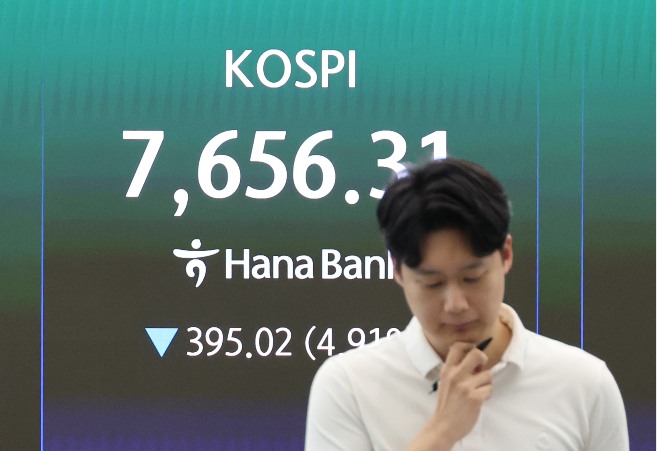
The South Korean benchmark Kospi slumped nearly 5 percent Tuesday, despite market heavyweight Samsung Electronics posting a record-high quarterly operating profit earlier in the day.
The benchmark index closed at 7,656.31, down 4.91 percent from the previous session. After opening just below the 8,000 mark at 7,919.2, the index extended its losses, falling below the 7,400 level and hitting an intraday low of 7,389.22. Although it later pared some of its losses, it failed to recover above the 7,700 mark.
Earlier in the session, a sell-side sidecar was triggered at 10:23 a.m., suspending program sell orders for five minutes. The measure was followed by a market-wide circuit breaker at 1:51 p.m., which halted trading on the main bourse for 20 minutes.
Tuesday's plunge caught the market by surprise, as market heavyweight Samsung Electronics reported a record quarterly operating profit of 89.4 trillion won ($58.5 billion), exceeding market expectations.
The sharp sell-off suggested that investors had been looking for an even stronger earnings surprise, with profit-taking emerging as the dominant short-term market driver.
Samsung Electronics fell 6.92 percent to 296,000 won, while its crosstown rival SK hynix slid 6.06 percent to 2.201 million won.
While local market analysts viewed Tuesday's plunge as a technical correction rather than the start of a long-term downcycle, concerns over a potential peak in the semiconductor cycle have been gaining traction.
Morgan Stanley said it believed the semiconductor-driven rally was nearing its end in a note issued to its clients Monday, saying there could be "more capex discipline in the near-term."
The chip sell-off spread across other large-cap stocks. SK Square tumbled 9.3 percent to 1.356 million won, while Samsung Electro-Mechanics dropped 9.85 percent to 1.648 million won.
The Kospi extended its losses as foreign investors stepped up selling pressure. Offshore investors were net sellers of 2.91 trillion won, driving the market's sharp decline. Institutional investors also remained net sellers, offloading 310.8 billion won worth of shares.
Although retail investors were net buyers, purchasing 3.13 trillion won, their buying was not enough to offset the sharp sell-off.
silverstar@heraldcorp.com