Brokerages view selloff as sentiment-driven, citing intact AI spending cycle
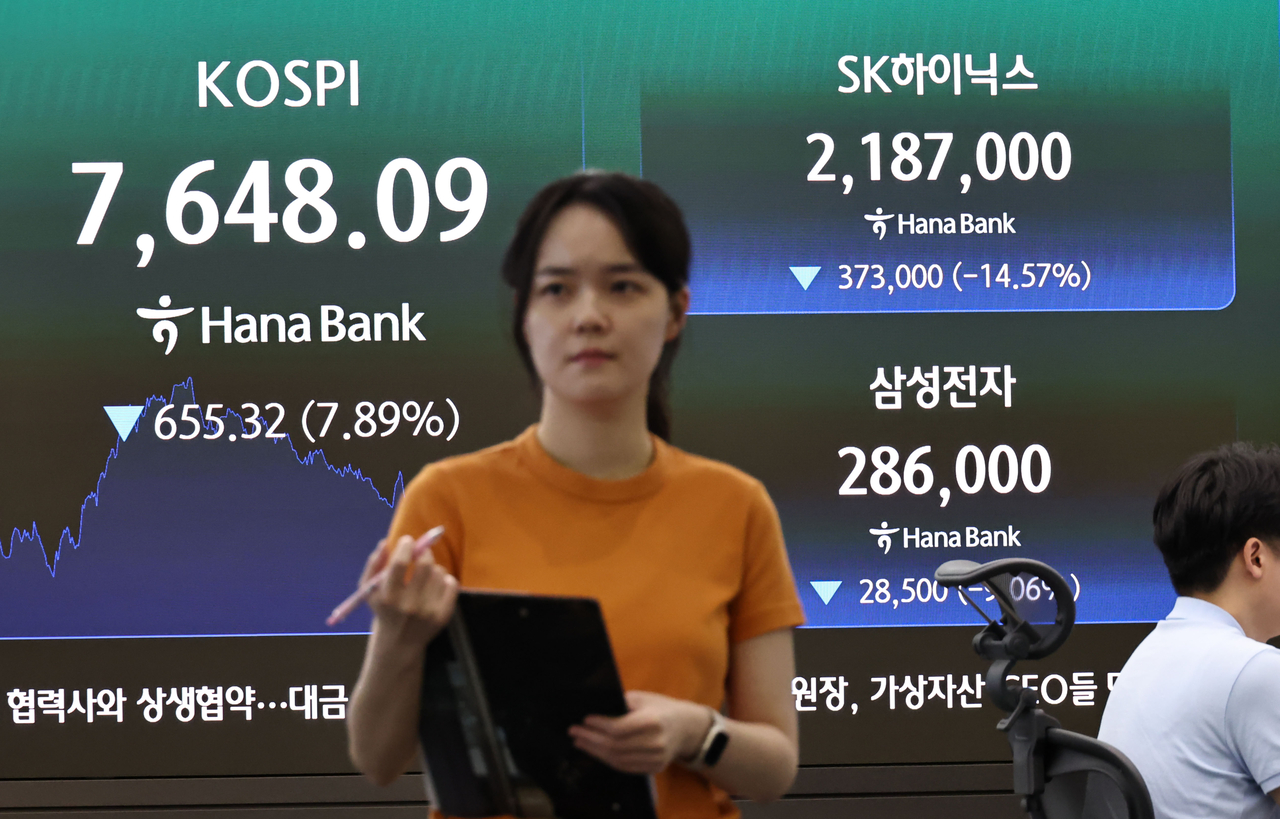
South Korea's benchmark Kospi tumbled nearly 8 percent on Thursday, led by sharp losses in heavyweight chipmakers Samsung Electronics and SK hynix, tracking an overnight sell-off in US technology stocks as investors grew increasingly concerned about a slowdown in chip demand.
The index fell below the 8,000-point mark at the open, triggering a sell-side sidecar, a five-minute curb on program trading, at 9:07 a.m. Although it briefly recovered above the threshold during intraday trading, it ultimately closed at 7,648.09, down 7.89 percent from the previous close.
The sell-off followed a sharp rout in US semiconductor stocks overnight, with Micron Technology tumbling 10.57 percent, while Intel and AMD fell 9.03 percent and 6.89 percent, respectively, dragging the Philadelphia Semiconductor Index down 6.27 percent.
The decline was sparked by a Bloomberg report that Meta Platforms was considering launching a cloud business to sell excess AI computing capacity, fueling concerns that Big Tech's AI spending boom may be easing and that chip demand could be approaching a peak.
Concerns over slowing chip demand battered Korea's top chipmakers, sending Samsung Electronics slumping 9.06 percent to 286,000 won ($185) and SK hynix 14.57 percent lower to 2.187 million won.
SK hynix's nearly 15 percent decline on Thursday marked its steepest one-day loss in nearly 17 years, since it plunged 14.91 percent on Nov. 20, 2008, at the height of the global financial crisis.
The sell-off extended beyond chipmakers to semiconductor materials, parts and equipment suppliers. SK Square slid 13.2 percent to 1.525 million won, while Samsung Electro-Mechanics lost 12.65 percent to 1.926 million won.
Retail investors bought a net 6.26 trillion won, but failed to offset foreign selling, with overseas investors unloading a net 4.37 trillion won on the main board, with more than 3 trillion won concentrated in Samsung Electronics and SK hynix. Institutional investors also added to the selling pressure, offloading a net 2.08 trillion won.
Foreign investors have been heavy net sellers on the Kospi this year, offloading 148.3 trillion won in shares during the first six months.
Samsung Electronics accounted for 72.6 trillion won of those outflows, while SK hynix made up another 57.1 trillion won. Combined net sales of the two chipmakers totaled 129.7 trillion won, representing about 87 percent of all foreign net sales in the first half.
Selling pressure spread to the tech-heavy Kosdaq in afternoon trading. The exchange activated a sell-side sidecar at 12:47 p.m. after the junior index tumbled more than 5 percent. It eventually wrapped up the trading at 866.72, down 6.74 percent on-session.
Despite the sell-off, analysts said the market reaction appeared excessive, arguing that the latest developments did not signal a meaningful slowdown in AI infrastructure investment.
"We believe the concerns sparked by Meta's reported plans are somewhat overdone," said Jo Ah-in, analyst at Samsung Securities.
"The recent volatility in semiconductor stocks reflects shifting investor sentiment driven by differing interpretations rather than any material deterioration in fundamentals."
Kim Young-gun, analyst at Mirae Asset Securities, said the recent pullback presents a buying opportunity for semiconductor stocks, citing the long-term AI investment cycle as remaining intact.
"There remains significant room for Big Tech companies to further expand their AI infrastructure spending," Kim said.
Brokerages also highlighted several upcoming events that could support semiconductor stocks, including Samsung Electronics' preliminary second-quarter earnings announcement on Tuesday, SK hynix's planned listing of American depositary receipts in the US on July 10, the company's earnings release on July 29 and quarterly earnings reports from the so-called Magnificent Seven technology companies later in the month.
Kiwoom Securities analyst Han Ji-young described them as "a string of upcoming events that could ease the narrative that AI spending has become excessive."
silverstar@heraldcorp.com