Foreign workers say employer-tied visa rules make it difficult to escape abuse, unpaid wages and unsafe workplaces
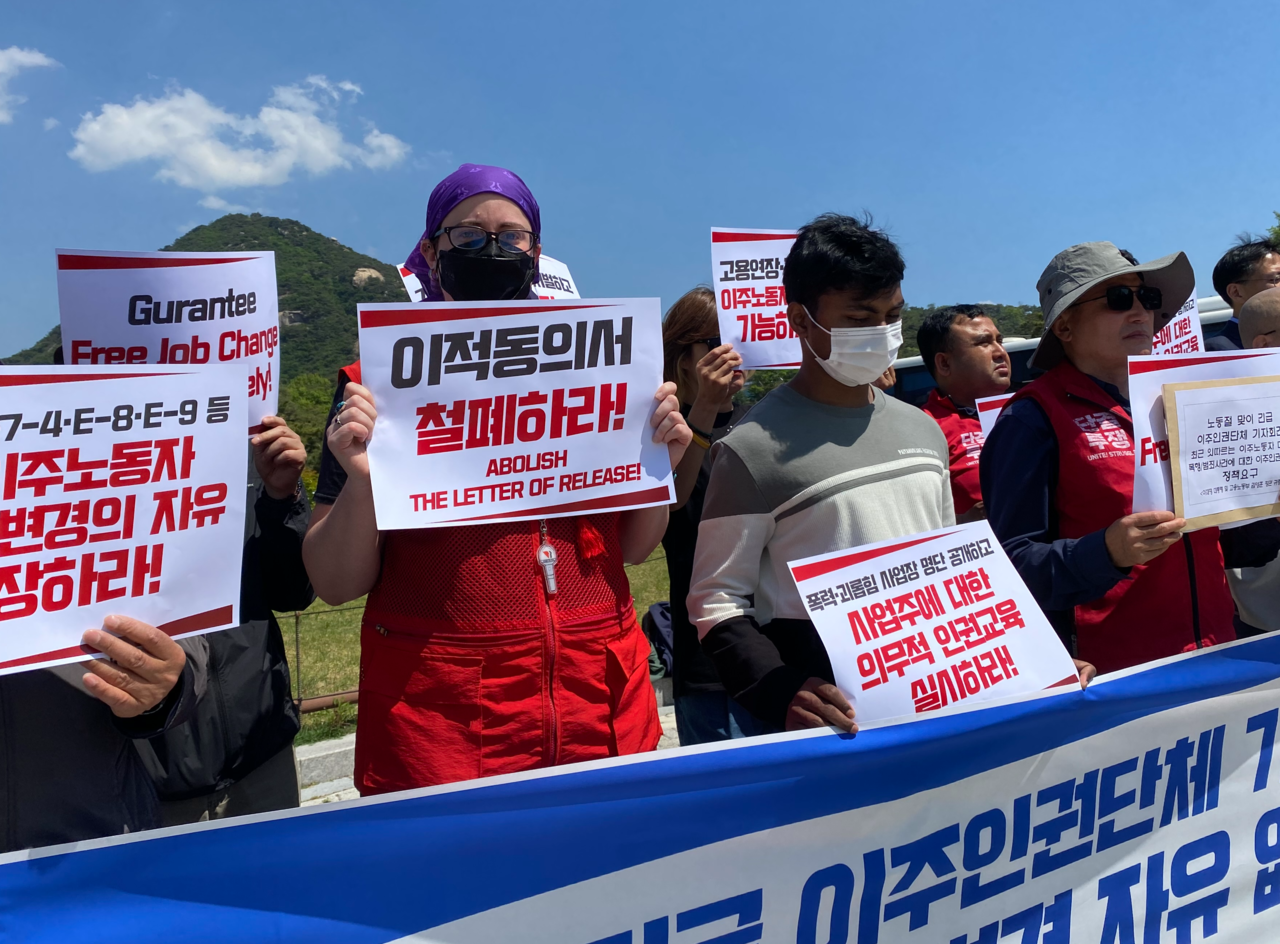
A Bangladeshi migrant worker whose assault was captured on video said Thursday he endured abuse because South Korea’s visa rules made leaving his job feel impossible.
“I thought such abuse would not happen if I spoke Korean well,” Rakibul Islam said in front of Cheong Wa Dae in central Seoul. “But this was not a language issue. Even when we make small mistakes, we are scolded too harshly or subjected to violence.”
Islam, who was repeatedly slapped by his employer, was speaking at a press conference held by foreign workers and advocacy groups to call for abolishing restrictions on job changes tied to Korea’s visa system. They argue that the rules leave migrant workers vulnerable to workplace harassment and human rights abuses.
Speakers pointed to a series of recent abuse cases involving foreign workers, including a Thai worker who suffered a severe intestinal injury. In a joint statement, protesters said many victims remain silent because the current system makes it difficult to leave abusive workplaces without risking their legal status.
“Migrant workers should have the right to change workplaces to protect themselves in dangerous situations, but even this basic right is not guaranteed,” the group said. “The ability to leave a job could also encourage employers to improve working conditions.”
Under Korea’s Employment Permit System, migrant workers are generally restricted to designated workplaces, and leaving a job without proper authorization can result in deportation, regardless of how long they have lived in the country.
Many workers also end up owing one to two years of earnings to brokers, which the government relies on to source foreign labor.
The issue is most often associated with the E-9 nonprofessional visa, which covers more than 300,000 workers.
The government allows limited job changes under specific conditions, such as when workers are not at fault, but advocates argue that these exceptions are too narrow and difficult to prove, particularly for workers unfamiliar with the Korean language or legal system, leaving significant blind spots in human rights protection.
Job changes are also capped at three times over three years and are typically restricted to the same region.
The press conference included representatives of teaching and professional visa holders, who said similar restrictions affect holders of E-2 language teaching visas and E-7 professional visas.
“I must have (my employer’s) permission and a letter of release to change jobs midcontract,” said Erin Day, chair of the Seoul Native Language Teachers Union. “Many bosses will offer to give a teacher the letter, but only if they pay millons of won in ‘penalty fees.’”
As the administration of President Lee Jae Myung places greater emphasis on strengthening labor rights, the Ministry of Employment and Labor is reportedly reviewing measures to ease the rules. Discussions include allowing E-9 workers to change jobs within their region after completing a mandatory period of employment, according to local media.
However, advocacy groups say such measures fall short, arguing that requiring employer consent to leave a job remains a fundamental issue that enables abuse, including unpaid wages and lack of protection in cases of workplace injury.
“The Act on the Employment of Foreign Workers is interpreted very narrowly and strictly in practice when it comes to exceptions allowing job changes,” said Choi Jung-kyu, a lawyer at law firm Wongok.
“While the government is discussing easing the criteria, the restrictions on grounds for changing workplaces should be completely abolished to address the structural problem.”
forestjs@heraldcorp.com


![[Legal updates in Korea] New insurance mandate protects firefighters on the job](https://wimg.heraldcorp.com/news/cms/2026/10/01/news-p.v1.20261001.76835f19eb424f18814ac3bb65d896a9_T1.jpg?type=h&h=800)