The rapper's curatorial debut in San Francisco offers a window into Korean modernism
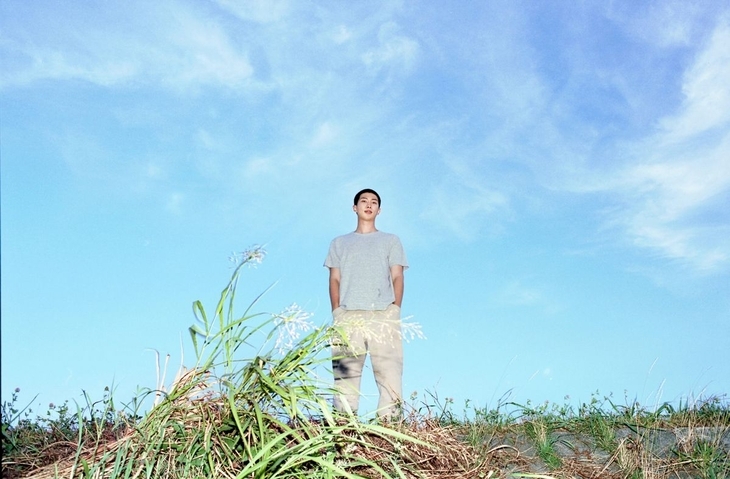
"I still feel like I'm always drifting and floating somewhere, whether I'm in the US or even when I'm in Seoul, where I was born and raised. I think I've leaned on art a lot because of that feeling."
The sense of displacement and rootlessness RM described at the San Francisco Museum of Modern Art on Tuesday will sound familiar to anyone who has followed the leader of the world's biggest boy band through its meteoric rise. Fame on that scale tends to leave a person without a fixed place to stand, and for RM, that unease has been a recurring theme of his solo records, from 2018's "Mono" to 2024's "Right Place, Wrong Person."
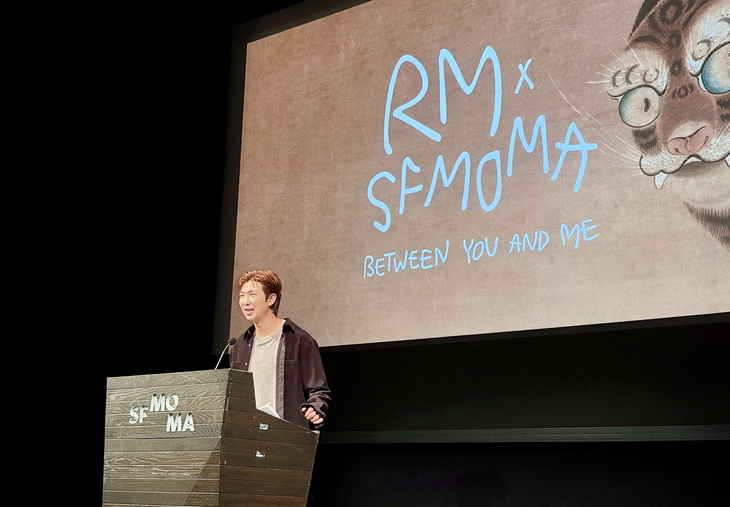
Through the better part of a decade as pop royalty, he has channeled that search for footing into one of the more serious private collections of Korean art around. It now sits at the center of one of the season's most anticipated museum shows.
"RM x SFMOMA: Between You and Me" opens to the public Saturday and runs through Feb. 7, 2027. It brings together nearly 200 works, about three-quarters from RM's own collection and the rest from the museum's holdings. The rapper's fingerprints are all across the show: He spent two years co-curating it with SFMOMA's America Castillo and Hyoeun Kim, writing the wall labels himself, narrating the audio guide and even putting together a playlist for the galleries.
Hype is running high, with dozens of fans lining the street outside the invite-only preview and thousands signing up for museum memberships. But the show matters beyond the fandom, too, as a rare, sizable look at modern Korean art for American audiences, shaped by one collector's distinct taste.
Here are some highlights from the show.
Kim Whan-ki
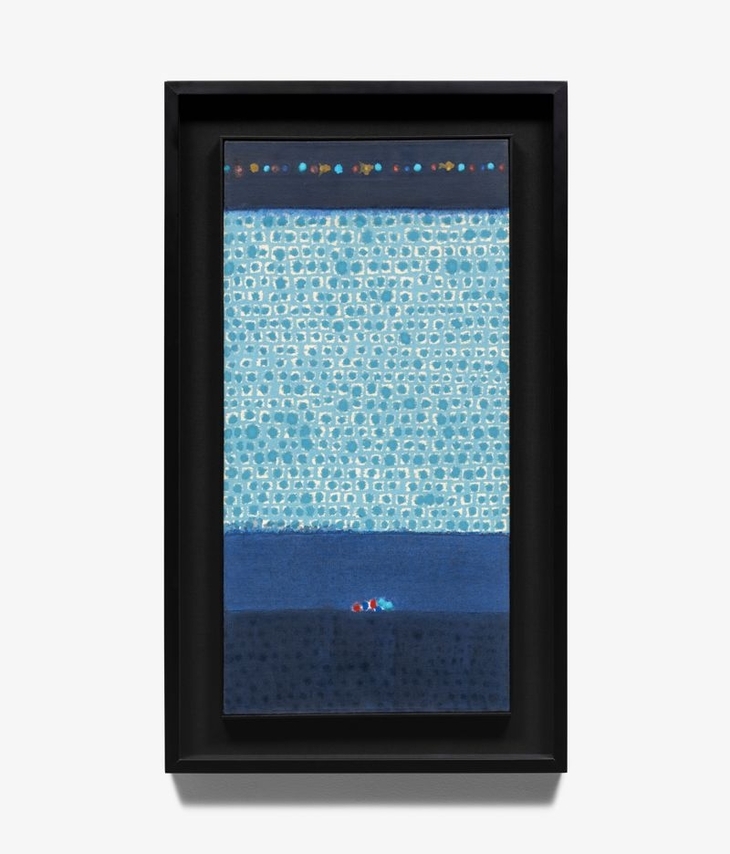
"RM x SFMOMA" opens with Kim Whan-ki's "26-I-70" (1970), a blue dot painting in SFMOMA's collection since 1979. Kim Hyang-an, the artist's widow and a formidable writer in her own right, donated it, giving the museum its first real link to modern Korean art.
The backstory seems to have struck a chord with RM. According to a museum official, he brought it up in the handwritten reply to SFMOMA's offer. Nearly five decades later, his show picks up where the gift left off.
The painter's life makes a fitting overture for a show concerned with crossing borders. Kim moved from a small island off Korea's southwest coast to Tokyo, then Paris, and finally New York, where he died in 1974. In New York he arrived at the dot paintings now considered his hallmark, after falling in with Mark Rothko and Barnett Newman.
In the gallery titled "Bluewater," "26-I-70" hangs with RM's own "15-VII-70 #181" (1970). That painting sold for 630 million won (about $464,650) at Seoul Auction in 2019, though it is unknown when RM acquired it. Joining them is French artist Yves Klein's "Sponge (SE 251)" (1961), a sea sponge soaked in his trademark ultramarine. Both men used the color blue to reach for something infinite, though their methods differed greatly. Klein flooded the surface with a single saturated pigment; Kim worked his with countless hand-daubed dots.
Yun Hyong-keun
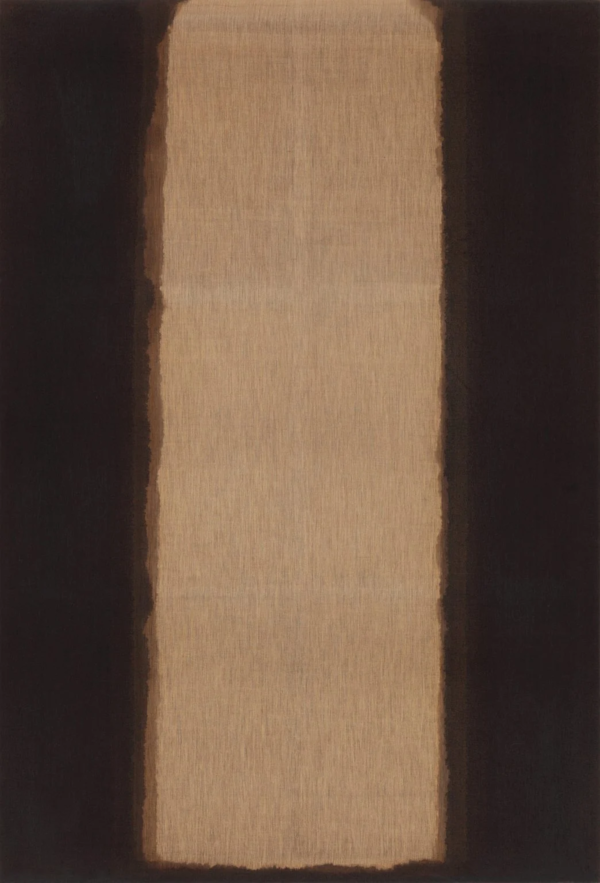
RM fans might already know the name. RM's 2022 solo album "Indigo" opens with a track titled "Yun," a tribute to the painter that opens and closes with his own voice. At SFMOMA, 16 of Yun's works fill a gallery of their own.
Kim Whan-ki's student and later his son-in-law, Yun became a leading figure of dansaekhwa, the Korean monochrome movement of the 1970s that has had a big moment over the past decade or so. He is best known for stacking ultramarine and burnt umber into dark, blocky columns on raw linen, a pairing he once likened to the gate of heaven and earth.
Outside the studio, Yun had a long history of standing up to injustice. He was arrested four times for political reasons, and in 1973, was imprisoned after speaking out against corruption at the school where he taught.
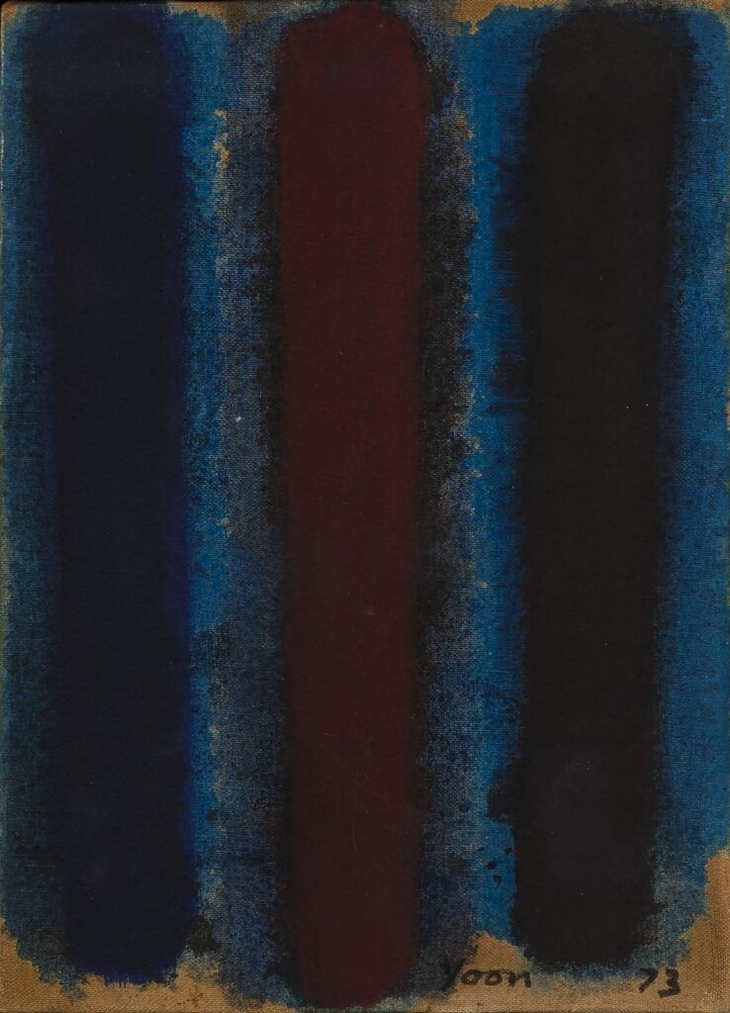
For RM, the man's character and the work are inseparable. In "Yun," he addresses the painter directly: "To your life that crossed the death line back and forth /and to those things you left in this world eventually / I, too, wish to be just a little better grown-up."
At SFMOMA, Yun's "Burnt Umber & Ultramarine" (2001) hangs beside "To Susan Buckwalter" (1964) by the American Minimalist Donald Judd. The two met in 1991, and Judd went on to champion Yun's work abroad.
Yoo Young-kuk
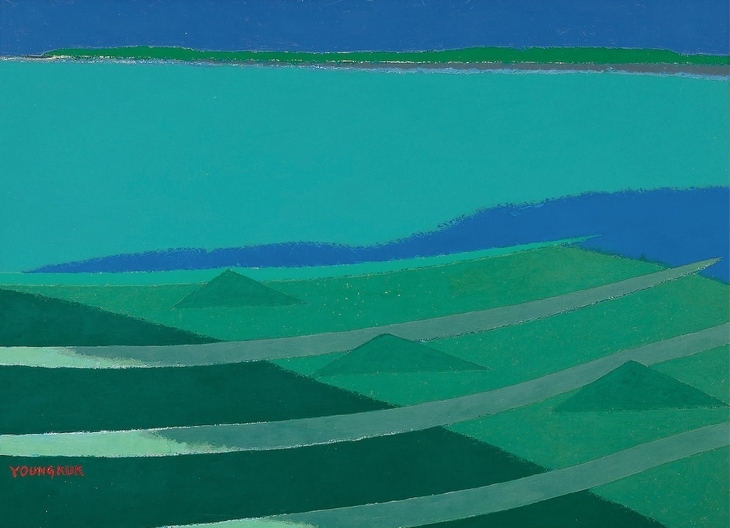
"The mountain is not in front of me but inside of me," Yoo Young-kuk once said. Carved on his tombstone, the line sums up an artist who spent decades turning Korea's mountains into pure color and shape.
Along with Kim Whan-ki, Yoo was among the first Korean painters to fully embrace abstraction. In 1948, the two banded together with fellow artists to bring modern art to the newly liberated country. Only in his 40s did Yoo settle on his signature style: triangles, circles and blazing fields of color stand in for peaks, suns and the rugged shoreline of his coastal hometown, Uljin.
His "Work (Trees)" (1981), from RM's collection, is paired with "Clear Cut Landscape" (1951) by Milton Avery, the American modernist known for flattening figures and landscapes into simple shapes. Painted 30 years and an ocean apart, both works reduce trees almost to symbols, letting color do the emotional work that detail usually would.
RM has made clear his admiration for Yoo, posting the painter's works and quotes on social media more than once. He also lent his own "Work" (1968), a sturdy green mountain set against a wall of orange, to Yoo's retrospective at the Seoul Museum of Art in June.
Chang Ucchin
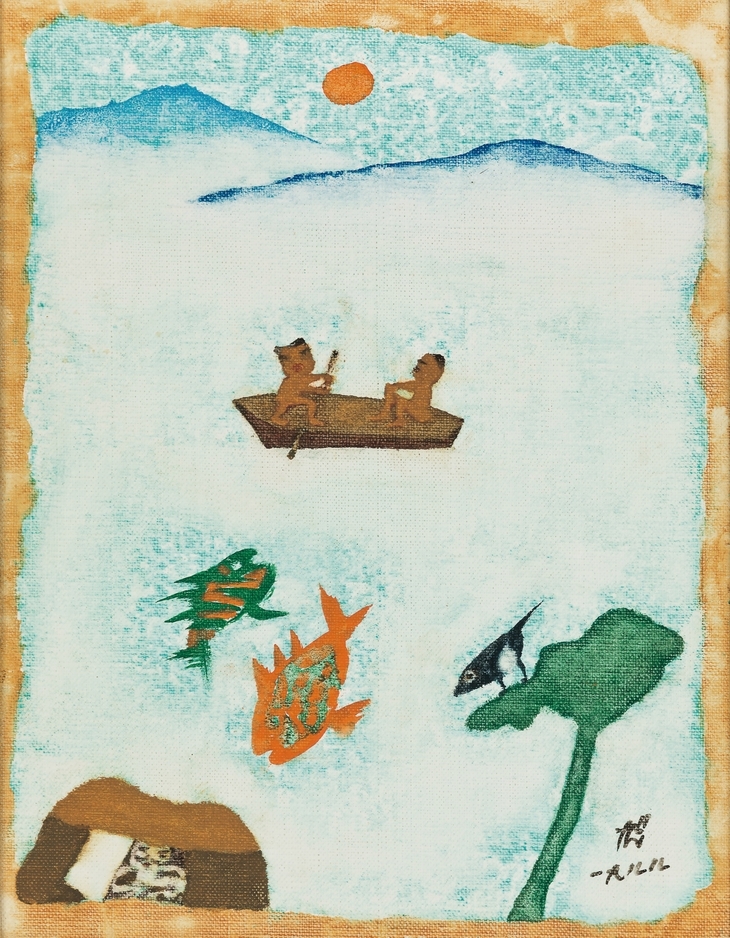
Chang Ucchin may not enjoy quite the same name recognition abroad as the dansaekhwa circle, but he is one of the most widely loved modern painters at home. Often no bigger than a sheet of paper, his works are full of magpies, trees, cows, children and little houses perched on hills, each a tender snapshot of an idyllic rural Korea drawn with a childlike shorthand.
RM's fondness for Chang goes back years. He lent six works to Chang's 2023 retrospective at the National Museum of Modern and Contemporary Art, though which ones were his had not been revealed. He has also made the rounds of Chang's exhibitions in person.
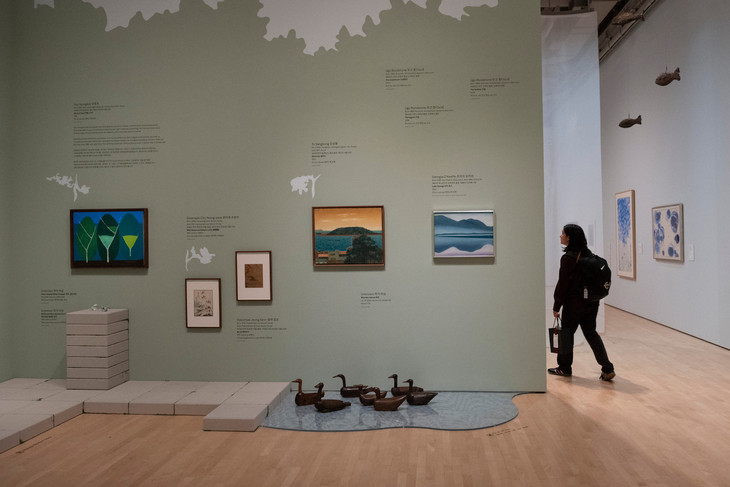
At SFMOMA, Chang's paintings, including "Road" (1986), hang in a gallery dressed up like a cozy living room. They share a small wall with Kim Whan-ki's earlier paintings of plum blossoms and white porcelain jars. A nearby cabinet holds contemporary ceramics alongside gray stoneware brushed with white slip that was made in the 14th and 15th centuries. Together they round out a room that feels less like a gallery than a home.
And the rest
Beyond the Korean modernists, the show draws from heavyweights from SFMOMA's holdings, including Mark Rothko, Henri Matisse, Agnes Martin, Georgia O'Keeffe and Nam June Paik.
RM brings a few big names too, among them a Giorgio Morandi still life, a 1969 Philip Guston and a "Waterdrops" canvas by Kim Tschang-yeul, famous for his eerily lifelike water droplets.
RM admits he can't always explain his picks; he even named one section "I Don't Know, But I Like It." He seems happy to let visitors find their own way in, though. "This exhibition is a pretty long introduction of myself," he said at the preview. So go ahead and pick a starting point.
moonkihoon@heraldcorp.com

![[Legal updates in Korea] New insurance mandate protects firefighters on the job](https://wimg.heraldcorp.com/news/cms/2026/10/01/news-p.v1.20261001.76835f19eb424f18814ac3bb65d896a9_T1.jpg?type=h&h=800)