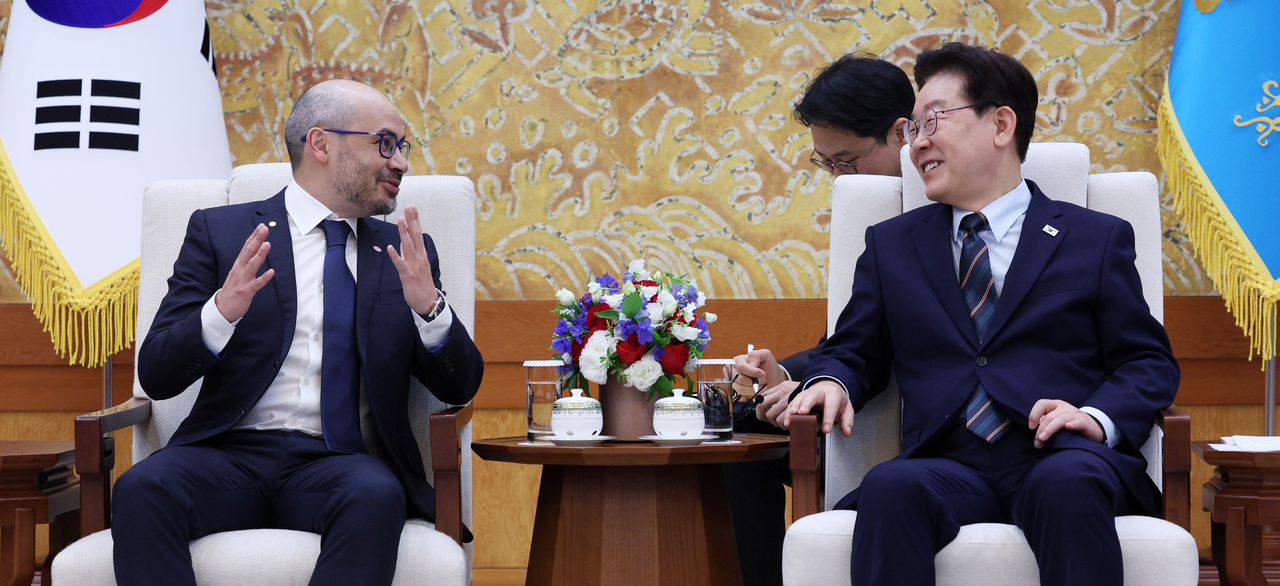
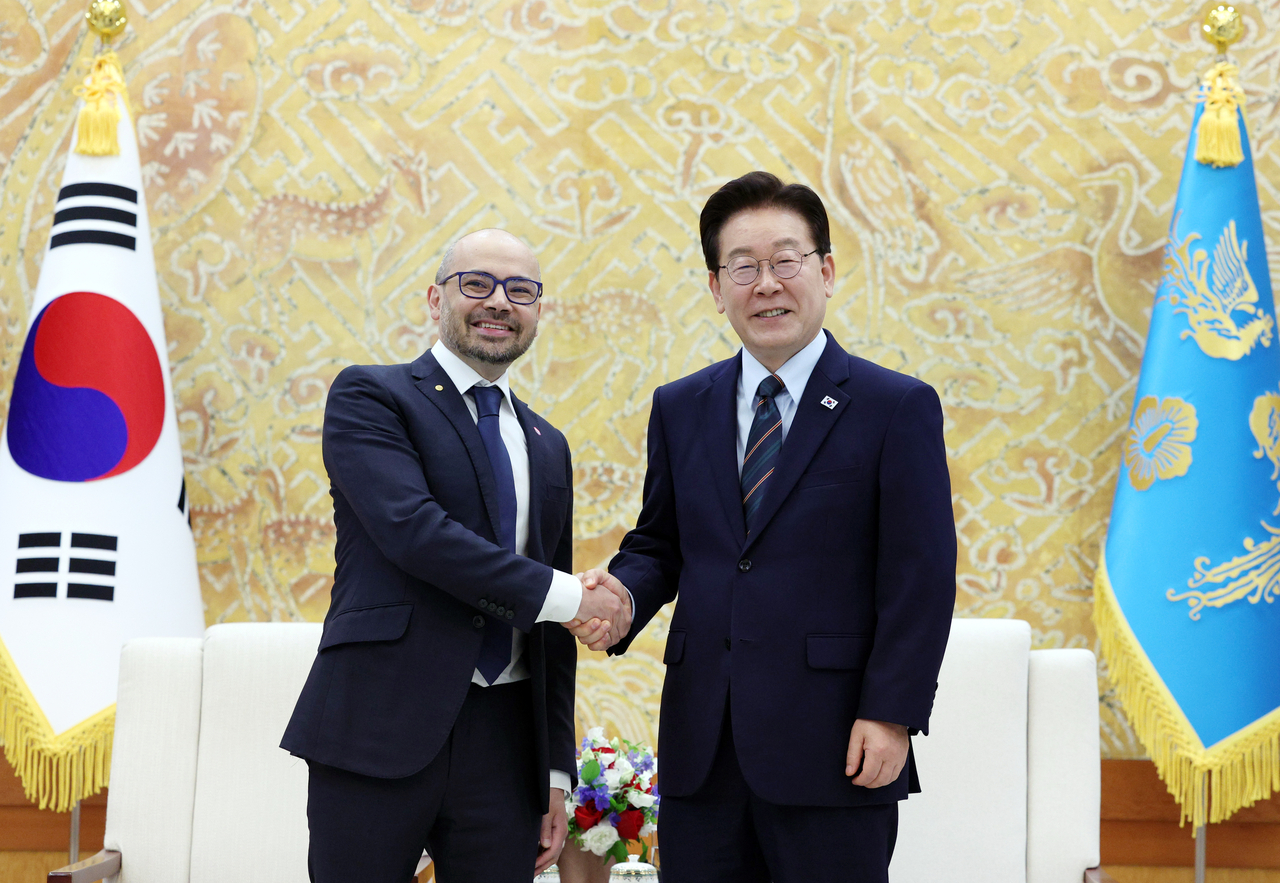
President Lee Jae Myung and Google DeepMind CEO Demis Hassabis met to discuss the promise and peril of artificial intelligence, including global guardrails and basic income for a society increasingly being reshaped by AI.
The meeting at Cheong Wa Dae in Seoul on Monday came about 10 years after AlphaGo's landmark Go match in the city helped usher in the modern era of AI in 2016.
"The two sides held in-depth discussions on the rapid recent advances in AI technology, the direction of future developments, the responsible use of AI and ways to strengthen global cooperation," Kim Yong-beom, presidential chief of staff for policy, said during a press briefing.
Lee and Hassabis also "discussed basic income at length," according to Kim.
"President Lee said he has talked about basic income for more than 20 years and asked whether the AI era is precisely the time when basic income is needed," Kim said.
"Hassabis agreed on the need for basic income, while adding that there is also a need to consider ways for the state to provide basic services such as housing, education, transportation and health care, while incorporating the principles of capital markets."
Kim further explained that Hassabis "suggested that there is a need to consider ways to support workers who train robots, in relation to productivity gains from robots replacing jobs."
As an outcome of the talks, South Korea and Google DeepMind agreed to pursue close cooperation centered on the government's flagship "K-Moonshot" initiative.
The K-Moonshot program is the Lee administration's mission-driven strategy aimed at tackling major scientific and technological challenges by harnessing AI to solve national-level problems across eight strategic sectors by 2035, including advanced biotechnology, physical AI, space and quantum technologies.
"With DeepMind's world-class scientific AI capabilities joining hands with our researchers, we expect Korea's capabilities to take another leap forward in fields such as biotechnology, weather and climate, and future energy," Kim said.
To support that effort, the Ministry of Science and ICT and Google DeepMind signed a memorandum of understanding on Monday. Google also plans to open an AI campus in Seoul within this year to expand cooperation with researchers and startups.
"The Google AI Campus carries considerable significance, as it will be the first of its kind that Google opens anywhere in the world in Korea," Kim said.
Kim added that Hassabis had also agreed to actively consider dispatching Google researchers to South Korea. "I asked that at least 10 people be sent, and he agreed on the spot," Kim said.
During the meeting, Lee raised concerns about the risks posed by artificial intelligence.
"We also have great interest in artificial intelligence," Lee told Hassabis. "As a country, we are investing heavily in it. But we do not yet know whether it will develop in ways that genuinely improve human welfare, or in ways that could harm humanity or threaten peace."
In response, Hassabis acknowledged both the promise and the risks of the technology. "It's very important for me to see AI being used for things like science and medicine," he said.
Hassabis further explained that this is the work he began with AlphaFold, a web service that can generate highly accurate biomolecular structure predictions involving proteins.
"That's what I hope AI is going to be used for. This is what I'm trying to work on, but you're right — there are also challenges."
During the meeting, Lee also asked about Gemini's unexpected behavior.
"I also frequently use the Gemini program, and I hear that Gemini sometimes does things it was not instructed to do. Is that a kind of bug, or what exactly is it?" Lee asked.
"Sometimes these foundation models can be working on other things, maybe if your instructions are not specific enough," Hassabis answered. "So we have to make sure that the systems follow the guardrails we give them. This is one of the challenges with powerful AI systems."
"Now we're building agent systems that can do things themselves, and eventually we'll get to AGI. One of the big risks is making sure they stick to the guardrails humans give them," Hassabis added.
Artificial general intelligence, or AGI, is a hypothetical type of AI that can understand and learn across many different tasks at a human level or beyond.
Before the meeting, Hassabis prepared a special gift marking the 2016 AlphaGo match: a Go board bearing the signatures of Hassabis and Go master Lee Se-dol, which he presented to the president, according to Kim. Hassabis oversaw the landmark 2016 match between AI program AlphaGo and the Go master.

dagyumji@heraldcorp.com
![[Legal updates in Korea] New insurance mandate protects firefighters on the job](https://wimg.heraldcorp.com/news/cms/2026/10/01/news-p.v1.20261001.76835f19eb424f18814ac3bb65d896a9_T1.jpg?type=h&h=800)