More South Korean universities are launching foreign alumni associations, but for many graduates the groups mean more than an extension of school ties.
They offer a way to preserve friendships, professional connections and a sense of belonging shaped during their years in Korea.
That sentiment was evident when it comes to Hanyang University in late November, when more than 140 alumni gathered in Kuala Lumpur to launch the school’s Malaysian alumni association.
The university described the event as the culmination of more than 30 years of educational and cultural exchange with Malaysia.
“I still feel connected to Hanyang University even after graduation,” said Aminudin bin Abu, a professor at the University of Technology Malaysia who studied at Hanyang in the 1990s and 2000s and now heads the university’s Malaysian alumni association.
“Although I am not in Korea physically, the knowledge, the experience and professional mindset I developed continue to influence my work.”
He added that he still collaborates with professors from Hanyang University, showing how ties formed during university years can continue long after students leave Korea.
For Abu, the alumni group is not simply a formal network. “The alumni association has helped me build strong professional relationships and friendships with fellow alumni from Hanyang University,” he said.
“The network has also provided valuable mentorship and knowledge sharing.”
He described it as “an international professional community built on shared academic experience and mutual support” that gives graduates both a sense of belonging and a practical network across borders.
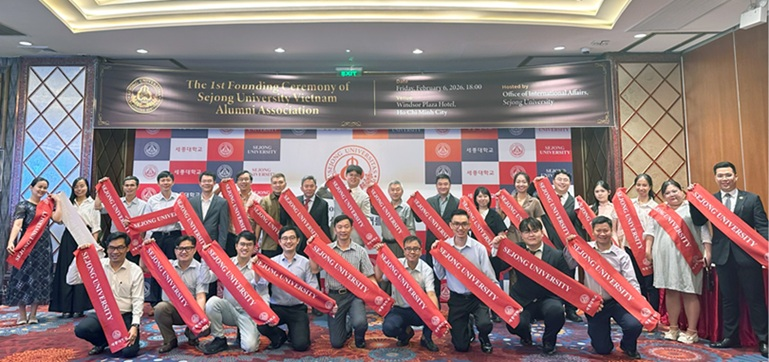
Other universities are moving in the same direction. Sejong University inaugurated its Vietnamese alumni association in February, while Pusan National University has been operating an international alumni body with branches in 16 countries.
For universities, such groups also carry strategic value, helping schools maintain ties with overseas graduates, expand global networks and potentially support future recruitment.
Still, the appeal of these associations is often most clearly expressed by graduates themselves. For many, they are a way to reconnect with a formative period marked by unfamiliar classrooms, language barriers, academic pressure and the challenge of adapting to another country.
Long after graduation, Korea can remain tied not only to a degree, but also to memory, identity and belonging.
In some cases, those ties take on an even more tangible form. Two Chinese Hanyang University alumni, Liu Yang and Qu Longyue, went on to launch a business with a Korean classmate after graduation, naming the company Hanyang Antenna after the university where the three first met.
“We decided to name the company (after the university) because it was the most direct and honest,” they said. “It shows where we came from, and where our roots are.”
Ngo Huu Cuong, a Vietnamese alumnus of Sejong University who is now a professor at Ho Chi Minh City University of Technology, also described alumni networks in deeply personal terms.
“I consider this network to be one of the most essential networks,” Cuong said, adding that it fosters friendships, career connections and mutual benefits among alumni and with the university.
He said he still has fond memories of his time in South Korea and that studying at Sejong University helped shape his career path.
Cuong said he hopes that stronger alumni networks, such as Sejong’s in Vietnam, will further deepen ties between Korea and students’ home countries.
“These networks also serve as a bridge between Vietnam and the Republic of Korea,” he said, using South Korea's formal name. “Furthermore, it supports career guidance for future students.”
seungku99@heraldcorp.com