Exam officials seek to avoid repeat of last year's difficulty controversy; Turnout lower amid AI-cheating fears
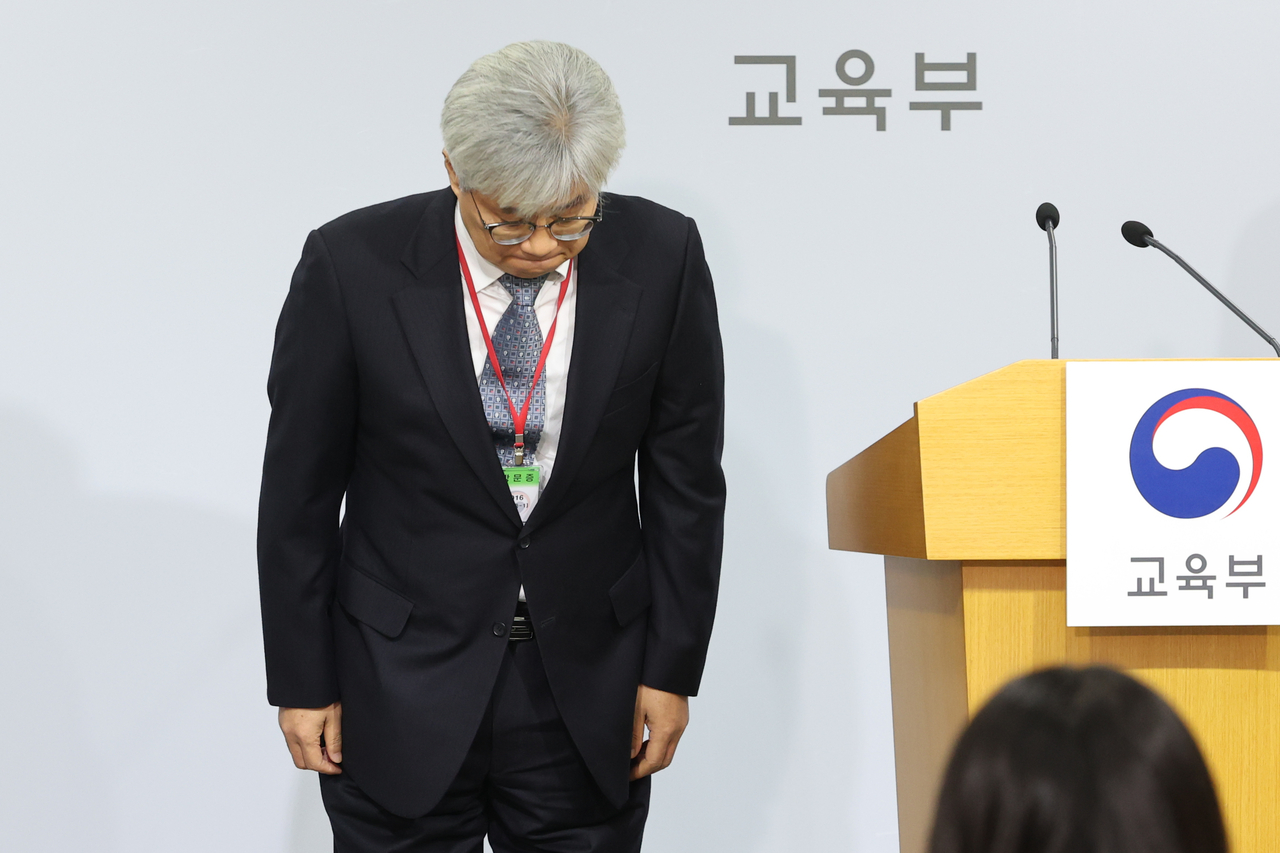
This year’s College Scholastic Ability Test, or Suneung, was designed to distinguish among students based on what they learned in school, the chair of the exam’s question-writing committee said Thursday.
“We thoroughly excluded questions that would give an advantage to students who had learned test-taking techniques and undergone repetitive training through private education,” Oh Gi-yeong, a professor at Hankyong National University, said at a briefing at the Government Complex Sejong.
Oh said the committee used a range of difficulty levels to assess students within the high school curriculum and excluded “killer questions,” or exceptionally difficult problems that call for knowledge or techniques beyond that taught in school.
Such questions have long drawn criticism for giving students who can afford private tutoring an edge. The difficulty of the exam came under renewed criticism last year, when just 3.11 percent of test-takers earned the top grade in English, which requires a score of at least 90 out of 100.
Oh Seung-geol, then president of the Korea Institute for Curriculum and Evaluation, later resigned, taking responsibility for misjudging the difficulty of the exam.
English difficulty adjusted after last year's controversy
Oh said the question-writing committee had made particular efforts to maintain an appropriate level of difficulty in the English section, which is graded on an absolute scale rather than relative to other students' performance.
"For English, we developed questions that assess students' ability to listen, speak and communicate using vocabulary within the levels prescribed by the national curriculum," Oh said.
"We made every effort to maintain an appropriate level of difficulty in line with the original purpose of introducing absolute grading."
Oh said the committee had fine-tuned the difficulty of this year's English section based on the results of mock examinations held in June and September, seeking to ensure that the proportion of students receiving the top grade remained relatively stable.
Following last year's controversy, the Korea Institute for Curriculum and Evaluation had proposed a target of 6 to 10 percent of students receiving the top English grade.
However, KICE's current president, Kim Moon-hee, declined to commit to a specific target in March, saying only that the exam would be designed at an appropriate difficulty level.
Oh also said the committee had focused on essential concepts in the high school curriculum, modifying question formats and problem-solving approaches where necessary, including when drawing on material covered in previous examinations.
Korean section easier than last year: teachers
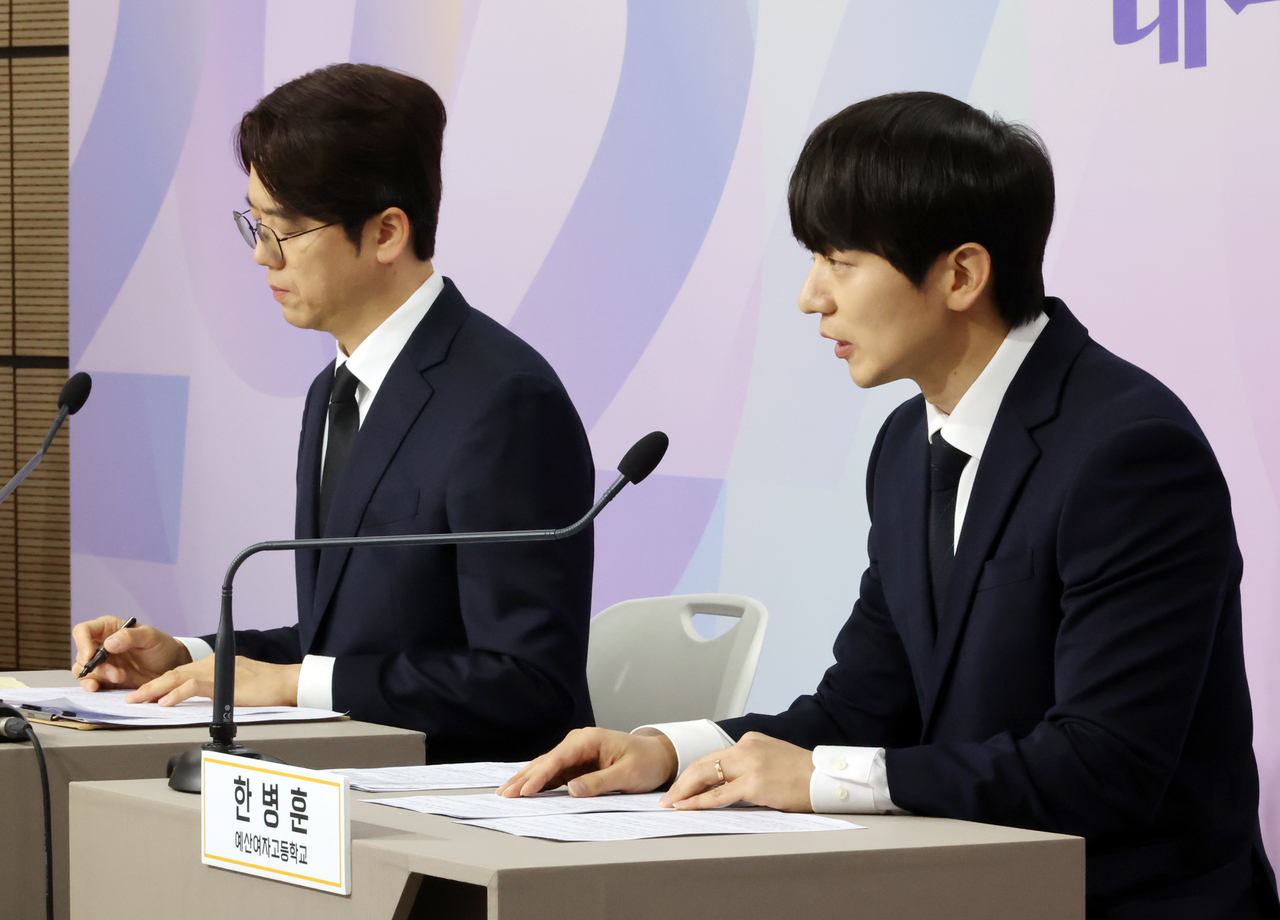
On the Korean-language section, Oh said the exam was designed to assess students' comprehension and ability to apply what they had learned to different types of texts and communication using passages and materials in various formats.
An initial analysis by a panel of teachers on public education broadcaster EBS suggested a lower difficulty on this year's Korean-language section.
"The Korean-language section was easier than last year's Suneung and this year's September mock examination," the panel said during a briefing Thursday.
Han Byeong-hun, a teacher at Yesan Girls' High School, said the reading passages contained a manageable amount of information presented in a relatively straightforward manner, reducing the advantage of students with extensive background knowledge.
"The passages contained less information and were structurally less complex than those in last year's Suneung and the September mock examination, making the overall difficulty relatively moderate," Han said.
Despite the relatively moderate difficulty, the panel said the exam contained a balanced mix of questions of varying difficulty, allowing it to adequately differentiate students by academic ability.
Math section similar to last year
EBS teachers assessed this year's math section as similar in difficulty to last year's Suneung, with questions focusing on students' understanding of key mathematical concepts rather than complex calculations.
"Like last year's exam, this year's exam included many questions that combined concepts from different areas of mathematics," said Nam Chi-yeol, a teacher at Baekseok High School. "Most questions were based on the public school curriculum and related EBS study materials."
Nam said the section focused on assessing students' ability to apply multiple mathematical concepts and make logical judgments, rather than simply plugging numbers into formulas or relying on repetitive practice.
He added that most questions could be solved by combining concepts students had learned throughout high school.
The two common subjects, math I and math II, each contained 11 questions, covering topics such as interpreting function graphs, identifying patterns in sequences and understanding relationships between speed and distance.
The three elective subjects — probability and statistics, calculus and geometry — each contained eight questions. These assessed key concepts including conditional probability, differentiation and integration, and ellipses and vectors, respectively.
Suneung marred by lower turnout, AI-cheating fears
This year's Suneung was the last under the current testing system, ahead of major changes scheduled for the 2028 academic year.
Starting next year, elective subjects in the Korean-language, math and inquiry sections will be abolished as part of a shift toward a more integrated examination system.
Oh, however, said the upcoming changes did not influence the question-writing committee's approach to this year's exam.
"We did not specifically adjust the exam's difficulty because this was the last exam under the current elective-subject system," he said.
The upcoming change, however, prompted more retakers to register for the exam.
Nearly 200,000 graduates and other nontraditional applicants registered to take the exam, the largest number in 23 years.
However, Education Ministry reports on Thursday afternoon showed that the actual number of student who showed up for the first examination period had dropped from a year earlier.
A total of 490,915 students sat for the first period of Suneung, out of 545,253 registered applicants, bringing the absentee rate to approximately 10 percent, according to the Education Ministry.
Attendance was down by more than 6,000 students from last year, when 497,080 of the 548,376 registered applicants took the Korean language section of the exam, recording an absentee rate of 9.4 percent.
Meanwhile, the government stepped up security measures amid concerns over AI-assisted cheating, following revelations of misconduct involving AI-powered devices on a national professional qualification examination.
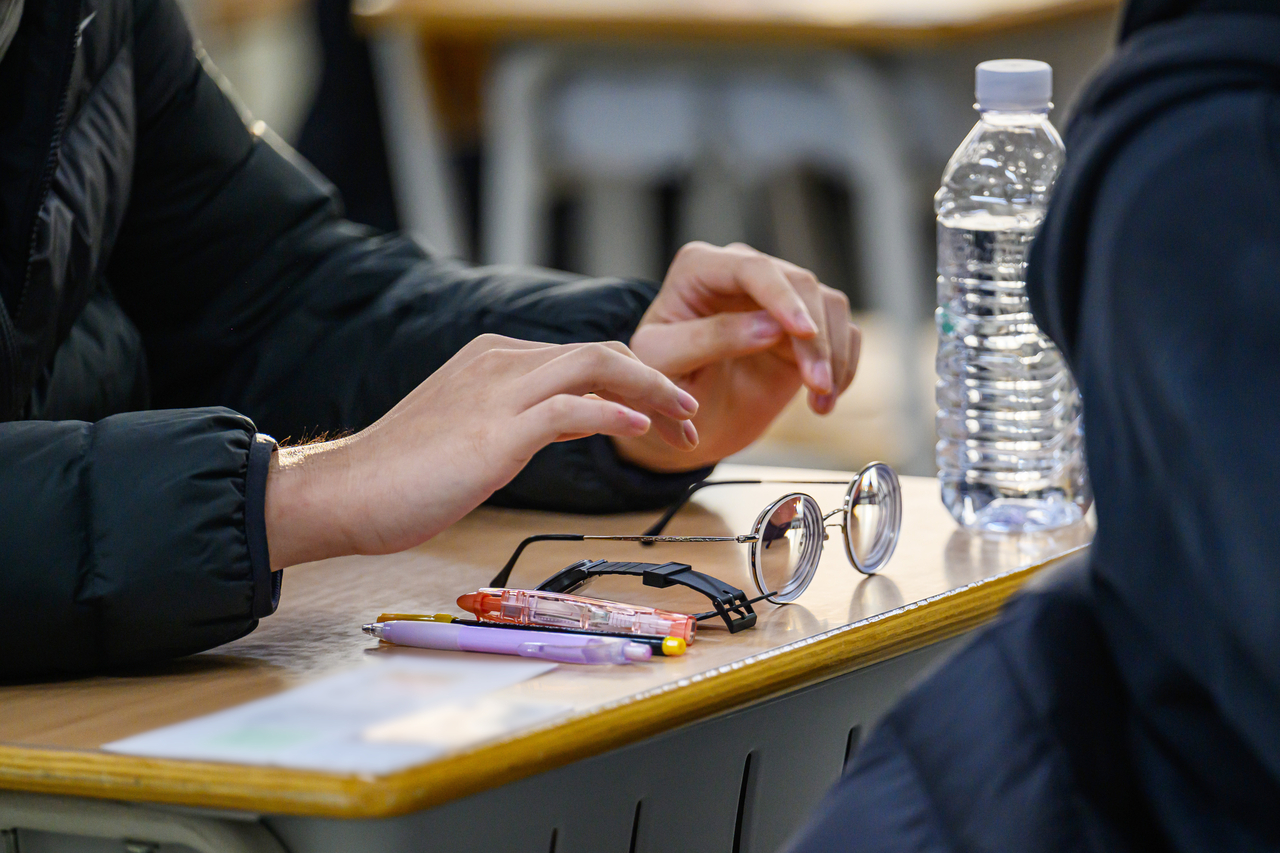
Authorities deployed additional proctors to inspect buttons on clothing and check for miniature cameras, while sending emergency alerts to detect smartphones that students had failed to surrender.
The government also prohibited additional types of stationery, including certain erasers and mechanical pencils, over concerns that they could conceal electronic devices.
Vice Education Minister Choi Eun-ok said Thursday morning that the ministry had confirmed the distribution of necessary examination supplies and stickers to cover students' clothing buttons at testing centers nationwide.
The ministry also reported detecting 22 smartphones across nine cities and provinces following an emergency alert sent at 8:30 a.m., resulting in 22 students being identified for violating examination rules.
seungku99@heraldcorp.com