South Korea is reviewing whether to join a multinational mission to protect commercial shipping in the Strait of Hormuz, with a senior Seoul official on Tuesday signaling that participation in the work led by the United Kingdom and France is under active consideration. At the same time, the official stressed that no decision has been made on whether to provide military support.
A senior Foreign Ministry official said Tuesday that there appear to be no major issues with joining the statement, which calls for the creation of a multinational mission to reopen the key maritime choke point and safeguard vessels.
“After reviewing the content, there seems to be no problem with joining,” the official told reporters at the ministry headquarters in Seoul. “We are proceeding with a review through internal processes,” the official said, adding that “it is necessary to take part in international cooperation.”
The move comes as Seoul weighs what form of contribution it can make, with the government keeping all options on the table — including diplomatic, humanitarian and potentially military support.
“When we talk about a practical contribution, it is often associated with military assets, but it is not limited to that,” the official said. “It can encompass diplomatic, humanitarian and military elements.”
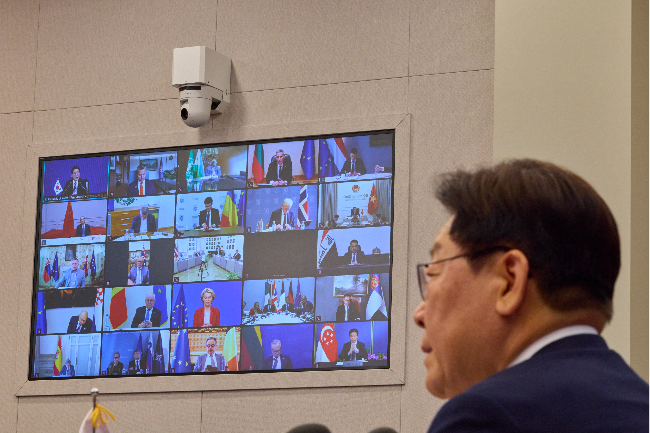
Britain and France on Friday hosted a virtual meeting attended by 51 countries and several international organizations, issuing a joint statement calling for the unconditional reopening of the strait. President Lee Jae Myung, who attended the meeting via videoconference, said South Korea would make a “practical contribution” to ensuring freedom of navigation in the strait.
The statement released after the meeting by the UK proposed the establishment of a multinational mission to protect commercial vessels, which London and Paris said would remain “strictly defensive in nature.” They added that more than a dozen countries have already expressed readiness to contribute through military assets, logistical support, financial assistance or political backing.
South Korea also signaled its willingness to take part, with the Foreign Ministry official noting that “it would not be inaccurate to say that Korea is included” among the 12 countries.
The official said such contributions could include a broad range of measures, including information-sharing, though no specific plans have been finalized.
“We are not considering any single measure, but rather looking at all possible options,” the official said, adding that any decision would be made after reviewing legal feasibility and effectiveness.
The discussions come amid growing international coordination to secure the waterway, a critical artery for global energy shipments that has faced disruptions since late February following US and Israeli strikes on Iran.
The ministry official said the proposed multinational mission would only operate once hostilities subside and the situation stabilizes, emphasizing that safety — including the absence of physical threats to vessels — must be ensured before activities begin.
“Even if hostilities end, freedom of navigation will not be restored overnight,” the official said. “The initiative reflects a judgment that external support is needed in the process of fully restoring it.”
The official added that normalization efforts would be impossible as long as risks such as vessel attacks, seizures or detentions persist, and that the mission would ultimately be temporary.
“It is clear that such activities cannot take place under current conditions, where attacks on or detentions of ships are still occurring,” the official said, adding that the initiative also serves as a signal urging Iran to swiftly allow free passage.
The official also noted the mission would be dissolved once it is no longer necessary.
Twenty-six South Korea-linked vessels remain effectively stuck in the area, with efforts to secure safe passage encountering repeated setbacks.
A Korean-flagged ship that attempted to pass through the strait on Thursday night was forced to abort its transit and turn back, despite having prior clearance from Iran’s Foreign Ministry, after the Islamic Revolutionary Guard Corps reinstated maritime restrictions.
mkjung@heraldcorp.com