NEW DELHI — President Lee Jae Myung said Monday that South Korea and India should prepare for the future together by combining their respective strengths in advanced industries.
Following his summit with Prime Minister Narendra Modi, Lee attended the Korea-India Business Forum, a large-scale gathering of around 600 government officials and business leaders from both countries held during the first state visit to India by a South Korean president in eight years.
In opening remarks at the business forum, Lee said relations between Seoul and New Delhi were growing deeper “beyond historical ties, into each other’s daily lives and industries.”
“K-pop and Korean dramas are widely loved across India, while Bollywood films, yoga and Indian cuisine have become familiar parts of culture in Korea,” Lee said.
Lee added that South Korean companies such as Hyundai Motor, Samsung Electronics and LG had taken deep root in India’s economy and in the lives of its people, while Indian conglomerates such as Reliance, JSW and Tata were also broadening cooperation with South Korea in global markets.
“In this way, relations between our two countries are reaching a new turning point,” Lee said. “At the same time, common challenges that require joint responses — including the restructuring of global supply chains, digital transformation and the climate crisis — are also increasing.”
Lee underlined that “Now is the time to move beyond old ways and build a more advanced framework of cooperation.”
Lee stressed that South Korea and India “should prepare for the future through cooperation in advanced industries.”
“If India’s world-class strengths in artificial intelligence and software are combined with Korea’s manufacturing competitiveness in semiconductors, batteries, automobiles and shipbuilding, the two countries will be able to generate tremendous synergy,” Lee said.
“Cooperation in shipbuilding, in particular, will become a new starting point for industrial cooperation,” Lee added.
Lee also pointed out that South Korea and India should further expand cooperation in trade and investment.
“The current trade volume between our two countries is still not sufficient compared with India’s enormous economic scale,” Lee said. “But that also means there is great potential for future growth, cooperation and investment. We should use India’s dynamism as a new sail and more than double the current trade volume.”
To that end, Lee underscored the need to make swift progress in talks to upgrade the Korea-India Comprehensive Economic Partnership Agreement and establish an institutional framework that would allow businesses in both countries to cooperate more stably.
“Prime Minister Modi and I agreed to produce visible results at the earliest possible date,” Lee said at the business forum.
The South Korean delegation included the country’s top business leaders, such as Samsung Chair Lee Jae-yong, Hyundai Motor Group Executive Chair Chung Euisun, LG Chair Koo Kwang-mo, POSCO Group Chair Chang In-hwa and HD Hyundai Vice Chair Chung Ki-sun, along with about 250 other participants.
Also joining the trip were HD Hyundai Executive Chair Chung Ki-sun, Hyosung Group Chair Cho Hyun-joon, SK Inc. Vice Chair Lee Hyung-hee, Naver CEO Choi Soo-yeon, GS E&C CEO Huh Yoon-hong and Krafton CEO Kim Chang-han. Representing major business groups were Federation of Korean Industries Chair Ryu Jin and Korea International Trade Association Chair Yoon Jin-sik.
The Indian side included about 350 participants, among them Vijay Sankar, chairman of Sanmar Group; Ravikant Ruia, co-founder and vice chairman of Essar Group; Rajiv Memani, president of the Confederation of Indian Industry; and Jayant Acharya, CEO of JSW Steel.
Cheong Wa Dae said a total of 20 private-sector memorandums of understanding were signed across sectors including shipbuilding, digital industries and energy.
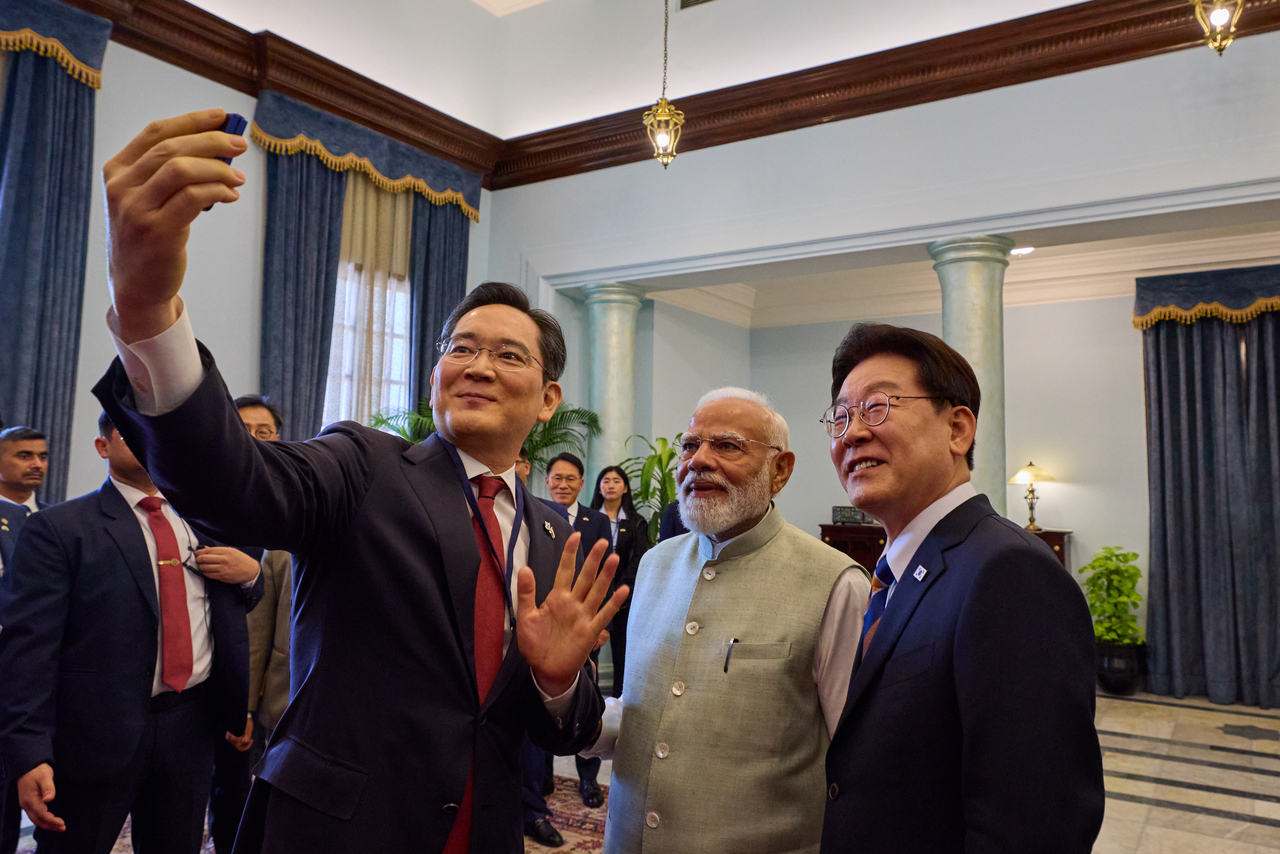
At a luncheon hosted by Modi, Samsung Electronics Chair Lee Jae-yong took a selfie with Lee and Modi using a Samsung Galaxy Z Flip7 made at Samsung’s factory in Noida, a major industrial hub in Uttar Pradesh.
According to Samsung Electronics, the company has produced mobile phones in Noida since 1996 and manufactures all flagship and entry-level models there, including foldable devices, contributing to the Indian government’s “Make in India” initiative.
dagyumji@heraldcorp.com