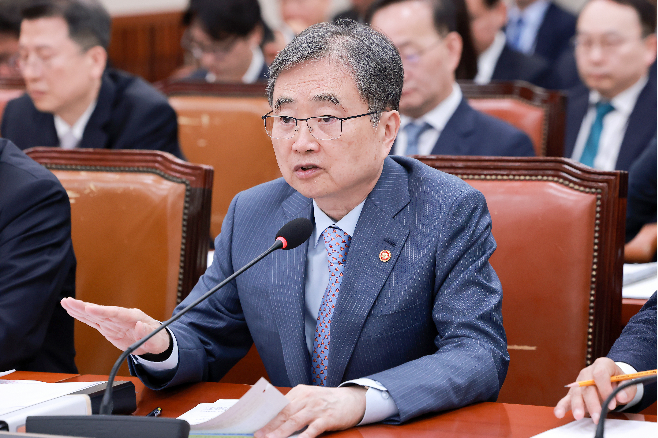
Foreign Minister Cho Hyun said Wednesday that South Korea shared information on its vessels stranded in the Persian Gulf not only with Iran but also with Gulf countries and the United States, as part of efforts to ensure their safety.
Cho made the remarks during a plenary session of the National Assembly’s Foreign Affairs and Unification Committee in Seoul, responding to a question from Rep. Kim Ki-woong of the main opposition People Power Party on whether Seoul had provided details on 26 South Korean ships to Iran.
“The information was not shared only with Iran. It was provided to Gulf Cooperation Council countries and the United States to ensure the safety of our vessels,” Cho said.
Asked whether efforts to secure the safety of the 26 ships and their crews were making progress, Cho replied, “Yes,” noting that the recent ceasefire between Iran and the United States had created a window for action.
“With the ceasefire in place, we shared information on the 26 vessels with neighboring countries and requested cooperation not only for their safety but also for safe passage,” he said.
Cho also addressed the role of Chung Byung-ha, a special envoy dispatched to Iran, saying he is prioritizing the safety of South Korean nationals and vessels.
“He is requesting cooperation from Iran to ensure the safety of our embassy staff and their families, as well as Korean nationals remaining in Iran,” Cho said.
“Around 170 Korean crew members are aboard the 26 vessels in the Strait of Hormuz, and talks are underway to ensure their safety,” he added, referring to South Korean vessels awaiting passage through the strait from the Persian Gulf.
He declined to disclose further details, citing diplomatic sensitivities.
“As this involves ongoing discussions with the other side, it is difficult to specify whom he is meeting,” Cho said. “I spoke with the envoy yesterday and advised him to remain there until the situation stabilizes.”
Chung is believed to be meeting senior Iranian officials, including a vice foreign minister, to discuss maritime transit issues involving South Korean vessels. Iran’s Foreign Minister Abbas Araghchi is reportedly in Pakistan amid negotiations related to a potential end to hostilities with the United States, and further contact with him may be sought.
On energy supply concerns, Cho said Seoul was consulting with multiple countries to secure stable imports, including the use of storage facilities and diversification of supply routes.
“Relevant ministries and companies are in discussions, and the Foreign Ministry is supporting these efforts through its overseas missions,” he said. “We are also exploring ways to secure energy sources that do not require passage through the Strait of Hormuz.”
Cho added that the current war in the Middle East should serve as an opportunity for South Korea to strengthen its economic resilience.
“We need to turn this situation into an opportunity to strengthen our economic fundamentals,” he said, pointing to efforts to develop logistics hubs and diversify energy import sources.
Meanwhile, Cho dismissed concerns raised by opposition figures over President Lee Jae Myung’s recent posts on X, saying they should not be viewed as diplomatically inappropriate. In Lee's post, he shared a video clip allegedly showing Israeli troops disposing of a body from a rooftop — footage Lee clarified in a follow-up post was recorded in 2024 — and described the act as a war crime.
Opposition lawmakers had criticized the post, arguing it could undermine Seoul’s diplomatic standing.
Cho said Israel had expressed reservations through its own social media channels, but that the issue was resolved through subsequent communication.
“Following close communication by the Foreign Ministry, the Israeli side came to understand our position, and the matter was concluded without further developments,” Cho said, adding that there were no diplomatic measures such as summoning the South Korean ambassador to Israel.
Asked about the practical gains of the president’s message, Cho said it was difficult to expect immediate results.
“It is hard to say that it will bring immediate tangible benefits,” he said, adding that Lee’s message was intended to emphasize universal human rights and international humanitarian law, as well as the principle that conflicts should be resolved peacefully.
flylikekite@heraldcorp.com