Dropping this Friday, the Netflix documentary on the making of Arirang is more candid than you might expect

When "Arirang" dropped on Friday, it quite literally sent BTS straight to the top of the world.
"Swim" has held No. 1 on Spotify's Daily Top Songs Global for two consecutive days, with "Body to Body" right behind it at No. 2. "Hooligan," "FYA," "Normal," and "Aliens" are all sitting in the top 10. The comeback, to put it simply, is fully on.
But beyond the numbers, there's a more grounded story waiting. "BTS: The Return," directed by Bao Nguyen, premieres this Friday (March 27), and it goes behind the scenes on the making of "Arirang": the recording sessions, the arguments, the self-doubt, and the grueling process of figuring out where the group should be headed after years away.
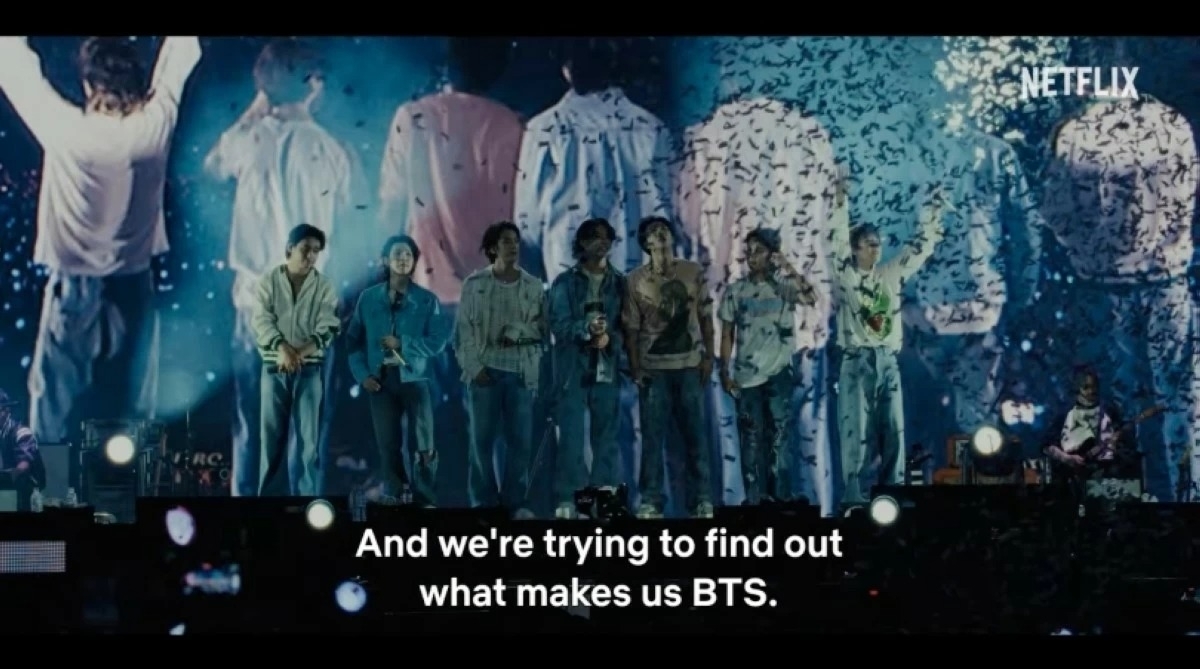
The film has a more intimate feel that belies the spectacle of the comeback. Shot heavily on retro cameras that give the VHS-style footage a dreamy, washed-out glow, it captures the members somewhere between disoriented and reenergized, freshly out of military service and finding themselves holed up in a Beverly Hills mansion with a deadline looming.
Style aside, the documentary has moments worth noting. Here are some interesting things it reveals about the group and the road to its much-anticipated comeback.
Jin arrived late in LA, completely burned out
Sharp-eyed fans will have noticed that Jin's name is absent from several of "Arirang's" songwriting credits. The documentary shows why.
While the other six members were already deep into sessions in LA, Jin was still in the middle of his solo world tour — the "RunSeokjin Ep. Tour," which ran from June through November 2025. He flew over mid-tour when his schedule allowed, joining the others after the early writing had taken place.
The film's narrative kicks off in earnest with this arrival: Jin rolling up to the house with a suitcase, members gathering at the door. You can tell the guy is completely drained; he yawns constantly through his first days there, mentions taking meds for not feeling well, and seems genuinely thrown by the fact that he's in LA at all, given the pace he's been keeping.
Jin was the last to join and also among the first to leave; his tour commitments pulled him back before the others wrapped up.
"When I heard what they'd made while I was away, I was genuinely moved," he said in an interview last year. "I thought, 'These guys are truly remarkable.'"
Life in LA was no vacation
A swanky Beverly Hills mansion, a pool and California sunshine sound like a good time. The documentary tells a different story.
The members were in the studio six days a week, working with producers, grinding through lyric rewrites and arrangement decisions. There are extended sequences of RM workshopping lines in English with a co-writer, trying to find the phrasing that actually lands. It's the kind of slow, unglamorous work that doesn't usually make the highlight reel.
No wonder homesickness creeps into almost every dinner scene. The members would gather around samgyeopsal and soju, and according to several of them, that hour around the table was the one part of the day that felt like home. Jungkook and others say it more directly: There's nowhere like Korea.
Jimin's day-off is peak introvert stuff
Midway through the film, in what feels like a deliberate change of pace, the documentary cuts away to Jimin — back in Seoul, on a regular day off. As a kind of answer to LA's homesickness, here's what home actually looks like for him.
Glued to his PC, he eats delivery Chinese food, watches science videos on YouTube — which he says he turns on every night before falling asleep — and plays League of Legends for hours. That's basically his whole day.
Jimin mentions that he used to think of himself as an extrovert, but not anymore. When he isn't working, he says, he barely leaves his room. It's one of the more genuinely wholesome — and, for fellow introverts, deeply relatable — moments in the film.
Military service left a mark
The film doesn't dwell on the enlistment period for too long. It moves through it in quick cuts of members shaving their heads or dressed in uniform. Roughly 18 months of service are compressed into glimpses.
But as any Korean man who's served could probably tell you, those days don't just stay in the past.
RM casually mentions in the opening beach scene, while the members are filming a live together, that he "learned how to hustle" in the military. The specific vocabularies of Korean military life keep resurfacing as punchline material in their everyday lives — the kind of shared language that embeds itself whether you want it to or not.
The funniest scene connected to any of this involves RM picking up his saxophone and playing the Korean Army's morning reveille — the wake-up call that haunts every Korean man who has served, even long after discharge. The other members completely lose it, equal parts horrified and amused.
'Swim' almost didn't make it as the lead single
The choice of "Swim" as the lead single raised eyebrows when the album dropped. It's mellow and almost meditative, a very different register from the high-energy openers surrounding it. As it turns out, the members weren't fully sold on it either.
In early sessions, RM describes the song as feeling "low-energy," like it drags relative to everything else on the album. Others note how different it is from the kind of hook-heavy, kinetic track people typically associate with a BTS comeback.
In one scene, V tells close friends including actor Park Seo-joon that the most understated track on the album somehow ended up being the one they're putting front and center.
What pushed it over the line seems to be a collective decision to lean into a more grown-up sound.
"It's time we give off a grown-up vibe," RM says at one point.
It also helped that they'd been wrong about this kind of thing before; the members openly admit they weren't that enthusiastic about "Dynamite" while recording it, either.
The 'Arirang' folk melody in 'Body to Body' sparked a real debate
"Body to Body" is one of "Arirang's" most-talked-about tracks, partly because of how it works the centuries-old folk song into an otherwise full-throttle hip-hop production. Getting there, apparently, involved some significant back-and-forth.
The documentary frames this as one of its central tensions. Some members felt the integration was too on the nose — too overtly patriotic in its coding. One of them puts it memorably: It felt like "eating kimchi fried rice in the middle of Paris." They wanted the folk reference to be briefer, more subtle, not dropped in wholesale.
On the other side was Hybe Chairman Bang Si-hyuk, who pushed hard for including the full melody. The documentary shows him making his case in a meeting at Hybe's Yongsan headquarters — framing it in theatrical terms, essentially asking the members to picture tens of thousands of people singing "Arirang" together at Gwanghwamun Square and whether that wouldn't be worth it.
He got his way. "Body to Body" currently sits at No. 2 on the global Spotify chart.
The perfectionism runs deeper than the stardom
The documentary's more compelling moments kick in when the weight of being a star quietly slips through.
During recording sessions, RM expresses frustration that some of what they're making sounds too young, like a callback to their early 20s rather than where they actually are now. Jimin complains about his vocal range, which he feels doesn't fully meet the demands of the material.
There's also a recurring sense of disbelief at everything they've accomplished — how a bunch of "humble Korean guys," as the members put it, could have made it this far.
Even at this level of global stardom, the language question comes up again as well. There's pressure from the label side to incorporate more English into the lyrics, and the members push back, because, of course, rapping in a second language is genuinely hard. Scenes of them checking anxiously during playback — does that sound right? Is the accent okay? — hit differently when you consider how long they've been doing this.
It's a reminder that making it this big doesn't make the self-doubt go away; after all, these are just seven guys trying to work it out like the rest of us. And that, more than anything, is probably why fans find them so easy to root for.
moonkihoon@heraldcorp.com
![[Graphic News] 6 in 10 people living alone feel lonely](https://wimg.heraldcorp.com/news/cms/2026/10/13/news-p.v1.20261013.78692699312346e2a2817fabedf14bb6_T1.gif?type=h&h=800)