Government-backed effort channels funding into universities to strengthen Korea’s chip workforce

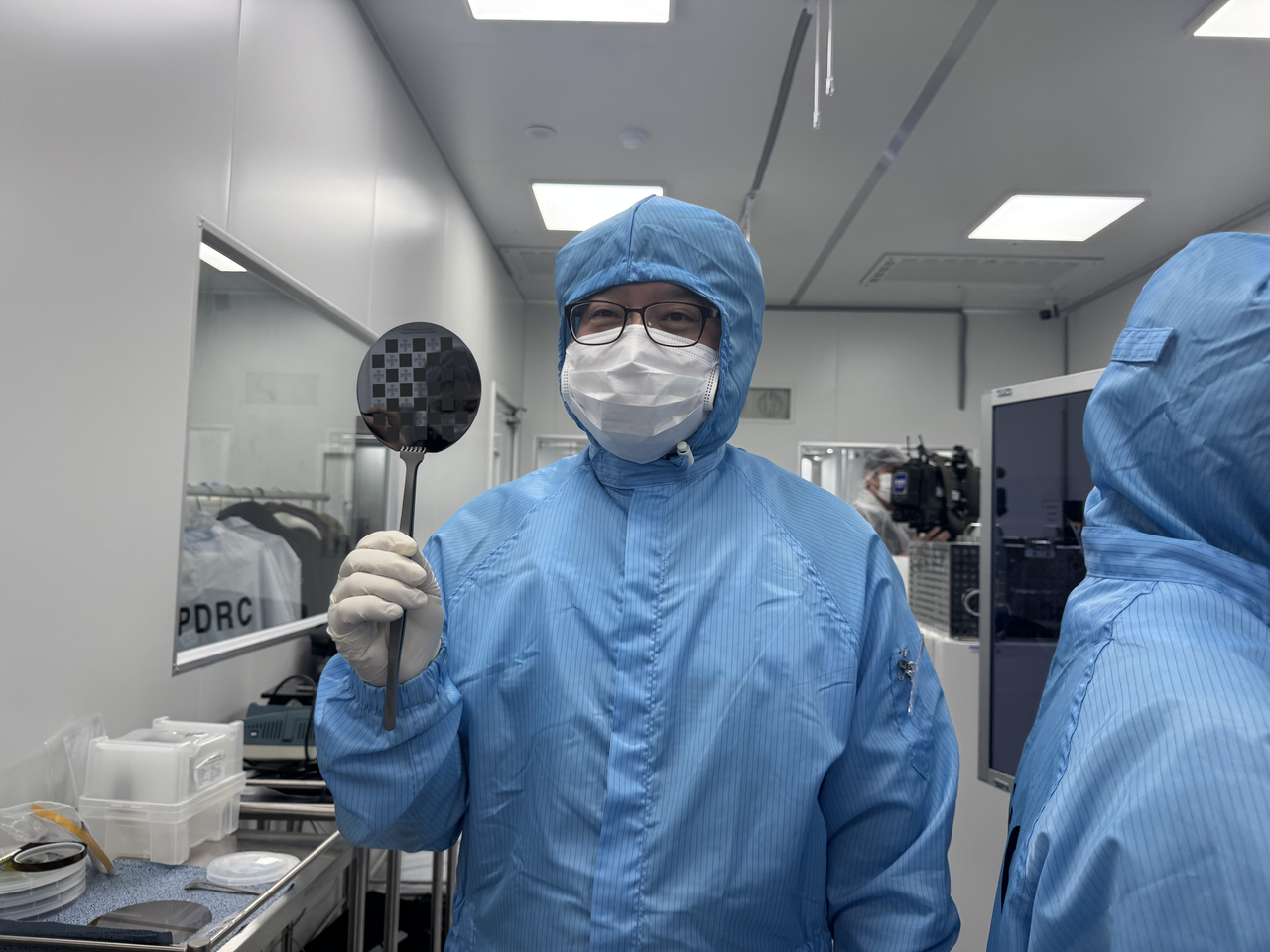
Two students and a professor in light blue cleanroom suits huddle around a semiconductor wafer on Wednesday following an etching process at a lab at Myongji University’s Yongin campus, part of a government-backed effort to train the next generation of chip engineers.
“It is a privilege to work in a lab equipped with state-of-the-art facilities,” said Lee Hyun-joon, a postdoctoral researcher at the lab.
Myongji University is among more than 40 institutions chosen under a government program to train talent in high-tech sectors such as semiconductors, batteries, biotechnology and robotics — industries key to South Korea’s current and future global competitiveness.
The government has allocated a total of 120.9 billion won ($80.6 million) to support participating institutions through improving educational infrastructure, introducing more flexible academic systems, expanding faculty recruitment and strengthening student employment support. Ultimately, the initiative aims to supply undergraduate-level talent while building a pipeline for advanced degree holders.
Myongji University, specializing in semiconductors, partnered with Hoseo University in 2023 to participate in the program.
“(The two universities) have been working together for the past three years with the goal of joint growth, sharing strengths and complementing each other’s weaknesses,” said Hong Sang-jeen, a professor of semiconductor engineering at Myongji University.
Myongji’s semiconductor program expands
Myongji University’s semiconductor department has grown from 30 students in 2023 to 98 in 2025, according to Hong.
“The official quota was 30, but many undeclared students later chose semiconductor engineering as their major,” he said.
A school survey found that more than 100 out of 150 students who enrolled in March 2026 without declaring a major expressed interest in the department.
The program offers a structured curriculum that begins with foundational science and laboratory training in the first two years, followed by more advanced theoretical coursework in the junior and senior years. It culminates in industry-linked projects commissioned by semiconductor firms.
Government funding has been used to recruit faculty and install advanced equipment.
The number of full-time faculty has increased from two professors in 2023 to eight in 2026. The department also hosts two visiting professors from Samsung Electronics, who provide industry-oriented instruction and hands-on training.
The university plans to add two more faculty members annually to meet growing demand.
The campus currently operates three fabrication facilities and six laboratories, including two cleanrooms — controlled environments where airborne particles are minimized to prevent contamination during chip production. Some of the equipment mirrors that are used by major chipmakers such as Samsung Electronics and SK hynix.
The university is also set to receive two additional sets of industry-grade testing equipment through a donation from Japanese chip equipment firm Advantest.
Industry exposure through inter-university collaboration
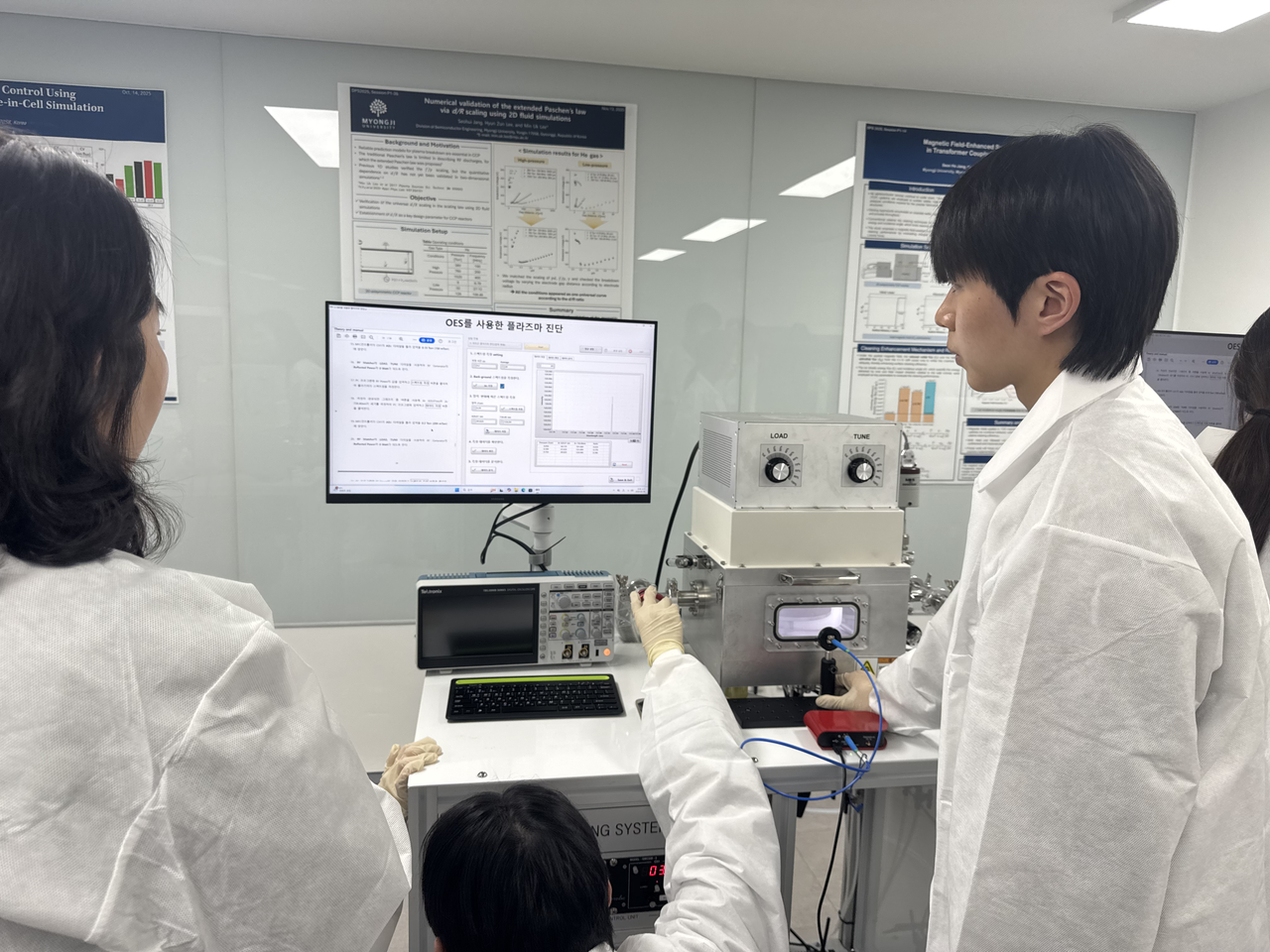
Under its partnership with Hoseo University, Myongji students can participate in a weeklong intensive summer program in Cheonan, South Chungcheong Province.
“They provide dormitories, and we get to use equipment that is not available at our university,” said Jung Jae-hoon, a senior in the semiconductor engineering department who has published a paper in an SCI-indexed journal.
“Hoseo University is located near the Asan industrial complex and has many professors specializing in packaging, which gave us valuable exposure,” he said.
Hong said such collaboration helps broaden students’ understanding of the semiconductor ecosystem.
“When students think of semiconductors, they tend to focus on companies like Samsung or SK hynix, which handle both design and manufacturing,” he said.
“But the industry is much broader, encompassing materials, components and equipment suppliers, as well as processes such as testing and packaging.”
He added that the two universities’ geographic advantages — Myongji in Yongin near manufacturing clusters and Hoseo in Cheonan near packaging facilities — allow students to gain exposure to different parts of the industry.
Myongji University said its goal is to train entry-level engineers with core competency across the industry's supply chain.
Hong also noted that while South Korea is a global semiconductor powerhouse, much of its equipment and key components are still imported, highlighting the need to strengthen the domestic supply chain.
Questions remain over program outcomes
As the first cohort was admitted in 2023, the department has yet to produce any graduates.
“Right now, the industry is not necessarily desperate for new hires,” Hong said. “But I believe demand will grow.”
He highlighted the development of a major SK hynix semiconductor complex in Yongin, which is expected to attract suppliers and increase demand for skilled workers.
“I hope the timing aligns with when our students graduate,” he said.
Hong also noted that hiring trends have shifted, with many companies preferring experienced workers over entry-level recruits. However, he said it was encouraging that students are increasingly interested in diverse roles across the semiconductor value chain, rather than focusing solely on design and manufacturing.
The Ministry of Education said employment outcomes are only one of several metrics used to evaluate the four-year-long program.
Some observers have raised concerns that most students opt for graduate school instead of entering the workforce, potentially undermining the program’s goal of supplying undergraduate-level talent.
Professors, however, counter that the availability of advanced equipment, research opportunities and integrated bachelor’s-master’s programs naturally encourages further study.
seungku99@heraldcorp.com