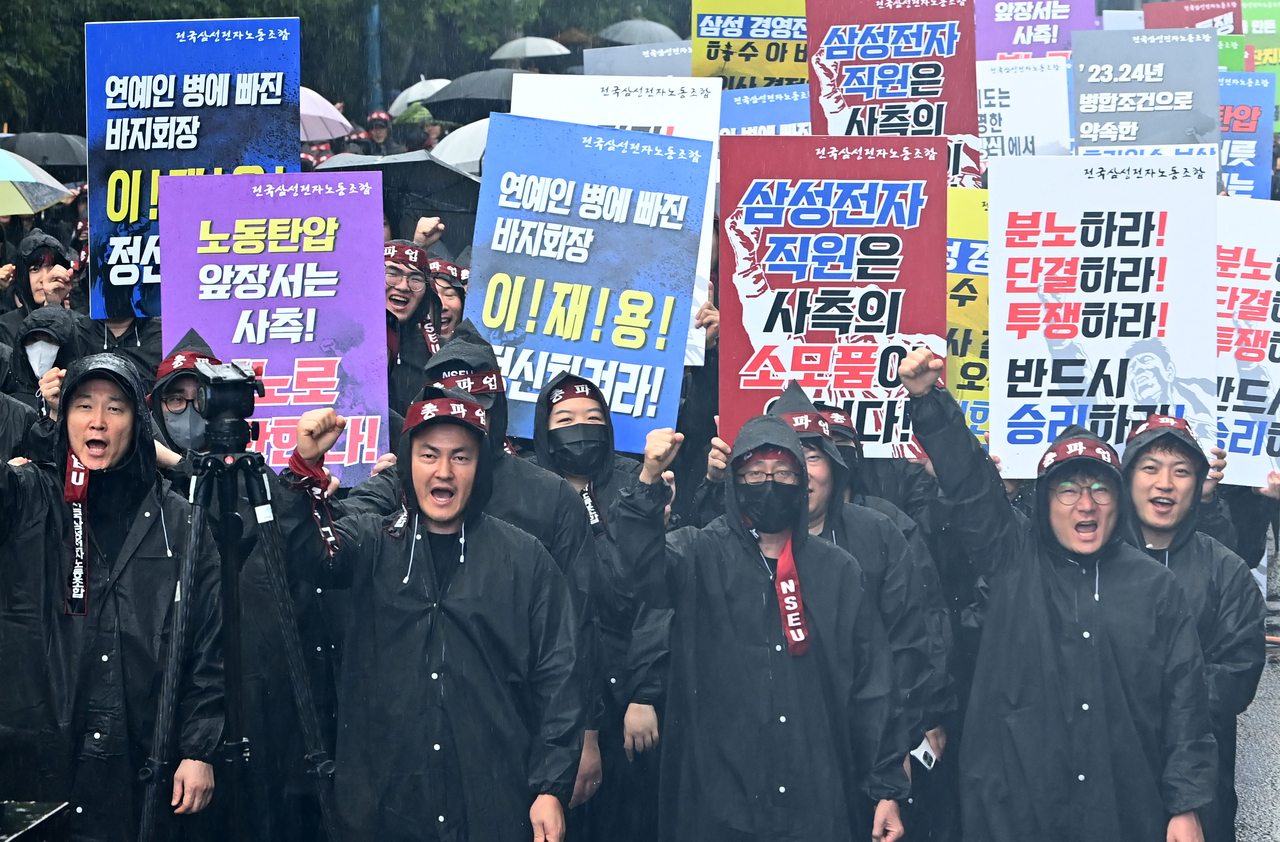
Samsung Electronics’ labor unions will launch a general strike in May, marking the first such action in nearly two years and only the second in the company’s history.
A joint labor coalition said Wednesday it had secured the legal right to strike after 93.1 percent of participating members backed a walkout.
The coalition, known as the Joint Struggle Headquarters, brings together three unions: the Samsung Group United Union Samsung Electronics Co. Union, the National Samsung Electronics Union and the Samsung Electronics Co. Union.
The largest of the three — the Samsung Group United Union Samsung Electronics Company Union — has more than 60,000 members.
Turnout marked 73.5 percent, with 66,019 of roughly 90,000 eligible members casting ballots. Of those, 61,456 voted in favor.
The vote came after mediation under the National Labor Relations Commission broke down. The commission had earlier suspended arbitration, effectively clearing the way for a strike.
A large-scale rally is planned for April 23. The unions say they will carry the momentum into May, calling for normalized bonus payments and a fairer compensation system.
At the center of the dispute is pay. The unions’ key demands for the 2026 wage talks include greater transparency in performance-based bonuses, the removal of bonus caps and a 7 percent increase in base salaries.
If realized, the walkout would be the first at Samsung Electronics since July 2024 — and only the second since the company’s founding in 1969.
Negotiations had run for more than three months after a joint bargaining group was formed in November. But positions never narrowed. The unions declared talks had deadlocked on Feb. 19 and sought mediation soon after.
That effort also collapsed. Following the commission’s March 3 decision to halt mediation, the unions regrouped under the current coalition and moved to secure a strike mandate.
Samsung Electronics, for its part, had put forward a revised bonus framework in response to calls for greater transparency. The proposal would allow employees to choose between allocating 20 percent of economic value added or 10 percent of operating profit as the basis for the operating profit incentive pool.
The tech giant also offered a 6.2 percent wage increase, 20 shares of treasury stock, higher salary caps by rank and expanded long-service leave.
Within its device solutions division, which oversees the semiconductor business, it proposed an additional incentive of up to 100 percent of operating profit incentive if operating profit reaches 100 trillion won ($67 billion).
The unions refused to drop their demand to scrap the upper limit on operating profit incentive payouts, even while showing some flexibility on base wage increases. Management pushed back, warning that removing the cap could deepen disparities across business units and fuel a sense of relative deprivation in weaker divisions.
With neither side backing down, negotiations ultimately broke down — setting the stage for a potential full-scale strike.
yeeun@heraldcorp.com