Talks cover AI chips, memory and cloud infrastructure as Su makes her first Korea visit since taking office in 2014
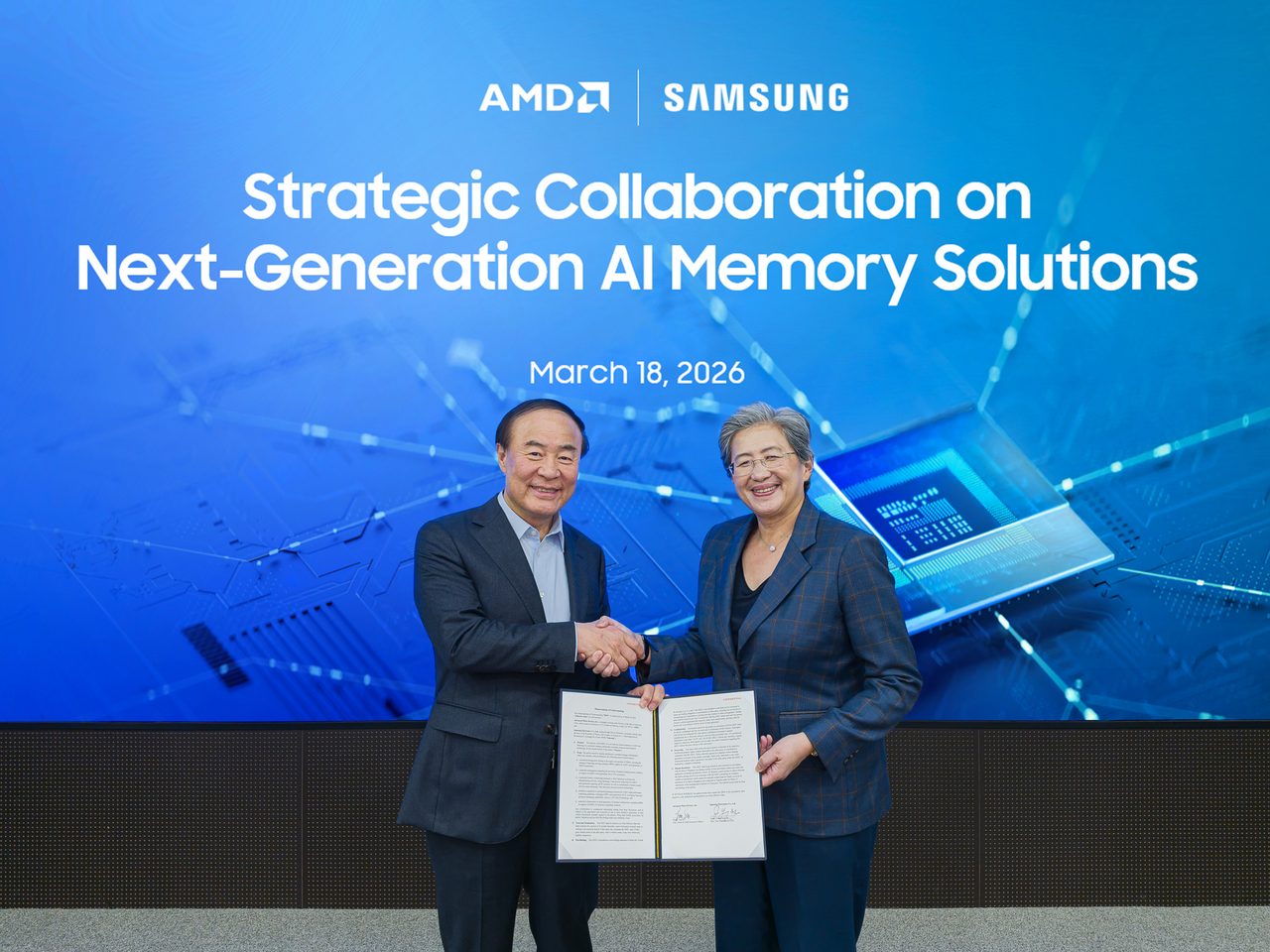
Samsung Electronics said Wednesday it has signed a memorandum of understanding with Advanced Micro Devices to expand strategic collaboration on next-generation artificial intelligence memory and computing technologies.
The signing ceremony was held at Samsung’s Pyeongtaek campus in Gyeonggi Province, as AMD CEO Lisa Su visited the site in the afternoon on the first day of her two-day trip to South Korea. This marks Su’s first visit to Korea since taking office in 2014.
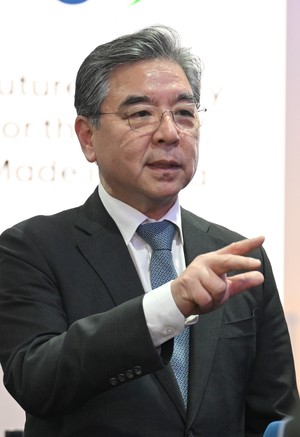
"Samsung and AMD share a commitment to advancing AI computing, and this agreement reflects the growing scope of our collaboration," said Jun Young-hyun, head of the device solutions division at Samsung Electronics.
"From industry-leading HBM4 and next-generation memory architecture to cutting-edge foundry and advanced packaging, Samsung is uniquely positioned to deliver unrivaled turnkey capabilities that support AMD’s evolving AI roadmap," he added.
According to Su, AMD looks forward to the expanded collaboration with Samsung, which combines its leadership in advanced memory with AMD's Instinct GPUs, EPYC CPUs and rack-scale platforms. "Integration across the full computing stack, from silicon to system to rack, is essential to accelerating AI innovation that translates into real-world impact at scale."
Under the deal, Samsung and AMD will align on sixth-generation HBM4 supply for AMD’s next-generation AI accelerator, the AMD Instinct MI455X GPU, while also working on advanced DRAM solutions for sixth-generation AMD EPYC CPUs, codenamed “Venice.”
The technologies will support next-generation AI systems that combine AMD Instinct GPUs, EPYC CPUs and rack-scale architectures such as the AMD Helios platform.
The two companies are also collaborating on advanced memory technologies tailored for AI and data center workloads, as demand grows for higher bandwidth and improved power efficiency at the system level.
Samsung’s HBM4, which the company said is the first in the industry to enter mass production, is built on its sixth-generation 10-nanometer-class DRAM process and a 4-nanometer logic base die. It offers speeds of up to 13 gigabits per second and bandwidth of up to 3.3 terabytes per second.
The MI455X GPU is expected to serve as a key component in high-performance systems designed for AI model training and inference.
The GPU will also underpin AMD’s rack-scale architecture, designed to deliver the performance and scalability required for next-generation AI infrastructure.
As part of the agreement, the companies plan to co-develop high-performance DDR5 memory optimized for sixth-generation AMD EPYC processors, targeting systems built on the Helios platform.
The agreement also includes discussions on potential foundry cooperation, under which Samsung could provide manufacturing services for AMD’s future products.
The deal underscores deepening ties between the two companies as competition intensifies in the global AI semiconductor market, where advanced memory and integrated system architectures are becoming key differentiators.
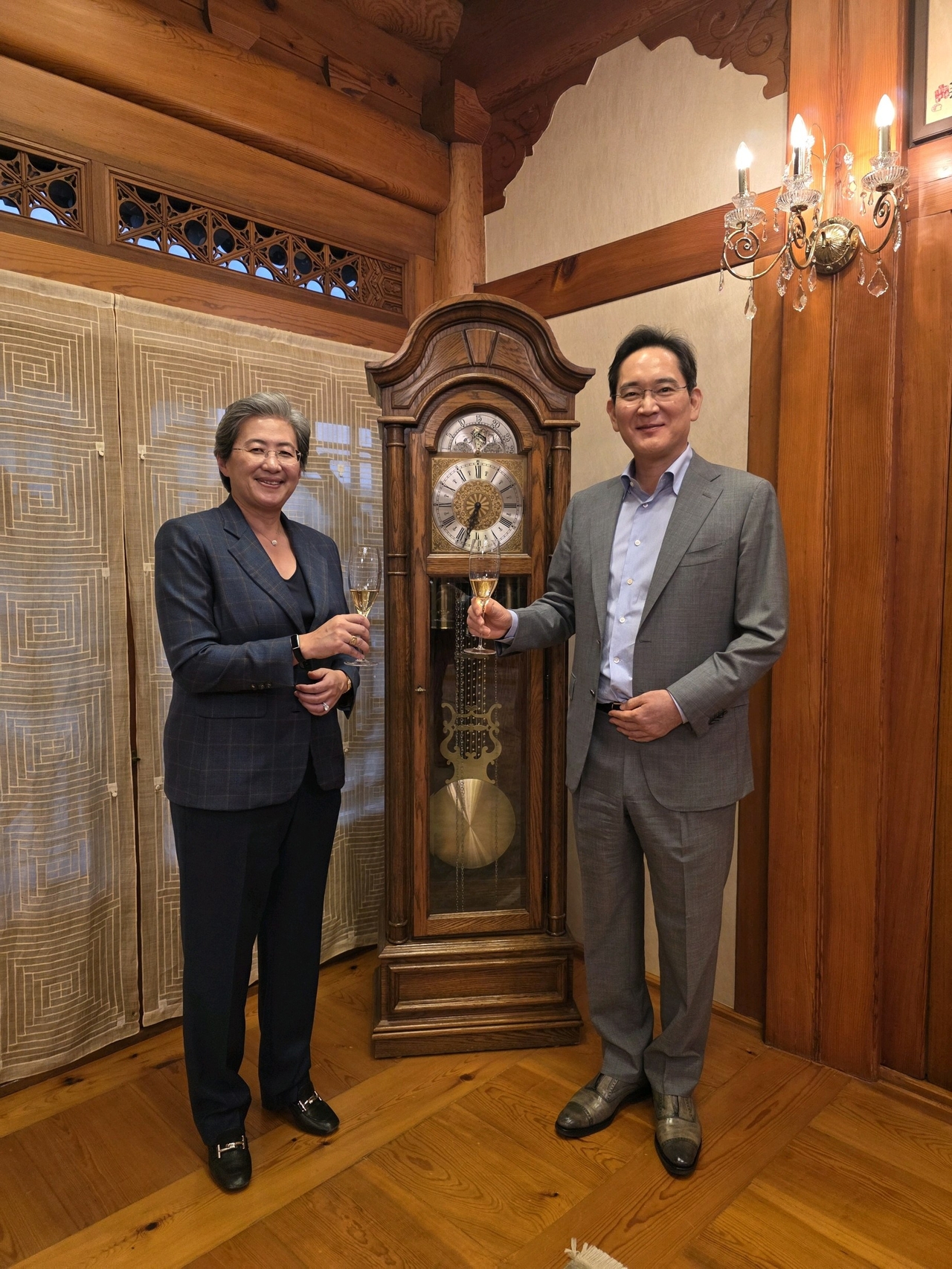
Su later joined Samsung Chairman Lee Jae-yong for dinner at Seungjiwon in Seoul, a venue often used for high-level business meetings, where the two discussed ways to deepen their cooperation.
Seungjiwon has served as a private meeting place for the company’s leadership for decades, originally used by the late Chairman Lee Kun-hee and previously by founder Lee Byung-chul.
Lee Jae-yong has hosted a number of global figures there, including Meta CEO Mark Zuckerberg, Saudi Crown Prince Mohammed bin Salman and Mercedes-Benz Chairman Ola Kallenius.
Su is also expected to meet Roh Tae-moon, who leads Samsung’s Device Experience division covering mobile, TV and home appliance businesses on Thursday.
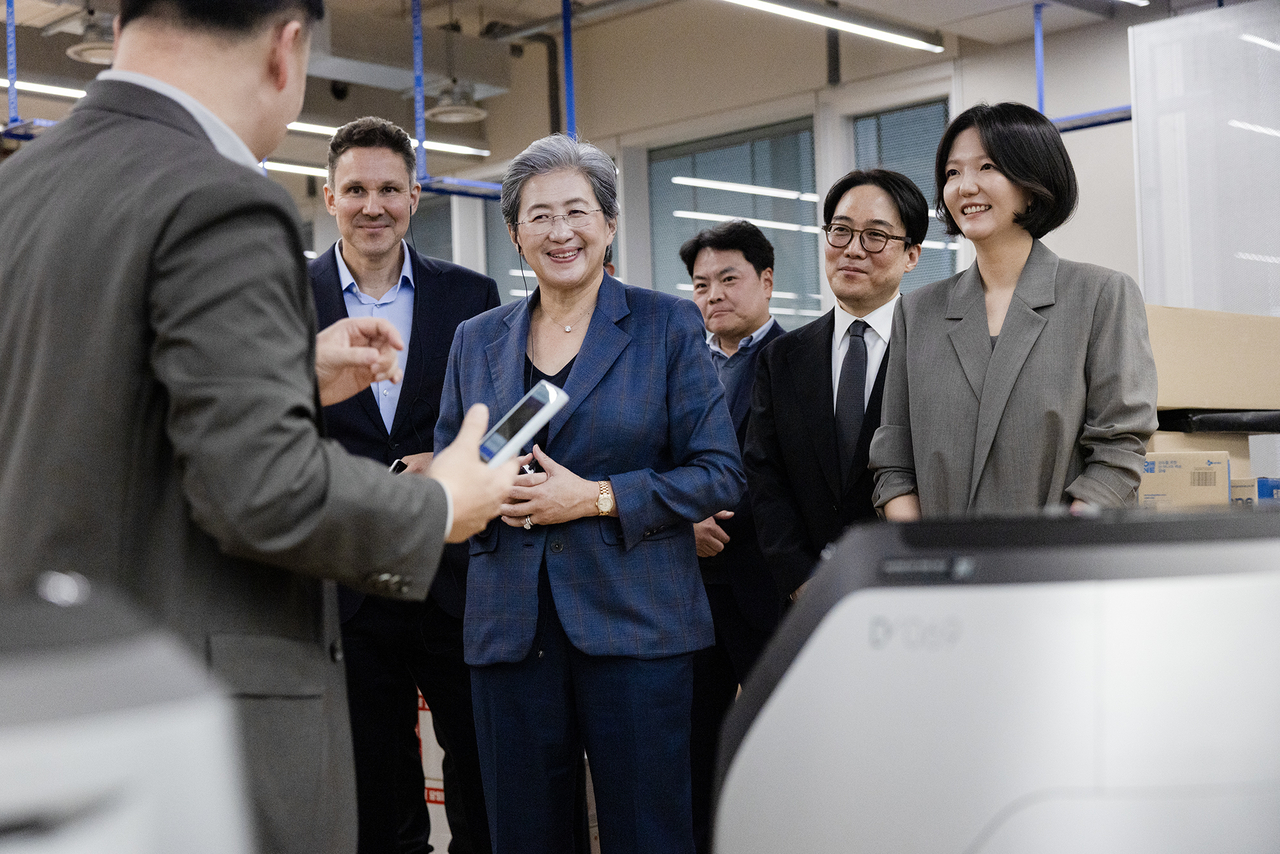
Earlier in the day, Su began her schedule in Korea with a visit to Naver’s headquarters, 1784, in Seongnam, Gyeonggi Province, where she met with CEO Choi Soo-yeon.
The two signed a memorandum of understanding to build a more integrated AI ecosystem that connects technologies across diverse infrastructure environments while improving flexibility in deployment, the Korean IT giant said.
As part of the effort, Naver and AMD will strengthen technical collaboration to develop a high-performance GPU computing environment optimized for Naver’s hyperscale AI model HyperClova X. The goal is to further advance infrastructure capabilities that enable stable and efficient operation of AI models.
Naver is seen as a key partner in applying AMD’s next-generation infrastructure to real-world services. The company has built a full-stack AI capability spanning its proprietary large language models, data centers, cloud infrastructure and large-scale user services.
Building on this, the two companies also plan to support academic research by providing AI computing resources and launching joint research initiatives, aiming to broaden research outcomes across various infrastructure environments.
“The partnership with AMD will serve as a meaningful opportunity to strengthen Naver’s technological diversity and enhance our AI infrastructure competitiveness,” the Naver chief said.
“We will continue to expand the use of AMD platforms across Naver Cloud and our broader AI services while working together to develop next-generation technology stacks and services,” she added.
yeeun@heraldcorp.com