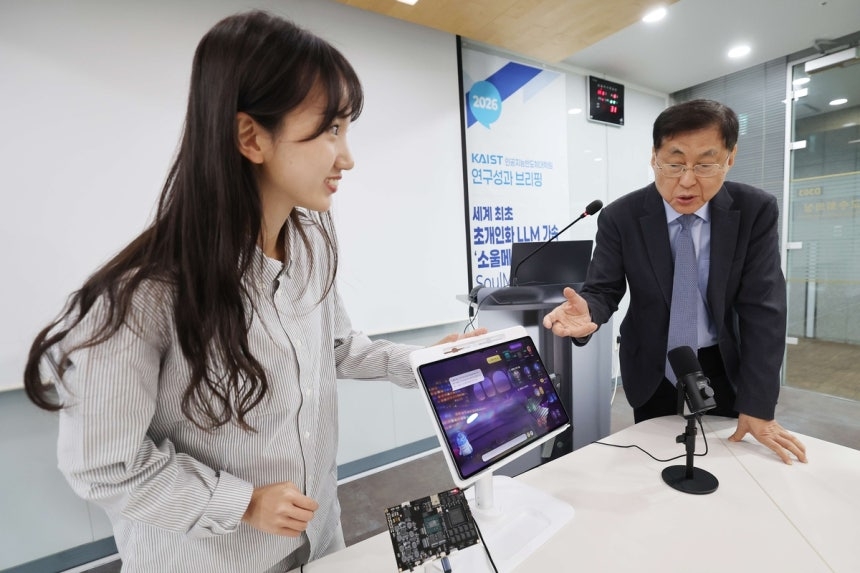
Researchers at the Korea Advanced Institute of Science and Technology have developed a semiconductor accelerator designed to run highly personalized artificial intelligence models directly on devices, a step that could expand AI services without relying on cloud computing.
The chip, dubbed “SoulMate,” was created by a team led by professor Yoo Hoi-jun at KAIST’s Graduate School of AI Semiconductor, the institute said Tuesday.
Unlike conventional AI systems that depend on remote servers, the new processor runs large language models on devices such as smartphones and wearables while learning users’ preferences and conversation styles.
The technology combines two techniques commonly used in modern AI systems. One is retrieval-augmented generation, which produces responses based on stored conversation data. The other is low-rank adaptation, a method that updates models using user feedback with minimal computing resources.
By integrating these functions directly into the semiconductor hardware, the system can both learn and generate responses in real time.
The processor delivers response times of about 0.2 seconds while performing both training and inference, according to the research team.
The chip also uses a mixed-rank architecture that adjusts processing depending on the importance of information, significantly lowering energy consumption.
The processor operates at just 9.8 milliwatts, roughly one five-hundredth the power used by a typical smartphone processor, allowing complex AI tasks to run continuously on mobile devices without draining batteries.
Because all data processing occurs on the device rather than in external servers, the system also prevents personal data from being transmitted to the cloud, reducing privacy risks.
The research was presented at the International Solid-State Circuits Conference in San Francisco, where it was selected as a highlight paper. During the event, the team demonstrated a working chip that adjusted its response style in real time based on user reactions.
Professor Yoo said the technology could enable a new generation of AI systems designed to act more like personal companions than tools.
“Future AI will go beyond simple assistants and become companions that understand users while fully protecting their privacy,” he said.
The team plans to commercialize the chip through KAIST startup OnNeuroAI, with commercialization targeted for next year.
hnpark@heraldcorp.com

![[Graphic News] S. Korea ranks 9th in noodle consumption](https://wimg.heraldcorp.com/news/cms/2026/09/29/news-p.v1.20260929.e3945338add94d57ab3f00f8e6781416_T1.gif?type=h&h=800)