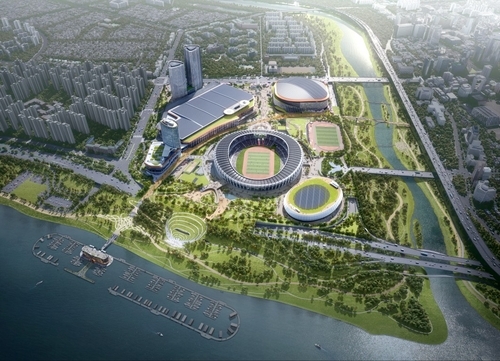
A 3.3 trillion-won ($2.2 billion) sports and convention complex featuring South Korea’s largest domed baseball stadium is planned for completion in Seoul by 2032 after the city finalized long-delayed negotiations for the Jamsil Sports and MICE Complex redevelopment.
The Seoul Metropolitan Government said Wednesday it had concluded four years of negotiations with Seoul Smart MICE Park, a consortium led by Hanwha Construction Division selected as the preferred bidder for the privately funded project.
The development will redevelop about 350,000 square meters of the Jamsil Sports Complex in Songpa-gu into a large-scale hub combining sports, exhibitions, business and leisure facilities.
Construction is scheduled to begin later this year and run through 2032, with the plan centered on a 30,000-seat domed baseball stadium designed to host international games. The project will also include an exhibition and convention center about 2.5 times the size of Coex, multiple hotels and office towers.
The complex will include 841 hotel rooms across three facilities, consisting of a 288-room five-star hotel connected to the convention center, a 306-room four-star business hotel linked to the stadium and a 247-room residence-style hotel.
A 110,000-square-meter commercial zone connected to the Tancheon and Han River parks will also be developed, expanding retail and leisure space in the area.
The project will feature a 31-story prime office district with about 200,000 square meters of floor space aimed at companies linked to the meetings, incentives, conferences and exhibitions industry. New pedestrian-friendly riverfront walkways, cultural spaces and water features are planned to expand public access along the waterfront.
The site will also include a vertiport for urban air mobility, enabling short air routes such as a roughly 15-minute trip between Gimpo Airport and Jamsil.
City officials said the project will become South Korea’s largest privately funded development of a sports and convention complex.
The plan was first proposed in 2007 under then-Mayor Oh Se-hoon’s Han River Renaissance initiative, but faced repeated delays before gaining momentum after the selection of the preferred bidder in 2021.
Oh said the redevelopment represents the culmination of nearly two decades of planning, describing it as a landmark project aimed at strengthening Seoul’s global competitiveness in sports, business and urban development.
jychoi@heraldcorp.com