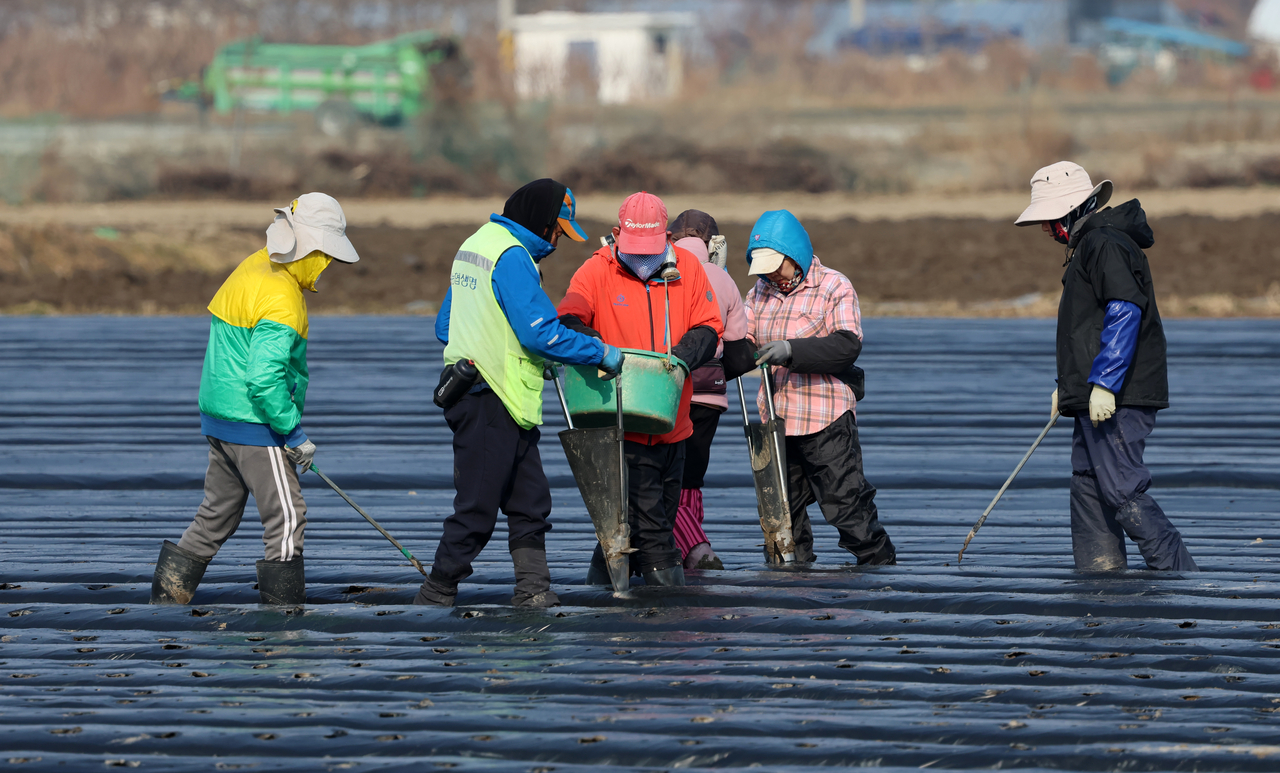
The Ministry of Statistics and the Ministry of Justice on Tuesday released the results of their annual Survey on the Residence and Employment Status of Migrants, offering a snapshot of how foreign residents and naturalized citizens live and work in South Korea.
The government has conducted the survey since 2017, examining demographic, visa and employment trends among migrants aged 15 and older who have stayed in the country for at least 91 consecutive days.
Here are some key findings from the 2025 survey.
Of the 1.69 million migrants in South Korea, 1 in 3 are in their 20s
A total of 1.69 million migrants aged 15 or older were living in South Korea as of May 2025, an increase of 8.3 percent from 2024.
Those in their 20s accounted for the largest share of the migrant population at 30.9 percent, followed by those in their 30s (27.5 percent), 40s (15.7 percent), 50s (12.6 percent) and 60 and older (13.3 percent).
Men made up 57.9 percent of the total, while women were 42.1 percent. Men were more likely to be in the country on employment visas, while women were more commonly in Korea through marriage migration or to study.
More than 2 in 3 foreign workers are satisfied with their jobs
Some 68.7 percent of foreign workers said they were satisfied with their workplaces.
Job satisfaction was relatively higher among nonprofessional workers (77 percent) and professional workers (74.7 percent).
About 10.8 percent said they hoped to change jobs, citing low wages and dangerous working conditions.
Half of foreign workers earn 2 million to 3 million won
Among foreign workers, just over half — 50.2 percent — earned between 2 million and 3 million won ($1,360-$2,040) per month.
Another 36.9 percent earned more than 3 million won per month, according to the survey.
Workers on nonprofessional employment visas (68.9 percent), marriage migration visas (48.9 percent) and working visit visas (42.8 percent) were most likely to fall into the 2 million to 3 million won income bracket.
In contrast, permanent residents (59.3 percent), professional workers (50.8 percent) and overseas Koreans (46.3 percent) were more likely to earn more than 3 million won per month.
Among international students, 51.2 percent reported earning between 1 million and 2 million won per month.
Overseas Koreans remain the largest visa group
Among visa types, overseas Koreans accounted for 24.2 percent of migrants, constituting the largest group.
They were followed by those holding nonprofessional employment visas (19 percent), international student visas (14 percent) and permanent residency (9.6 percent).
However, the proportion of migrants on overseas Korean (F-4), working visit (H-2), marriage (F-6) and nonprofessional employment (E-9) visas declined year-on-year.
Meanwhile, the share of migrants on international student visas (D-2 and D-4-1-7), professional employment visas (E-1 to E-7) and permanent residency (F-5) visas increased.
The share of migrants on international student visas saw the most notable increase. Students accounted for 14 percent of migrants in 2025, up 1.2 percentage points from 12.8 percent in 2024.
Nearly 3 in 4 migrants have at least high school degree
In terms of education, a high school diploma was the highest level of education for 43.1 percent of migrants, while another 30.8 percent also held a college degree.
The proportion of college graduates fell 0.3 percentage point from 2024, while that of high school graduates stayed the same.
Meanwhile, the ratio of those with middle school or lower education saw a slight increase of 0.3 percent.
One-third of migrants are ethnic Korean Chinese
Ethnic Korean Chinese made up the largest foreign nationality group at 29.9 percent, followed by Vietnamese at 16 percent.
More than 90 percent of foreign residents living in Korea were from Asian countries, the survey found.
Nearly half of foreign students live in capital region
Population concentration in the Seoul metropolitan area was also evident among migrants.
A whopping 57.5 percent of migrants lived in Seoul, Incheon or Gyeonggi Province.
The overall trend was similar even for international students, with 47.7 percent living in the capital region — more than four times the share in Daegu and North Gyeongsang Province combined (11.3 percent).
Only 2% of nonprofessional workers live with family
Most migrants lived in detached or multiunit homes (58.5 percent), while 20 percent lived in apartments and 13.2 percent lived in dormitories. About 14.1 percent of migrants owned homes in South Korea.
Some 48.6 percent of all migrants said they lived with family, while 28.1 percent reported living alone.
Most workers on nonprofessional employment visas said they lived with coworkers, with only 2 percent reporting that they lived with family members.
More than 1 in 10 migrants face economic hardships
About 12.9 percent of migrants said they experienced financial difficulties over the past year.
International students reported the highest rate of financial difficulty at 22 percent, followed by working visit visa holders (15.8 percent) and overseas Koreans (14.2 percent).
The most common hardship was being unable to receive medical treatment due to hospital costs (36.2 percent). This was followed by failing to pay utility bills on time (29.4 percent) and difficulty covering tuition for themselves or family members (25 percent).
seungku99@heraldcorp.com