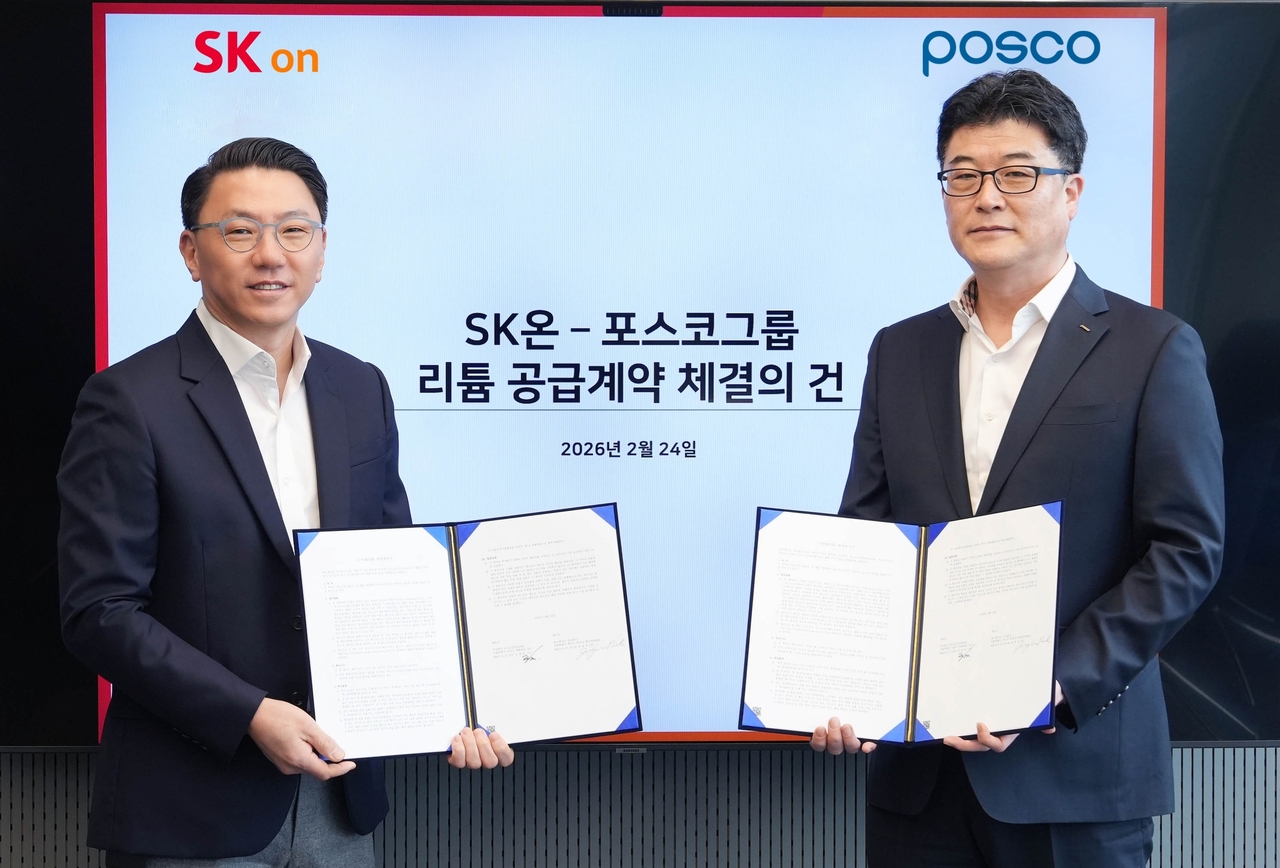
SK On said Wednesday it has signed a supply deal with Posco Holdings to secure up to 25,000 tons of lithium, advancing its efforts to diversify the battery raw materials supply chain away from China.
Key executives, including Park Jong-jin, head of strategic procurement at SK On, and Lee Jae-young, head of the energy materials business division at Posco Holdings, attended a signing ceremony for the lithium supply agreement at SK On Green Campus in Seoul on Tuesday.
Under the agreement, SK On will receive enough lithium to produce batteries for approximately 400,000 electric vehicles, sourced from Posco Argentina’s salt lake operations in the Hombre Muerto region.
The lithium is expected to be used in SK On’s EV battery projects across Europe and North America, where automakers increasingly require battery manufacturers to source raw materials outside China. The company is also reviewing the potential use of lithium for rapidly growing energy storage system applications and battery recycling.
Lithium, a critical component of cathode materials, is widely viewed as a key raw material that directly affects battery price competitiveness. Cathodes account for roughly 40 percent of total battery production costs, with lithium making up about 30 percent of cathode costs.
But given that lithium processing capacity is heavily concentrated in China, which dominates global lithium refining, supply chain stability has emerged as a decisive factor in long-term competitiveness amid rising geopolitical risks.
Notably, North America and Europe -- two of the world’s largest EV markets -- are promoting supply chain diversification policies that effectively discourage battery makers from being heavily reliant on China. US EV tax credits under the Inflation Reduction Act favor sourcing from the US or free trade agreement partners, while the EU’s raw materials and battery regulations aim to reduce dependence on single-country suppliers such as China.
By deepening ties with Posco, SK On plans to enhance its sourcing capabilities and respond more flexibly to supply-demand volatility in the global raw materials market.
“This agreement is part of our supply chain diversification strategy to strengthen mid- to long-term raw material stability and sourcing competitiveness,” stated Park. “We will continue expanding SK On’s raw material capabilities beyond EVs and into the ESS sector.”
hyejin2@heraldcorp.com