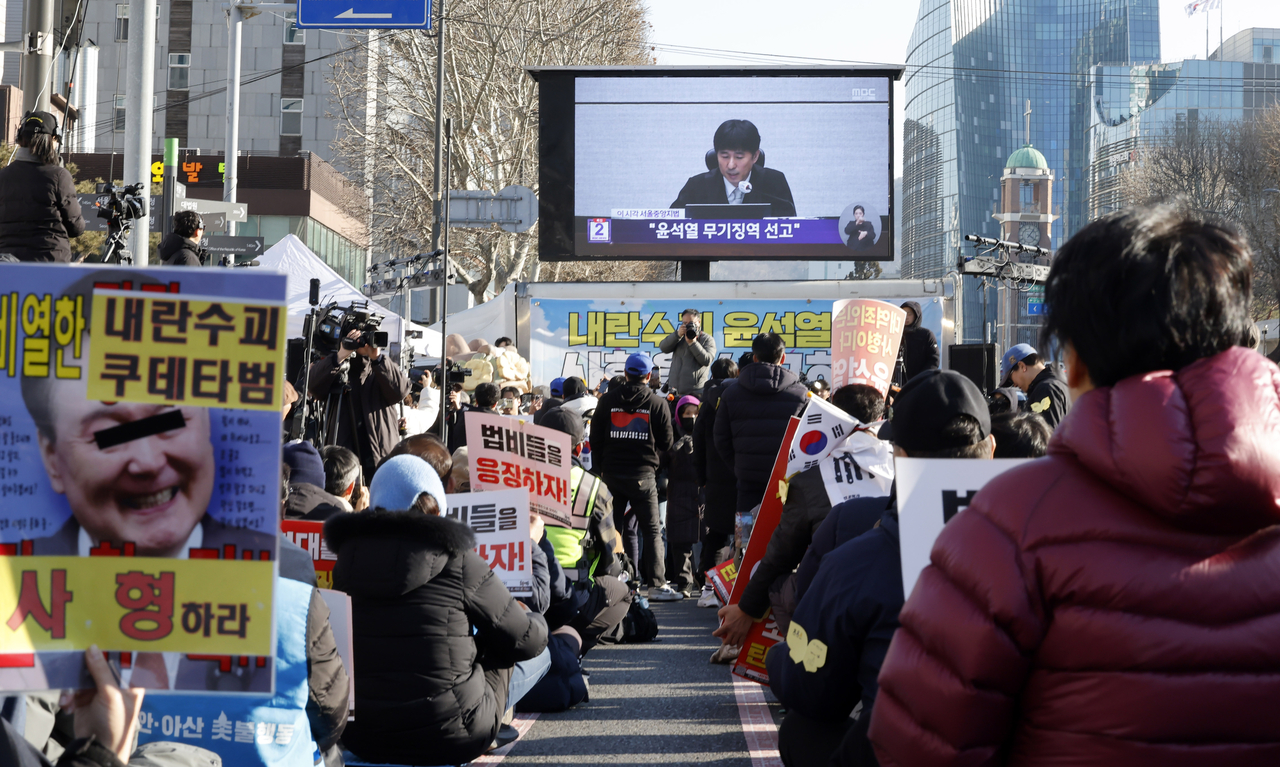
Former President Yoon Suk Yeol faces a widening calendar of criminal trials extending through at least the first half of the year, deepening the legal exposure created by the failed martial law attempt that has already brought him a life sentence in the insurrection case.
Yoon still has six pending trials filed by the three special prosecutors appointed by the National Assembly.
Each team has brought two cases covering charges ranging from espionage and perjury to abuse of power and election law violations. He also received a five-year sentence last month for obstructing the execution of an arrest warrant by the Corruption Investigation Office for High-Ranking Officials, raising the likelihood of additional prison time as the remaining cases unfold.
The most serious among the pending cases is the so-called Pyongyang drone case, overseen by a panel of the Seoul Central District Court that specializes in complex criminal matters.
Prosecutors said Yoon conspired with senior defense and intelligence officials to send drones into North Korea multiple times to create conditions favorable for declaring martial law, leading to the exposure of military secrets when one of the drones crashed near Pyongyang.
The panel will hold its tenth hearing on Feb. 23. Yoon remains in custody until at least July under a separate detention warrant tied to this case.
A separate bench at the same court is hearing a perjury case connected to former Prime Minister Han Duck-soo’s trial.
Prosecutors allege that Yoon falsely testified that the martial law order was to be issued after Cabinet deliberation, even though he imposed it immediately once a quorum was met.
The court will hold a second pretrial hearing on Feb. 26 and aims to open the first full hearing on April 16, with judges indicating they may move quickly toward closing arguments, as much of the evidence overlaps with the insurrection proceedings.
Two cases brought by the special counsel investigating the death of a Marine corporal begin substantive hearings in March.
One panel will examine allegations that Yoon pressured military investigators after reacting angrily to early findings naming a Marine commander as a suspect.
Another bench will open the first hearing on March 31 in a separate case accusing Yoon of appointing former Defense Minister Lee Jong-sup as ambassador to Australia to help him evade questioning.
The special counsel examining allegations involving Yoon’s wife, Kim Keon Hee, has also charged Yoon with receiving free political opinion polling worth about 270 million won ($186,000) ahead of the 2022 presidential election, violating campaign finance rules. The case is set to open on March 17.
A second case, alleging that Yoon spread false information during the campaign, is assigned to a different division, with the first hearing yet to be scheduled.
Korean law instructs each special counsel team to complete first-instance trials within six months of indictment, but several of Yoon’s cases have yet to fully enter the evidentiary stage.
With the insurrection verdict already imposing the country’s heaviest punishment short of the death penalty, the remaining rulings will determine how far Yoon’s criminal liability may expand and how long the former president could ultimately remain behind bars.
hnpark@heraldcorp.com











