North Chungcheong Province is emerging as one of Korea’s most dynamic hubs for global education and talent mobility, offering a model other regions are likely to watch.
The province is rapidly building a stable pipeline of international students, not as a short term enrollment boost but as a strategic boost to the population and workforce for its next decade of industrial growth.
That push is unfolding alongside a historic investment boom. The region secured 83.4 trillion won ($56.9 billion) in new investment during the current administration under Gov. Kim Young-hwan, the largest amount among all non-capital regions.
Officials say the province’s ability to attract both people and capital is now reinforcing itself, creating a foundation for long term industrial renewal.
North Chungcheong stands out as a Global Talent Hub because it has built a direct link between international student recruitment, employment and long term settlement at a scale unmatched by other regions.
It is also viewed as a strong Global Economic Connector for its record level of high tech investment, its integrated semiconductor cluster and its capacity to translate capital inflow into real economic outcomes.

Global Talent Hub: Turning global talent into population resilience
North Chungcheong is evolving into a laboratory for how regions can turn international students into long term residents.
The strategy connects study, employment and settlement in one pathway, forming what officials describe as a self-sustaining cycle in which population, industry and investment move together.
Gov. Kim sees this moment as decisive for regions confronting demographic decline. “Foreign students are not temporary visitors. They are future residents, future workers and potentially future families who will sustain our communities,” he said in an interview with The Korea Herald.
“The province has become a place where investment, jobs and population growth reinforce one another, and welcoming global talent is essential to that cycle.”
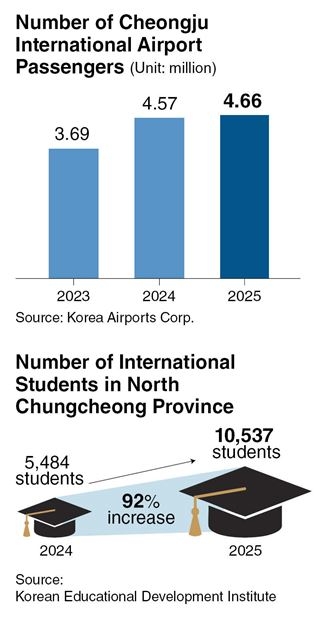
The province recorded 10,537 international students as of April 2025, a 92.1 percent increase from the previous year, the fastest growth rate in the country. Officials credit the rise to a recruitment model that ties education directly to employment and settlement opportunities.
The “Chungbuk (North Chungcheong) style K-Student” initiative has been central to the province’s overseas outreach since 2023.
Provincial and university teams held fairs and briefings in India, Uzbekistan and Vietnam, reaching more than 3,400 prospective students last year.
Once students arrive, integration support continues. The province's K Guardian Program, the first of its kind in Korea, pairs international students with local volunteer mentors who assist with housing, public services and daily life.
The program has significantly improved retention, with more students choosing to stay in the region beyond graduation, according to officials.
Settlement incentives are expanding. Under the Ministry of Justice’s Regional Visa Pilot, North Chungcheong secured 830 visa slots through 2026.
Financial requirements were eased and part time work limits increased from 25 to 30 hours per week.
These changes, Kim said, “give students a real chance to support themselves while gaining experience directly connected to our regional industries.”
The province plans to open the Chungbuk Foreign Resident and Integration Support Center next July, providing language courses, visa counseling, legal services and cultural programs in a single hub.
The province’s talent strategy is closely linked to its industrial transformation.
North Chungcheong is home to one of Korea’s most established semiconductor bases, centered on SK hynix’s Cheongju complex, which includes the M15 fab, the planned P&T7 advanced packaging facility and the upcoming M15X line for next generation DRAM.
The region has become a critical node in the HBM and AI memory supply chain, driving strong demand for skilled workers as global competition intensifies.
That demand grew sharply when SK hynix announced a 19 trillion-won investment to build an advanced semiconductor packaging facility, P&T7, in Cheongju.
The complex is expected to break ground in April 2026 and begin operation by late 2027.
The project as a pivotal step toward completing a rare integrated semiconductor cluster that spans front end production, back end processing and high end packaging.
The facility will strengthen Korea’s position in high bandwidth memory, a core component for artificial intelligence systems.
The investment follows SK hynix’s earlier expansion, including the construction of M15 in 2018 and the 20 trillion won M15X announcement in 2024 to secure next generation DRAM capacity. The cluster has become central to Korea’s AI semiconductor competitiveness.
Kim said the company’s decision reflects the province’s structural advantages, especially water.
“North Chungcheong is rich in lakes and mountains, making it one of the most water abundant regions in the country,” he said. “Semiconductor production needs high quality water, and we can supply it reliably.”
Provincial officials argue that water security is a decisive competitive factor in a sector often described as a “water consuming industry.” The combination of water availability and central geography is one reason the province has been able to anchor successive waves of high tech investment.

Global Economic Connector: Record investment reshapes industrial map
The province’s cumulative investment during this administration reached 83.4 trillion won, the highest in its history and far beyond the 60 trillion-won target Kim set when taking office.
A total of 1,231 companies, including SK hynix, LG Chem, LG Energy Solution and Hyundai Mobis, committed to new investment or expansion.
The region posted one of the strongest GRDP growth rates in the country last year, as well as the fastest export growth among non-capital areas.
It also recorded the highest employment rate and lowest unemployment rate nationwide.
Officials say the province’s strength lies in execution. Streamlined approvals, coordinated infrastructure planning, utility support and on site administrative teams have become part of what the provincial government calls its “speed to growth” model.
Kim said a dedicated task force will manage the P&T7 project to ensure rapid progress.
The next challenge, he added, is building research and testing capacity that matches the scale of manufacturing. Although the province hosts major semiconductor fabs, it lacks its own large scale R&D and performance verification centers.
“We will support companies in every category, from systems to regulation to infrastructure, so they can invest and grow with confidence,” Kim said.
Kim argues that North Chungcheong’s economic rise and demographic turnaround stem from the same principle: regional autonomy.
The province recorded the fastest increase in birth rates in the country last year, including gains in smaller county level areas that have been at risk of depopulation.
Kim credits what he describes as “lifecycle based” policies, including strong child care allowances, support for multichild families and targeted programs for twin and triplet households.
“Regions know their own realities best,” he said. “Change begins when local governments have the authority and flexibility to act.”
He reiterated this view when discussing the ongoing debate over the proposed administrative merger of Daejeon and South Chungcheong.
He said the plan risked generating structural inequality if benefits are concentrated in a single metropolitan unit without compensating other regions that shoulder national burdens.
North Chungcheong supplies about 70 percent of the water used in the greater Seoul area, yet faces development constraints as a result.
Kim argued that any integration framework must include equitable regulatory relief and infrastructure support for regions like his. “Local autonomy is not optional,” he said. “It is the foundation of Korea’s next 100 years.”
Kim, a former science minister and four term lawmaker, said his legislative and administrative experience had shaped the province’s current trajectory.
Decisions made in the National Assembly taught him how to design systems, while his time as minister taught him the importance of execution.
“A governor must combine both,” he said. “You stand closest to the lives of residents and must decide quickly, with full responsibility for the outcome.”
For North Chungcheong Province, that has meant pairing investment with population strategy, industrial capacity with global talent and local autonomy with national responsibility.
As global competition shifts and Korea confronts demographic decline, the province’s experiment offers a preview of what a future ready regional model may look like.
“We are not just recruiting students,” Kim said. “We are building a global community that will be part of the region’s next decade.”
hnpark@heraldcorp.com