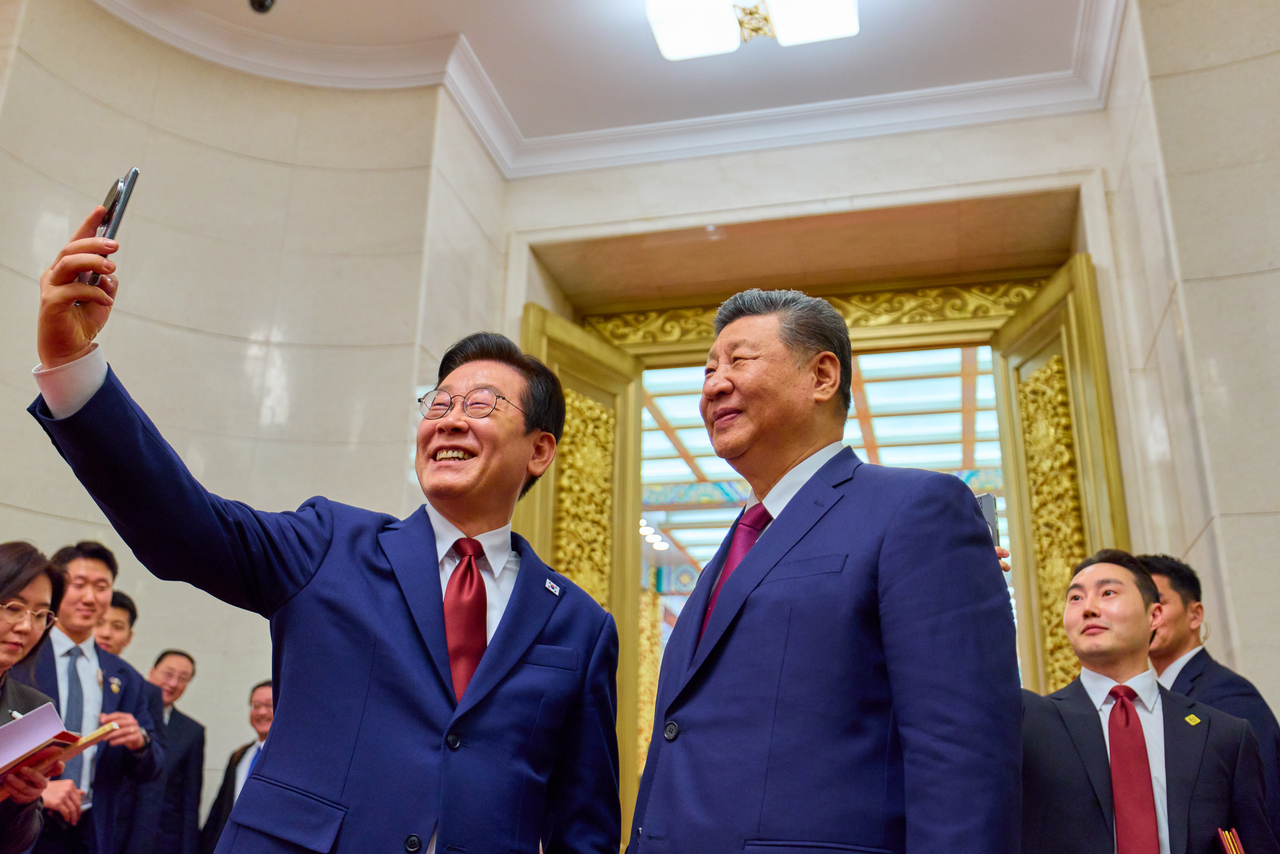
In diplomacy, timing is often the clearest form of symbolism. On Sunday, as President Lee Jae Myung boarded his plane for Beijing to end a nine-year freeze in presidential state visits to China, North Korea chose the moment to fire a volley of short-range ballistic missiles.
외교에서 타이밍은 종종 가장 명확한 형태의 상징성을 갖는다. 일요일, 이재명 대통령은 한국 대통령으로서는 9년만에 처음으로 중국을 국빈방문하기 위해 베이징으로 향하는 비행기에 올랐다. 그리고 북한은 이때에 맞춰 단거리 탄도미사일을 연이어 발사했다.
Beijing rolled out the red carpet; Pyongyang fired a warning shot. Between those two signals lies the real question over Lee’s China trip: whether South Korea can forge a path of strategic autonomy in a region where every gesture is scrutinized and misreadings are historically costly.
중국은 레드카펫을 깔아주었고 북한은 경고 사격을 했다. 이 간극에 이 대통령의 중국 방문을 둘러싼 진정한 질문이 자리한다. 모든 제스처가 하나하나 면밀히 분석되고 잘못된 해석은 역사적으로 큰 대가를 불러왔던 지역에서 한국이 전략적으로 홀로서기를 할 수 있는 방향을 구축할 수 있을지가 그것이다.
Lee’s four-day state visit, the first by a South Korean leader since 2017, came unusually quickly after his meeting with Xi Jinping in Gyeongju, North Gyeongsang Province, two months earlier. Such rapid leader-level engagement suggests urgency on both sides. For Seoul, relations with China have been stuck in a diplomatic permafrost since the US-deployed THAAD antimissile battery dispute, hardened by the US-China rivalry and Washington’s technology restrictions. For Beijing, stabilizing ties with a US ally has grown more important as strategic competition deepens.
4일에 걸친 이번 국빈방문은 2017년 이후로 처음 한국 대통령이 중국을 찾는 것이다. 이번 방문은 두달전 경상북도 경주에서 있었던 이 대통령과 시진핑 주석의 회동 후 예외적으로 빠르게 추진되었다. 정상급 만남이 그렇게 속히 이루어졌다는 것은 양측 모두 조바심을 내고 있다는 것을 시사한다. 한국 입장에서는 중국과 외교 관계가 오랜 기간 얼어붙어 있었다. 미국이 미사일 방어용 배터리 사드를 설치한 이후 경색된 양국 관계는 미중 경쟁과 미국의 기술 분야 규제로 한층더 어려워졌다. 중국으로서는 전략적 경쟁이 심화되면서 미국의 동맹국과의 관계를 안정화시키는 것이 더욱 주요해졌다.
The visit signals a break from the old shorthand of security with the US and economics with China. That division no longer holds.
이번 방문은 미국과는 안보를 중국과는 경제를 추구한다는 단순한 셈법에서 벗어나는 것을 뜻한다. 더이상은 그런 분리는 의미가 없다.
Supply chains, AI and semiconductors are now treated as strategic assets, with policy increasingly shaped by resilience and control rather than efficiency. Lee’s case, laid out in his CCTV interview on Friday, is that South Korea needs room to pursue its own interests rather than reflexively aligning with either pole of the great-power rivalry.
공급체인, AI, 반도체는 이제 전략적 자산으로 취급된다. 정책을 경절하는 것은 점차 효율보다는 탄성과 통제다. 금요일 중국 중앙TV와 가진 인터뷰에서 이 대통령은 한국은 패권경쟁중인 두 나라중 한쪽에 맞추어 나가기보다는 자국의 이익을 추구할 운신의 폭이 필요하다는 의견을 내놓았다.
His reaffirmation of the "One China" policy fits that realist framing. Seoul has held this position since diplomatic normalization in 1992, and restating it now works as a stabilizer. With Beijing on edge over Taiwan, Lee’s insistence on principle without embellishment distinguishes South Korea from more confrontational regional voices. The aim is to limit friction, not to curry favor.
이 대통령이 "하나의 중국" 원칙을 재확인한 것은 현실주의적 입장에 들어맞는다. 한국은 1992년 중국과의 수교정상화 이후 이 입장을 견지해왔고 작금 이를 다시 밝힌 것은 상황을 안정시키는 역할을 한다. 중국이 대만 문제로 촉각을 곤두세우고 있는 상황에서 이 대통령이 꾸밈없이 이 원칙을 주장한 것은 좀더 공격적인 목소리를 내는 여타 아시아 국가들과 한국 간에 차이를 보여주는 것이다. 비위를 맞추는 것이 아니라 갈등을 최소화하려는 목적이다.
Strategic autonomy, however, does not excuse silence. The harder test lies where interests collide.
그러나 전략적인 자주성이 침묵을 용인해주지 않는다. 더 어려운 시험은 국가이익이 충돌하는 곳에 자리한다.
China’s permanent steel structures in overlapping waters of the Yellow Sea raise sovereignty concerns that cannot be dismissed as technical disputes, particularly as maritime boundaries remain contested and crisis-management mechanisms remain underdeveloped. Beijing’s unease over Seoul’s pursuit of nuclear-powered submarines adds another layer of mistrust, recalling how defensive security choices have triggered political and economic retaliation.
중국이 양국의 (배타적 경제)수역이 겹치는 황해에 설치한 영구적인 철골 구조물은 기술적인 분쟁으로 치부되어서는 안 될 영유권 문제를 불러일으킨다. 해양경계에 이론이 있고 위기관리 체계가 여전히 미비한 상태이기에 더욱 그러하다. 한국이 핵추진잠수함을 도입하려 하는데 대한 중국의 불안이 불신을 더한다. 국방안보 상의 선택으로 정치적, 경제적 보복이 뒤따랐던 것을 상기시키기도 한다.
More consequential still is North Korea. Recent Chinese military documents have quietly dropped explicit references to denuclearization of the Korean Peninsula. That omission matters. Lee must persuade Xi that stability without denuclearization is an illusion and that a nuclear-armed North is a persistent liability that complicates deterrence and increases escalation risks. Beijing’s role in nudging Pyongyang back toward dialogue remains indispensable, even if its leverage has waned.
여전히 더욱 중대한 것은 북한이다. 최근 중국 군부가 발표한 문서는 한반도 비핵화에 대해 명시했던 내용들을 슬그머니 삭제했다. 해당 문구가 생략된 것은 의미가 있다. 이 대통령은 비핵화 없는 안정은 환상에 불구하다고 그리고 핵으로 무장한 북한은 억제를 어렵게 하고 상황을 악화시킬 위험을 높인다고 시 주석을 설득해야만 한다. 북한을 다시 대화의 장으로 끌어오기 위해서는 비록 영향력이 줄어들었다고는 해도 중국의 역할이 여전히 필수적이다.
Economics offers a parallel arena for recalibration. During Lee’s visit, more than 10 memorandums of understanding covering artificial intelligence, green energy and future supply chains will signal a shift from vertical dependence to horizontal cooperation. His emphasis on solar energy and advanced technologies aims to anchor the relationship in mutual gain rather than asymmetric reliance.
경제 분야는 이와 유사한 재조정의 장을 제공할 것이다. 이 대통령의 방문 기간동안 인공지능, 친환경 에너지, 미래 공급체인 등을 다루는 10개가 넘는 양해 각서로 양국 관계가 수직적인 의존이 아니라 수평한 협력관계로 전환됨을 시사할 것이다. 태양광 에너지와 첨단기술에 힘을 준 이 대통령은 비대칭적인 의존이 아니라 상호 이익을 얻는 관계로 자리매김하고자 한다.
Lee has proposed institutionalizing annual meetings with Chinese leaders to avert another decadelong freeze. Regularity would lower the stakes and curb the impulse to read symbolic overreach into routine diplomacy. But procedure alone will not suffice. Strategic autonomy will be judged by outcomes, notably China’s role on North Korea and tangible progress on maritime rights and cultural exchanges.
이 대통령은 다시 중국과의 관계가 십년간 경색되는 것을 막기 위해 정상회담을 연례화할 것을 제안했다. 정기적인 회동은 위험을 낮춰주고 의례적인 외교활동에서 지나치게 의미를 찾으려는 충동을 막아줄 것이다. 그러나 절차만으로는 충분치 않다. 전략적인 자주성은 결과, 특히 북한 관련한 중국의 역할 그리고 해양관련 권리 및 문화교류 상의 눈에 보이는 진전으 로 판단될 것이다.
Pyongyang’s missile launch as Lee departed was a cold reminder that the peninsula’s volatility ignores protocol. For this Beijing reset to succeed, South Korea must prove it can act not as a buffer between giants, but as a pivotal actor shaping its own strategic environment.
이 대통령의 출국을 겨냥한 북한의 미사일 발사는 한반도의 예측불가능한 상황은 외교 의례조차 무시한다는 차가운 현실을 환기시켰다. 중국과의 관계를 재수립하는데 성공하려면 한국은 강국들 사이에서 완충역할만 하는 것이 아니라 자국의 전략적인 환경을 조성할 수 있는 주요 행위자임을 증명해야 한다.
That test begins in Beijing. Turning this state visit into sustained Chinese cooperation on regional stability will be the clearest measure of Lee’s “pragmatic diplomacy” and the hardest one to pass.
시험은 베이징에서 시작된다. 이번 국빈방문을 통해 지역 안정을 위한 중국의 지속적인 협력을 끌어내는 것이 이 대통령의 "실용외교주의"의 가장 명확한 잣대이자 가장 어려운 시험이 될 것이다.
a volley of 연발로
autonomy 자치권, 자주성
permafrost 영구 동토 층
shorthand 속기, 약칭
diplomatic normalization 수교 정상화
curry favor 비위를 맞추다
memorandum of understanding 양해 각서
asymmetric 불균형적인
tangible 실재하는
khnews@heraldcorp.com