A special law bill aimed at integrating Daegu and North Gyeongsang Province is drawing criticism for creating potential loopholes in Korea’s labor standards, as it includes provisions that could exempt certain areas from key regulations such as minimum wage and statutory working-hour limits.
The controversial provisions are framed as part of a broader deregulation push to attract global investment, reflecting recent efforts by the opposition bloc to ease labor regulations for industrial competitiveness.
Civic and labor groups, however, warn that such exemptions could legitimize unfair employment conditions already in the region, such as having employees work for long hours at low wages. They claimed that this could further accelerate the outflow of young people seeking better working conditions elsewhere.
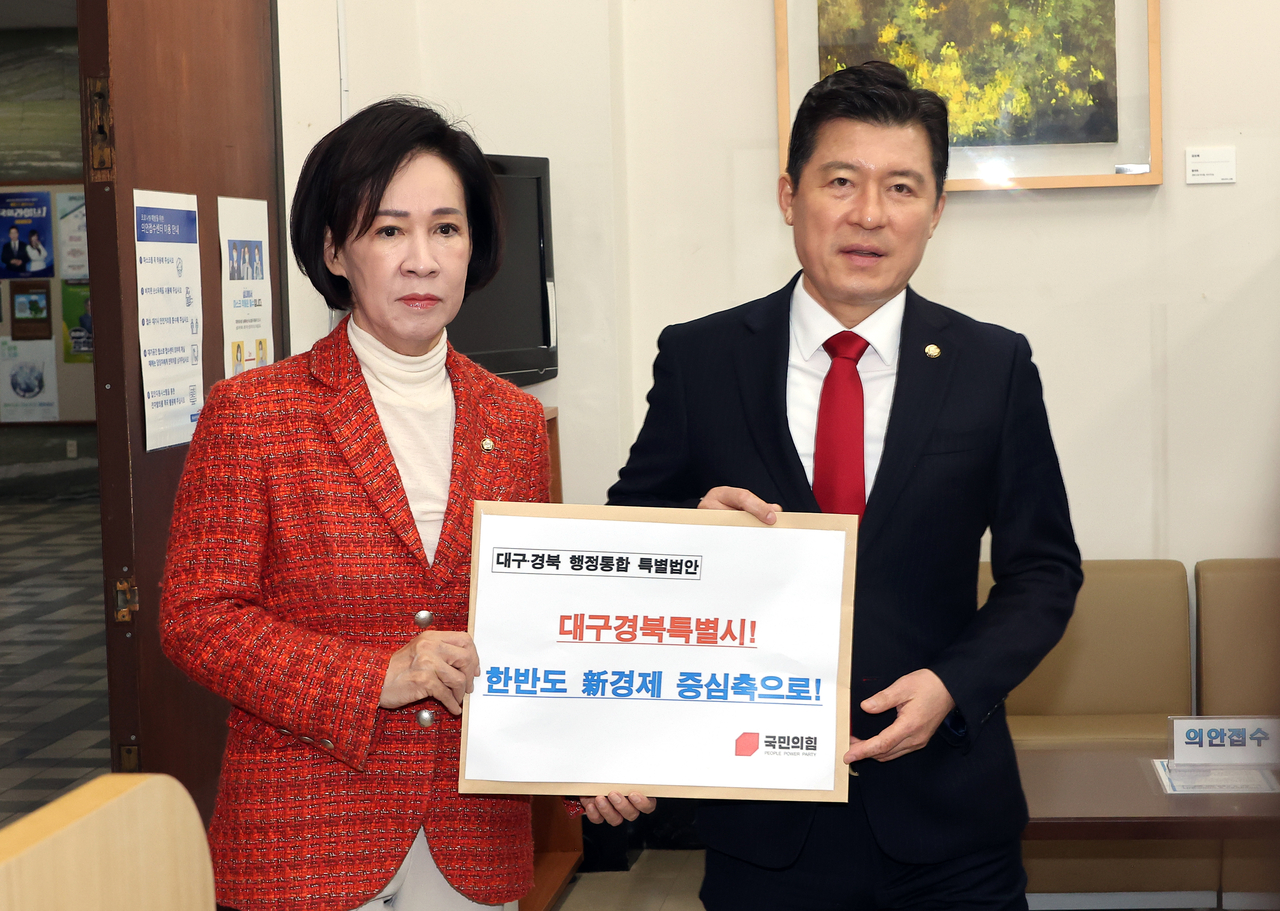
Proposed last Friday, the bill would establish a legal framework for the administrative integration of Daegu and North Gyeongsang Province and grant the new entity wide-ranging regulatory authority transferred from the central government.
It was introduced by 24 of the 25 lawmakers representing the region, all affiliated with the main opposition People Power Party. Lawmakers aim to pass the bill at the National Assembly by the end of February, with integration targeted for completion in June.
Minimum wage exception in region with most violations
The disputed provisions appear in the section describing a proposed “Global Future Special District,” envisioned as a regulation-light zone designed to attract high-tech, high-value-added industries.
According to the bill, employers in the district could be exempted from complying with Korea’s minimum wage law. South Korea’s minimum wage currently stands at 10,302 won ($7.1) per hour and is applied nationwide.
The bill also allows for a separate working-hour cap, within a range permitted by presidential decree, by exempting the district from Article 50 of the Labor Standards Act, which sets working hours at eight per day and 40 per week.
Local labor organizations strongly criticized the proposal, arguing that it contradicts the Constitution, which mandates the enforcement of a minimum wage system.
“Given that this could bring major changes to residents’ lives and labor conditions, it is inappropriate to push the bill without public hearings or meaningful consultation with stakeholders,” local branches of the Korean Confederation of Trade Unions said in a statement on Tuesday.
The union also alleged that the provision could enable employers to pay below-minimum wages or shift various business costs onto workers’ pay, practices explicitly prohibited under current law.
Such concerns are amplified by the region’s record of relatively low compliance with labor standards.
Daegu and North Gyeongsang Province have recorded the highest number of reported minimum wage violations per capita nationwide for four consecutive years, reflecting a prolonged industrial slowdown and an economy dominated by small enterprises. In 2024, 220 cases were reported in the city, equivalent to 4.49 cases per 100,000 people, according to government data.
In 2023, Daegu’s minimum wage noncompliance rate stood at 14.5 percent, higher than the national average of 11.4 percent. By comparison, Seoul and Ulsan recorded rates of 10.4 percent and 10 percent, respectively. North Gyeongsang Province posted an even higher noncompliance rate of 18.5 percent.
The shortage of jobs offering stable pay is widely cited as a key factor behind the region’s long-running population decline. Daegu has recorded net population losses for three decades, losing 4,272 residents in 2025 alone, while North Gyeongsang Province saw a net loss of 9,214.
An official from Rep. Koo Ja-keun’s office, the bill’s main sponsor, expressed regret over what he described as a narrow focus on the minimum wage and working-hour provisions, emphasizing that the bill’s goal is to expand employment opportunities.
“The intention is not to pay less than the minimum wage or make people work longer hours unconditionally,” the official said. “If we want to attract foreign companies, we need bold policy tools. The bill creates a comprehensive special regulatory zone, and these clauses are only a small part of a much broader package.”
While Daegu Metropolitan City, which has been pushing the initiative, plans to announce its position on the controversy in the coming days, the bill will be reviewed for revisions and supplementation before a vote at the National Assembly.
forestjs@heraldcorp.com