Battery giant on track to expand North American ESS business with second Hanwha deal
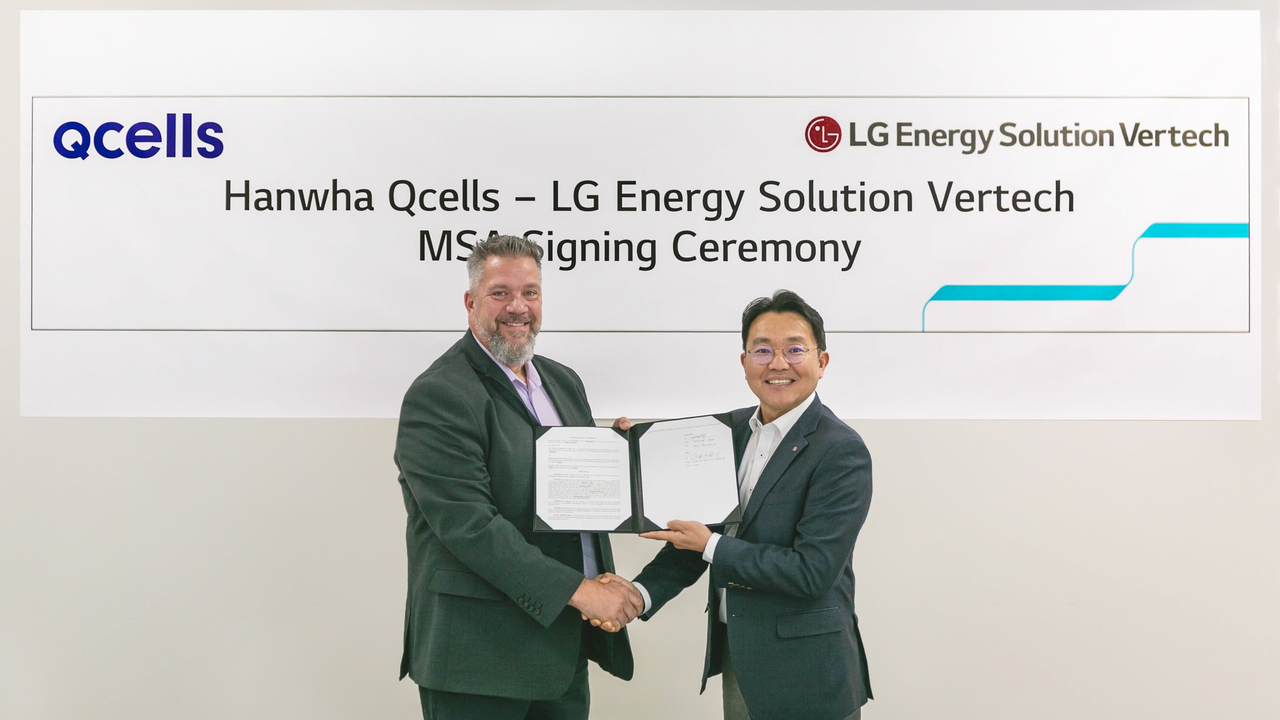
LG Energy Solution secured a roughly 1 trillion won ($690 million) deal with Hanwha Qcells to supply energy storage system batteries as part of its push to expand its footprint in the fast-growing North American ESS market.
LG Energy Solution said Wednesday that LG Energy Solution Vertech, its wholly owned US-based ESS integrator, and Hanwha Qcells’ US subsidiary have signed an agreement covering 5 gigawatt-hours of ESS batteries.
Under the deal, LG Energy Solution will supply cost-competitive lithium iron phosphate batteries, with deliveries from 2028 to 2030 for Hanwha Qcells’ grid-scale ESS projects across the US.
The agreement marks the second major ESS collaboration between the two companies, following last year’s 4.8-gigawatt-hour supply contract valued at around 1.4 trillion won.
Leveraging their US manufacturing bases, LG Energy Solution and Hanwha Qcells plan to jointly develop large energy projects that combine solar power generation with battery storage.
LG Energy Solution’s ESS batteries will be produced at its Michigan plant, while Hanwha Qcells’ solar modules will be manufactured in Georgia, enabling end-to-end US-based production.
As their US operations meet the requirements of the US Inflation Reduction Act, which incentivizes domestically sourced clean energy projects, the companies are expected to enhance project stability and long-term profitability.
The projects are also set to boost US job creation and reinforce the domestic clean energy supply chain.
“By supporting Hanwha Qcells across the entire project lifecycle, we aim to strengthen our collaboration and build a long-term partnership centered on strategic value,” said LG Energy Solution Vertech CEO Park Jae-hong. “We expect our joint projects to contribute to the long-term success of our customers’ businesses and to the stability of the US power grid.”
LG Energy Solution is expanding its ESS business to capitalize on electrification demand driven by the rapid growth of AI-powered data centers, partly offsetting a slowdown in its EV battery business.
During its recent fourth-quarter earnings call, the company said it plans to secure more than 50 gigawatt-hours of annual ESS production capacity in North America in its two Michigan plants and joint venture facilities with Stellantis and Honda. It also aims to surpass its record 90 gigawatt-hours of ESS orders locked in last year, with a broad product lineup spanning uninterruptible power supply systems, battery backup units and grid-scale applications.
From October to December, LG Energy Solution reported an operating loss of 122 billion won, marking its first quarterly loss in a year, as US automakers continued to scale down their EV rollout. By contrast, its ESS battery sales in North America more than doubled in the same period.
Recognizing the rising strategic importance of the ESS sector, LG Energy Solution began mass-producing LFP battery cells for ESS applications at its Michigan facility in June 2025, becoming the first global battery maker to launch large-scale LFP production in the US.
“As global tech giants and cloud service providers ramp up investment in AI data centers in the US, LG Energy Solution is expected to benefit by securing an early lead in LFP batteries — a segment traditionally dominated by Chinese competitors — positioning itself as a key non-Chinese supplier,” said an industry source familiar with the matter on condition of anonymity.
hyejin2@heraldcorp.com