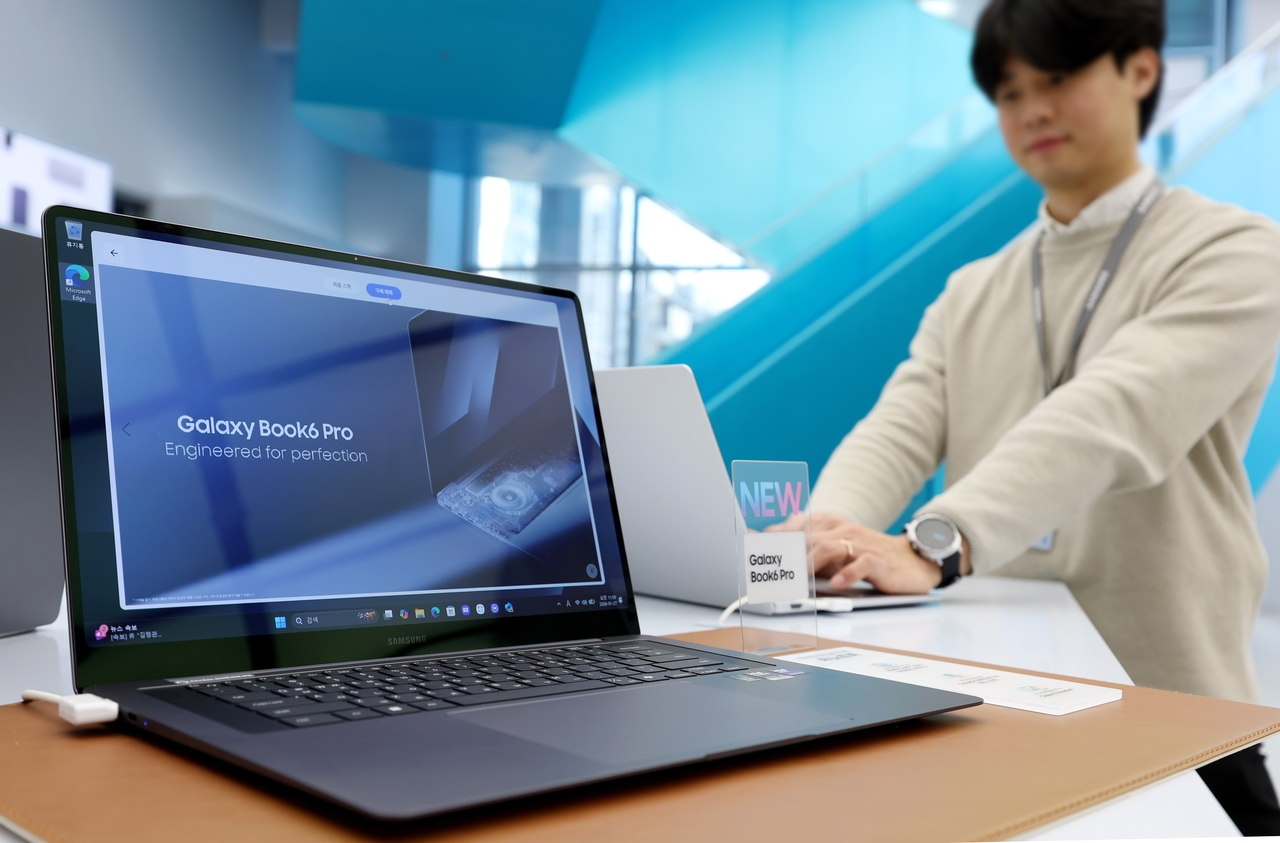
Retail prices for new high-end laptops from top Korean electronics brands have jumped sharply this year, as a global memory chip shortage driven by soaring demand from the artificial intelligence sector continues to push up component costs across the consumer electronics industry.
Samsung Electronics' newly launched Galaxy Book6 Pro now tops out at 3.51 million won ($2,420), a 25 percent increase from the highest-tier model in last year's Book5 Pro series, which peaked at 2.81 million won. It is the first time the "Pro" line has breached the 3 million won threshold in the domestic market, typically reserved for more specialized "Ultra" or workstation-grade models.

LG Electronics also raised prices on its flagship Gram Pro AI 2026, with the 16-inch version retailing at 3.14 million won, an 18.9 percent rise from the equivalent 2025 model.
Local industry officials attribute the increases to a phenomenon they call "memoryflation" — referring to price hikes caused by rising memory semiconductor costs.
The surge is being fueled by rapid expansion in AI infrastructure and high-performance computing, which has severely constrained supply for conventional DRAM and NAND used in consumer electronics. According to market tracker DRAMeXchange, fixed contract prices for DDR4 8Gb DRAM jumped from $1.35 in January 2025 to $9.30 in December, nearly a sevenfold increase.
DRAM now accounts for as much as 30 percent of a laptop's total bill of materials, rivaling the costs of CPUs and GPUs.
NAND flash prices have followed a similar trajectory. In January, fixed contract prices for 128Gb NAND rose 64.8 percent month-on-month.
TrendForce, a market research firm, projects that these cost pressures will drive a 14.8 percent quarter-on-quarter drop in global notebook shipments in the first quarter of 2026. The firm also slashed its full-year laptop shipment forecast to a 9.4 percent year-on-year decline, citing compounded supply issues, including CPU shortages and price hikes in other components such as printed circuit boards, batteries and power management integrated circuits.
Dell, Lenovo and Asus have all raised laptop prices by up to 30 percent, depending on configuration, while some brands have opted to maintain prices by cutting memory specs instead.
Smartphone-makers are also feeling the impact of rising memory costs. Chinese electronics giant Xiaomi has reportedly lowered its 2026 shipment forecast by 10 million to 70 million units, revising down from an initial target of 180 million, according to supply chain sources cited by the South China Morning Post. Samsung Electronics is also under mounting cost pressure ahead of its Galaxy S26 launch in March, with executives warning that price adjustments may be necessary to offset margin erosion.
TrendForce has warned that 2026 smartphone production could fall "approximately 15 percent, or potentially even higher under a pessimistic scenario," as escalating memory costs force brands to cut low-end models.
mjh@heraldcorp.com