CEO says currency risk, not government pressure, drives portfolio decisions
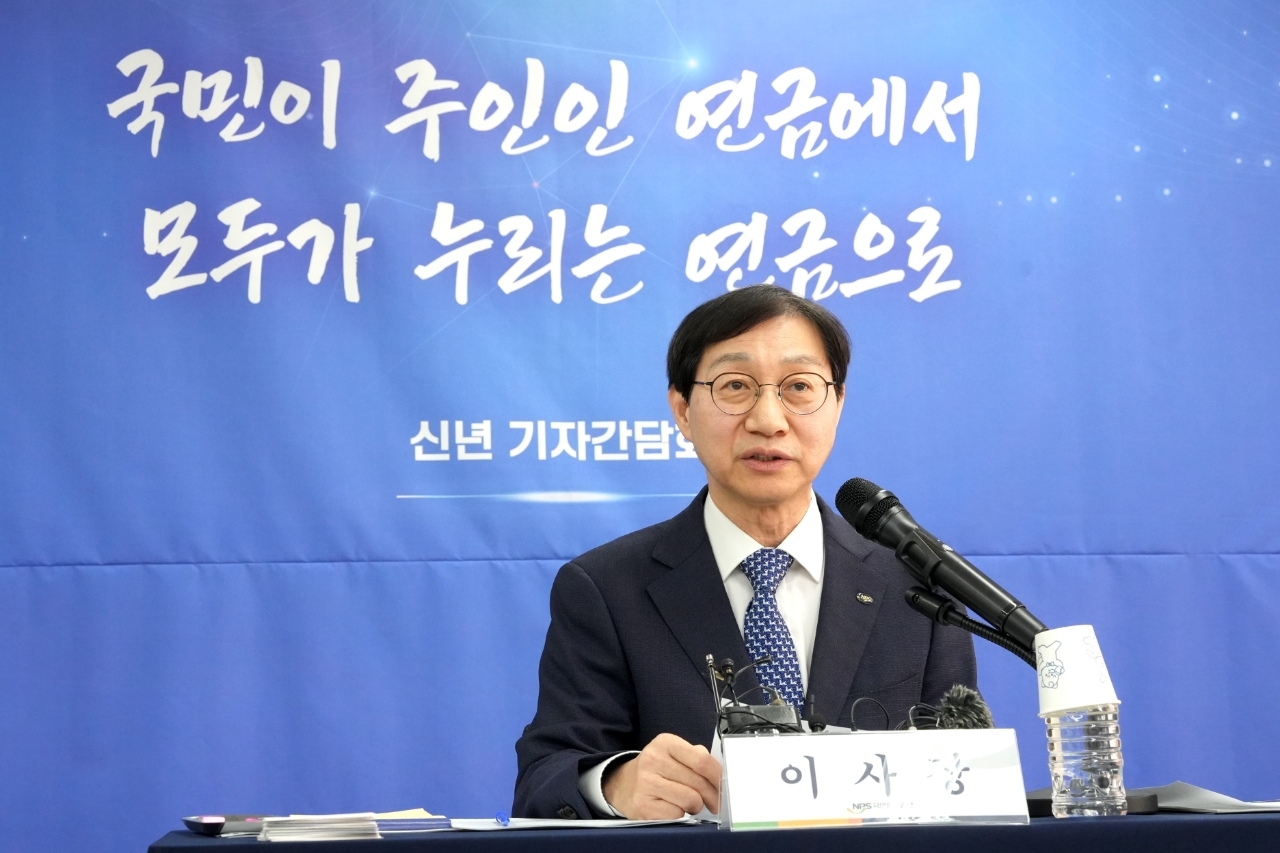
National Pension Service CEO Kim Sung-joo said Thursday the fund’s investment decisions are made “independently, without political interference,” as he sought to deflect criticism that the world’s third-largest pension fund has been used as a policy tool.
“Sharp currency swings are among the biggest risks to the fund,” Kim said at a press conference in Seoul, his first meeting with local reporters since taking office in December. “As a long-term investor, the NPS cannot avoid factoring in exchange rates and market fluctuations. This reflects our own investment strategy, not any government request.”
Kim said the fund’s currency risk management and recent portfolio adjustments were driven by internal assessments rather than government direction, rejecting claims that the NPS has been mobilized to stabilize the foreign exchange market.
He added that the latest asset allocation framework reflected a shift in risk conditions as overseas exposure had expanded and currency volatility had increased. Under the revised targets, the fund raised this year’s domestic equity allocation by about 0.5 percentage points while trimming the overseas stock target by roughly 1.7 percentage points, reversing a recent trend of expanding foreign equity holdings.
“Portfolio decisions are made from a return perspective, not to support the market,” Kim said, adding that the moves were not intended to prop up local equities.
Kim cited the domestic stock market rally — which saw the benchmark Kospi surge about 76 percent — as a key driver behind the NPS’s roughly 18 percent return, its strongest performance on record.
Although cautiously, the fund is reviewing increasing exposure to Kosdaq and venture investments, Kim added.
“Kosdaq investments remain relatively small compared with the overall portfolio due to high volatility. ... If stable returns can be secured, expansion is possible,” he said.
Kim also said the NPS is pushing to issue foreign-currency bonds as it seeks to diversify funding sources amid rising overseas investment. With amendments to the National Pension Act required, the fund has commissioned external consultants to conduct feasibility studies, he added.
On Thursday, Kim laid out a broader blueprint for pension reform, framing it as a balance between income security and fiscal sustainability.
“Korea is facing rapid aging and a low birthrate. While the country is the world’s 10th-largest economy, its elderly poverty rate is among the highest in the OECD,” he said. “Pension reform must meet the dual goals of ensuring retirement income and stabilizing public finances, and future structural reforms should place greater emphasis on income security.”
Kim called for a shift toward labor-market-linked approaches such as extending the statutory retirement age, raising mandatory contribution age limits and revisiting the legal definition of senior status.
Retirement pensions must also be strengthened as a source of lifetime income, Kim said, criticizing the system’s heavy reliance on lump-sum payouts.
“Although contributions are mandatory, management is handled entirely by the private sector, which means the system often functions as a lump sum rather than a true pension,” he said. “To turn retirement pensions into a reliable source of retirement income, the first step should be mandatory participation, followed by a transition to fund-based management.”
Kim said the NPS has no intention of dominating the market, adding that a limited, pilot role by the state fund could help establish a new model and foster healthier competition, ultimately driving efforts to improve returns.
He also called for acceleration in government funding.
“The ultimate goal is to ensure that the pension fund does not run out within the 21st century,” Kim said, adding, "The government also has a responsibility to support fund profitability, and by injecting public funds earlier, we can generate higher investment returns and ease the burden on future generations.”
jwc@heraldcorp.com