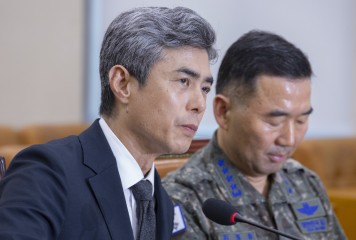
Washington’s newly released National Defense Strategy signals a recalibration of alliance roles on the Korean Peninsula, experts say, as senior US defense policymaker Elbridge Colby met with South Korean high-ranking security officials in Seoul on Monday.
Colby, a principal architect of the latest US National Defense Strategy, has been in South Korea since Sunday on a three-day visit, during which Seoul and Washington discussed alliance priorities and deterrence on the peninsula.
The Donald Trump administration released the 2026 National Defense Strategy last week as a supporting document to the National Security Strategy issued in December. The strategy places a sharper emphasis on defending the US homeland and calls on allies to shoulder a greater share of collective defense responsibilities.
In the document, the US Department of Defense states that it will seek to make it “as easy as possible for allies and partners to take on a greater share of the burden of our collective defense.”
Assessing South Korea, the strategy notes that “with its powerful military, supported by high defense spending, a robust defense industry, and mandatory conscription, South Korea is capable of taking primary responsibility for deterring North Korea." It adds that such responsibility would be assumed “with critical but more limited US support.”
Yu Ji-hoon, a research fellow at the Korea Institute for Defense Analyses and former professor of military strategy at the Republic of Korea Naval Academy, said the new strategy signals a clearer redistribution of alliance roles.
“The core of the latest National Defense Strategy is the prioritization of US homeland defense and deterrence against China, alongside a recalibration of alliance burden-sharing that places greater responsibility on allies for their own security,” Yu said.
“While North Korea remains defined as a direct threat, the United States appears to be shifting toward a more supportive and complementary role, premised on South Korea’s military capabilities, rather than assuming primary responsibility for deterrence on the peninsula.”
Yu believes this marks a clearer transition in the alliance structure.
“Rather than a US-led deterrence framework, the alliance is moving more explicitly toward a model of South Korea-led defense combined with US extended deterrence and critical support,” he said. “While the basic framework of US Forces Korea and the combined defense posture will remain intact, South Korea’s leadership and responsibility in operational planning, force employment and command-related discussions are likely to expand.”
The 2026 NDS reflects broader efforts toward what Washington has described as “alliance modernization.” Seoul would take the lead in conventional deterrence against North Korea, while the United States continues to provide extended deterrence, including nuclear protection.
The 2026 strategy also warns that the US will not fill security gaps created by what it describes as irresponsible choices by allied leaders — language analysts say underscores an expanded “America First” approach to defense policy.
For allies such as South Korea, the shift is expected to increase both strategic and financial burdens.
One notable omission in the strategy has raised concern in Seoul. While acknowledging that North Korea’s nuclear and missile capabilities continue to advance, the document does not refer to denuclearization — echoing the absence of such language in the National Security Strategy released late last year. Analysts say the dual omission may point to a shift in Washington’s policy emphasis.
On North Korea policy, Yu said the strategy reflects a more deterrence-centered approach.
“The NDS does not reject denuclearization in principle, but it no longer treats it as an immediate or visible objective,” he said. “Instead, it prioritizes managing and deterring nuclear and missile threats, which places South Korea in a position where military deterrence and response capabilities inevitably become the central pillar of policy.”
Yang Moo-jin, a professor at the University of North Korean Studies, echoed this assessment.
“The message is that South Korea will bear first-line responsibility for deterring North Korea, while the US provides decisive but limited support such as the nuclear umbrella,” Yang said. “This also implies potential adjustments to the role and scale of US forces in Korea, driven by Washington’s focus on homeland defense and strategic flexibility.”
Yang said the absence of denuclearization language suggests a shift toward managing the North Korean threat rather than resolving it outright.
“It reflects a realistic recognition of North Korea as a de facto nuclear power and leaves room for future negotiations,” he said. “By emphasizing the threat narrative while avoiding explicit denuclearization language, Washington appears to be keeping diplomatic flexibility open, including the possibility of future US-North Korea talks.”
Yang added that Pyongyang is likely to react strongly.
“North Korea can be expected to issue critical statements pushing back against what it sees as the exaggeration of its threat,” he said. “At the same time, the absence of denuclearization as a precondition could act as an incentive for dialogue, potentially increasing the chances of talks that do not center on nuclear disarmament.”
Nuclear-powered submarines as key issue
The topic of nuclear-powered submarines emerged as a key issue in the latest talks between Seoul and Washington.
Foreign Minister Cho Hyun underscored South Korea’s push to acquire nuclear-powered submarines as a step that would strengthen deterrence on the Korean Peninsula and reinforce the Korea-US alliance during talks with Colby, the US under secretary of war for policy, Seoul's Foreign Ministry said in a readout.
Colby is in South Korea this week following the Pentagon’s release of its new National Defense Strategy outlining Washington’s approach to alliance management and regional security, including the Korean Peninsula.
According to the ministry, Cho stressed during the breakfast meeting that cooperation on nuclear-powered submarines would enhance South Korea’s deterrence capabilities and strengthen the alliance. He also called for concrete follow-up steps through working-level consultations between the two sides.
“Minister Cho noted that cooperation on nuclear-powered submarines would strengthen South Korea’s deterrence capabilities and, in turn, contribute to the alliance, and called for concrete steps to be discussed through working-level talks,” the ministry said.
Colby, in response, conveyed Washington’s appreciation for South Korea’s efforts to play a more proactive role in defending the peninsula by strengthening its own defense capabilities, the ministry said.
The two officials also reviewed follow-up measures from recent Korea-US summit talks, as well as broader alliance issues and regional security concerns. Cho noted that last year’s two summits produced significant progress in outlining a reciprocal and future-oriented direction for the alliance, and emphasized the need for sustained coordination between diplomatic and defense authorities to translate those agreements into tangible outcomes.
Colby reaffirmed that the US Department of War would actively support the swift implementation of key agreements reached by the two leaders, according to the ministry.
A ministry official said both sides agreed that Seoul and Washington have maintained close coordination on Korean Peninsula issues since the early stages of the new administration, and pledged to continue cooperation to uphold a robust combined defense posture and promote peace and stability on the peninsula.
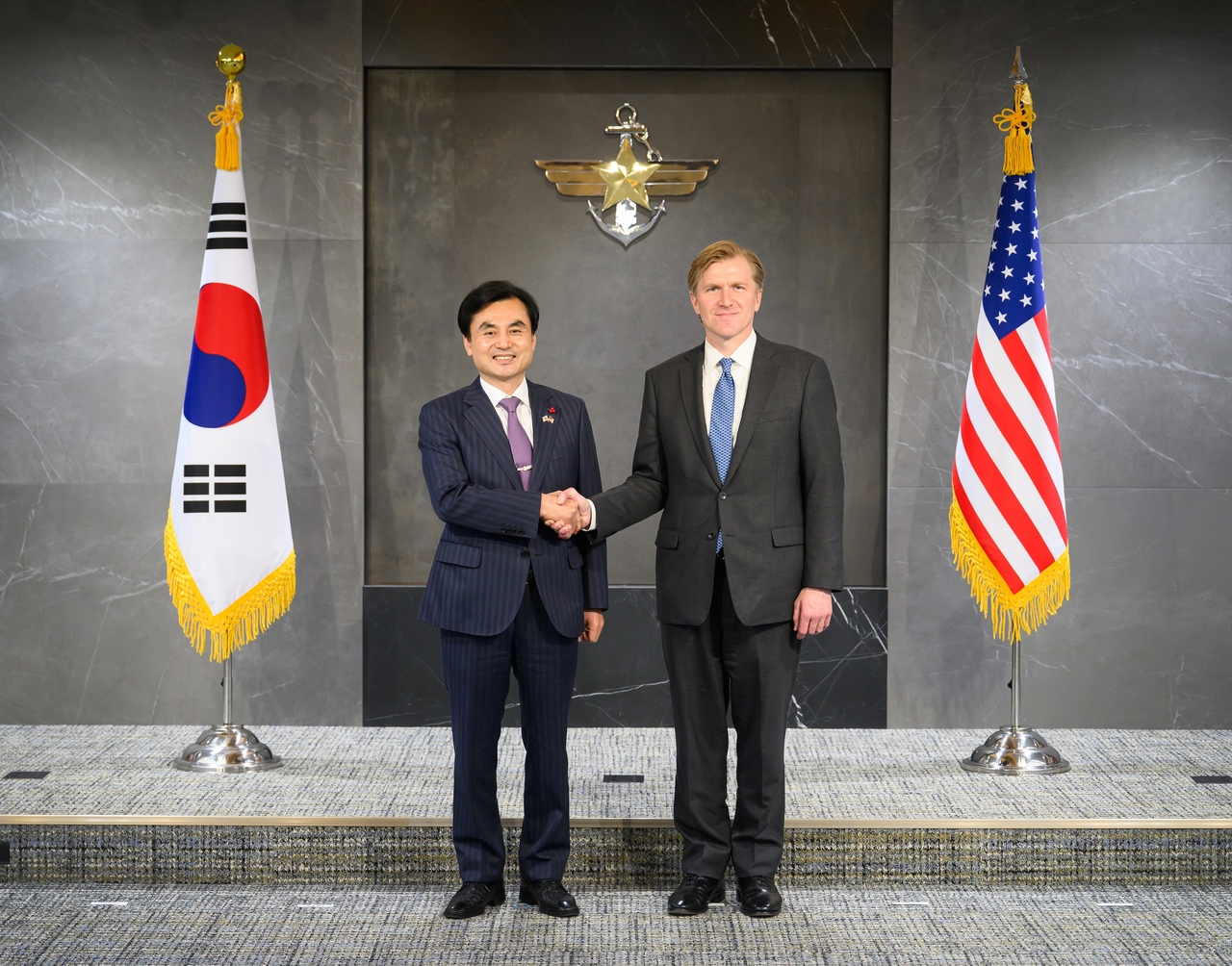
Colby later met with Defense Minister Ahn Gyu-back at the Defense Ministry in Yongsan-gu, Seoul. The two sides held in-depth discussions on the security situation on the peninsula and key alliance issues, including nuclear-powered submarines, the transfer of wartime operational control and broader efforts to strengthen South Korea’s defense capabilities.
According to the Defense Ministry, Ahn assessed the joint fact sheet agreed by President Lee Jae Myung and US President Donald Trump last year and the 57th Korea-US Security Consultative Meeting as a historic turning point in the development of the alliance, and called for 2026 to be a year focused on producing tangible outcomes in bilateral defense cooperation.
Colby noted that South Korea was the first overseas destination of his tenure, and reaffirmed Washington’s commitment to deepening defense cooperation with Seoul, describing South Korea as a model ally, the ministry said.
The two sides also shared the view that cooperation on South Korea’s nuclear-powered submarine program would strengthen the South Korean military’s leading role in the defense of the peninsula while serving as an important milestone in elevating the Korea–US military alliance, agreeing to maintain close coordination.
Ahn further stressed that the transfer of wartime operational control is essential to realizing a South Korean-led defense posture, calling for enhanced communication and cooperation — including the development of a roadmap — to accelerate progress toward meeting the required conditions.
The defense minister emphasized the importance of maintaining a robust combined defense posture to ensure peace and stability on the Korean Peninsula, outlining the government’s approach to North Korea policy based on alliance readiness, the ministry added.
At an afternoon forum hosted in Seoul on Monday by the Sejong Institute, Colby praised President Lee's decision to raise defense spending and assume greater responsibility for South Korea’s own defense, calling it a “clear-eyed and sage” response to the evolving security environment.
Colby said the move would help place the decadeslong Korea-US alliance on “sound footing” over the long term as the two sides pursue alliance modernization. He was referring to Lee’s pledge to pursue self-reliant defense and raise military spending to 3.5 percent of gross domestic product — a voluntary target aligned with Washington’s calls for allies to shoulder a greater share of the defense burden — and reiterated that US officials continue to view South Korea as a model ally.
Earlier in the day, Colby held talks with National Security Adviser Wi Sung-lac on outstanding issues concerning the bilateral alliance. While much of his itinerary remained undisclosed, he was expected to visit the largest overseas US military installation in Asia, Camp Humphreys in Pyeongtaek, Gyeonggi Province.
mkjung@heraldcorp.com