Overhaul separates policymaking and budgeting functions
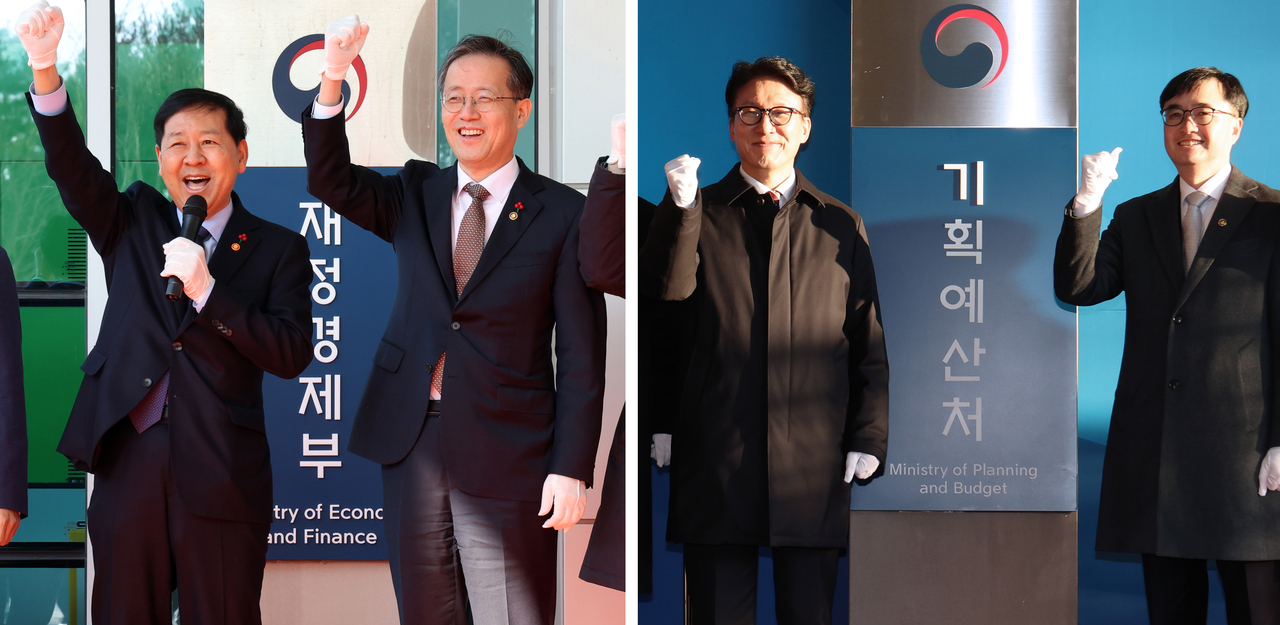
South Korea on Friday split the Ministry of Economy and Finance into two separate bodies, ending 18 years of unified control over economic policymaking and fiscal planning under a sweeping government overhaul.
The reorganization creates a new Ministry of Planning and Budget responsible for long-term economic strategy and budget coordination, while the existing Finance Ministry retains authority over taxation and fiscal management.
The two new ministries officially launched on the same day, holding signboard-hanging ceremonies at their offices in the government complex in Sejong, about 110 kilometers south of Seoul.
The restructuring marks the first separation in 18 years since the two functions were merged in February 2008 in a bid to streamline financial and economic policymaking.
President Lee Jae Myung had long called for the split, criticizing what he described as an overcentralization of authority in the Finance Ministry. As the ministry had controlled both policy planning and budget formulation, Lee even said it was “acting like a king over other ministries.”
The Finance Ministry will be led by incumbent Finance Minister Koo Yun-cheol, who also doubles as deputy prime minister for economic affairs. The revamped ministry will serve as the government’s central economic control tower, overseeing macroeconomic policymaking as well as financial and external economic affairs. Its broader remit includes managing the business cycle, exchange rates, taxation, the state treasury, public institutions and international economic relations.
“We now face the challenging yet essential goal of restoring the potential growth rate and laying the foundation for a major economic leap forward,” Koo said Friday at the ceremony. “If last year was focused on securing a recovery, this year must be one that drives full-scale growth.”
With the creation of the Ministry of Planning and Budget, the government is reinforcing its forward-planning capacity and strengthening budget coordination to support those plans. The move aims to improve integration of budgets and funds across ministries while enhancing medium- to long-term planning aligned with national policy priorities.
The Budget Ministry is affiliated with the Prime Minister’s Office, tightening central oversight of budgetary authority. Prime Minister Kim Min-seok, who attended Friday’s launch ceremony, said the ministry will “play a key role in national administration,” including the development of mid- to long-term strategies to respond to future social changes, as well as budget coordination and financial management.
Lim Ki-keun, the acting budget minister and formerly the second vice finance minister before the overhaul, said the ministry would “become a dynamic organization with a long-term perspective.”
Rushed reform clouding ambitions?
The launch comes amid lingering concerns, including that the restructuring was rushed, having taken place in just seven months into the current administration. Several senior posts at the two new ministries remain unfilled, including the budget minister position, to which former lawmaker Lee Hye-hoon has been nominated. Her confirmation hearing at parliament has yet to be held.
Lee’s nomination has itself met resistance. A longtime conservative, she has faced criticism from her political bloc for what it calls a betrayal, while supporters of the current administration have questioned whether she can provide leadership aligned with the government’s expansive, growth-focused policy agenda.
The outcome has also left questions about the Finance Ministry’s policy clout, with the overhaul ultimately scaled back from the administration’s initial blueprint. Early restructuring plans envisioned the new Finance Ministry absorbing the financial policymaking functions of the Financial Services Commission, while supervisory powers would be consolidated under the Financial Supervisory Service as a body affiliated with the Prime Minister’s Office.
That plan was shelved after strong opposition from employees at the two financial agencies, leaving the Finance Ministry without both budget authority and direct financial policymaking powers. The truncated remit has fueled doubts over whether it can function effectively as the nation’s economic control tower.
Questions also linger over whether the Finance Ministry and the new Budget Ministry can develop a coherent working relationship. Potential flashpoints include overlapping authority over taxation and budgeting, as well as possible frictions in setting short- and medium-term policy priorities, raising the risk of bureaucratic turf battles between the two bodies.
jwc@heraldcorp.com