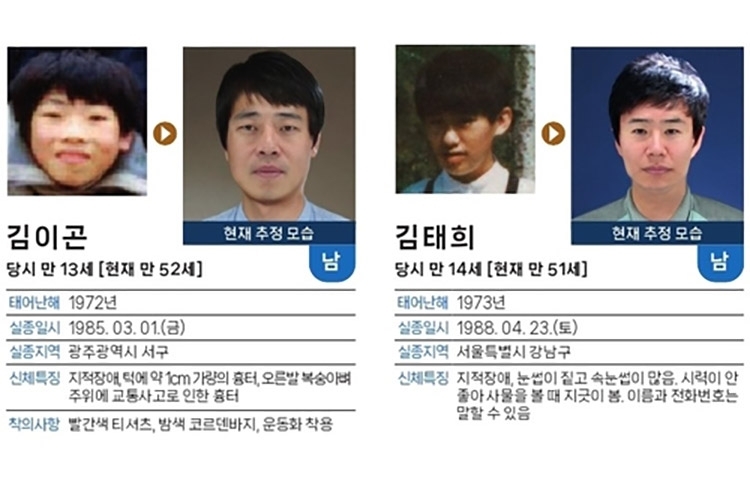
Over 90 percent of missing people in South Korea are found within a year, but 1,050 individuals who disappeared as children remain unaccounted for as of 2025.
한국에서 실종자 가운데 90% 이상은 1년 이내에 발견되지만, 어린 시절 실종된 1,050명은 2025년 현재까지도 여전히 행방이 파악되지 않고 있다.
Advances in artificial intelligence now allow authorities to generate realistic images of what these children may look like today, enabling wider distribution of posters featuring their presumed adult appearance.
인공지능 기술의 발전으로 당국은 이들이 지금이라면 어떤 모습일지를 사실적으로 구현할 수 있게 됐고, 이를 통해 추정되는 성인의 모습을 담은 전단의 배포 범위도 더욱 넓어졌다.
The state-run National Center for the Rights of the Child has produced AI-generated posters for 60 long-term missing children, using technology developed by the Korea Advanced Institute of Science and Technology.
국가아동권리보장원은 한국과학기술원(KAIST)이 개발한 기술을 활용해 장기 실종아동 60명의 AI 기반 전단을 제작했다.
According to KAIST, the program analyzes typical age-progression patterns and applies them to the child’s last known photo to produce an image of their likely adult face.
KAIST에 따르면 이 프로그램은 일반적인 얼굴 노화 패턴을 분석해 아동의 마지막 사진에 적용함으로써 성인이 되었을 때의 얼굴을 예측한다.
One example is Kim I-gon, born in 1972 and missing since 1985. Using a photo of him at age 13, the system generated an image of what he might look like at 52, with a squared jaw and visible wrinkles.
대표적 사례로 1972년생 김이곤 군은 1985년 실종됐다. 당시 13세였던 그의 사진을 토대로 시스템은 턱선이 각지고 주름이 뚜렷한 52세의 예상 모습을 생성했다.
The NCRC’s project is jointly carried out with the National Police Agency and the Ministry of Health and Welfare, and officials say the updated posters have occasionally prompted new public reports and tips.
이 사업은 경찰청과 보건복지부가 함께 추진하고 있으며, 관계자들은 최신화된 전단이 새로운 제보를 이끌어내는 경우도 있다고 설명한다.
Korea is not alone in deploying such technology.
이 같은 기술을 활용하는 국가는 한국만이 아니다.
Similar efforts are underway in Argentina, which recently used AI to re-create the adult faces of children who disappeared during the military dictatorship four decades ago.
아르헨티나 역시 최근 40여 년 전 군사독재 시기 실종된 아동들의 성인 모습을 AI로 재현하는 작업을 진행 중이다.
KAIST developed Korea’s age-progression system in 2015, but officials say it has taken a “major leap” since the addition of super-resolution imaging.
한국의 얼굴 노화 예측 시스템은 2015년 KAIST가 개발했으며, 초해상도 기술을 도입한 이후 “큰 도약”을 이뤘다는 평가를 받고 있다.
The NCRC has also used AI for other long-term missing-child campaigns, including its “Runway to Home” project announced in October.
국가아동권리보장원은 지난 10월 발표한 ‘런웨이 투 홈(Runway to Home)’ 등 다른 장기 실종아동 캠페인에도 AI 기술을 활용해왔다.
The initiative re-creates video of the missing person walking on a virtual runway — both as a child and as an adult — to intuitively visualize how their appearance may have changed and spark renewed public interest.
이 캠페인은 실종자가 가상 런웨이를 걷는 모습을 아동기와 성인 모습으로 각각 구현해, 시간에 따른 외형 변화를 직관적으로 보여주고 대중의 관심을 다시 환기시키는 것을 목표로 한다.
Tip
1. unaccounted for — 소재가 파악되지 않은, 행방불명인
2. authorities — 당국, 관계자
3. distribution — 배포
4. presumed — 추정되는, 상정된
5. analyzes — 분석하다
6. visible — 눈에 띄는, 뚜렷한
7. prompted — 촉발하다, 유도하다
8. intuitively — 직관적으로
khnews@heraldcorp.com