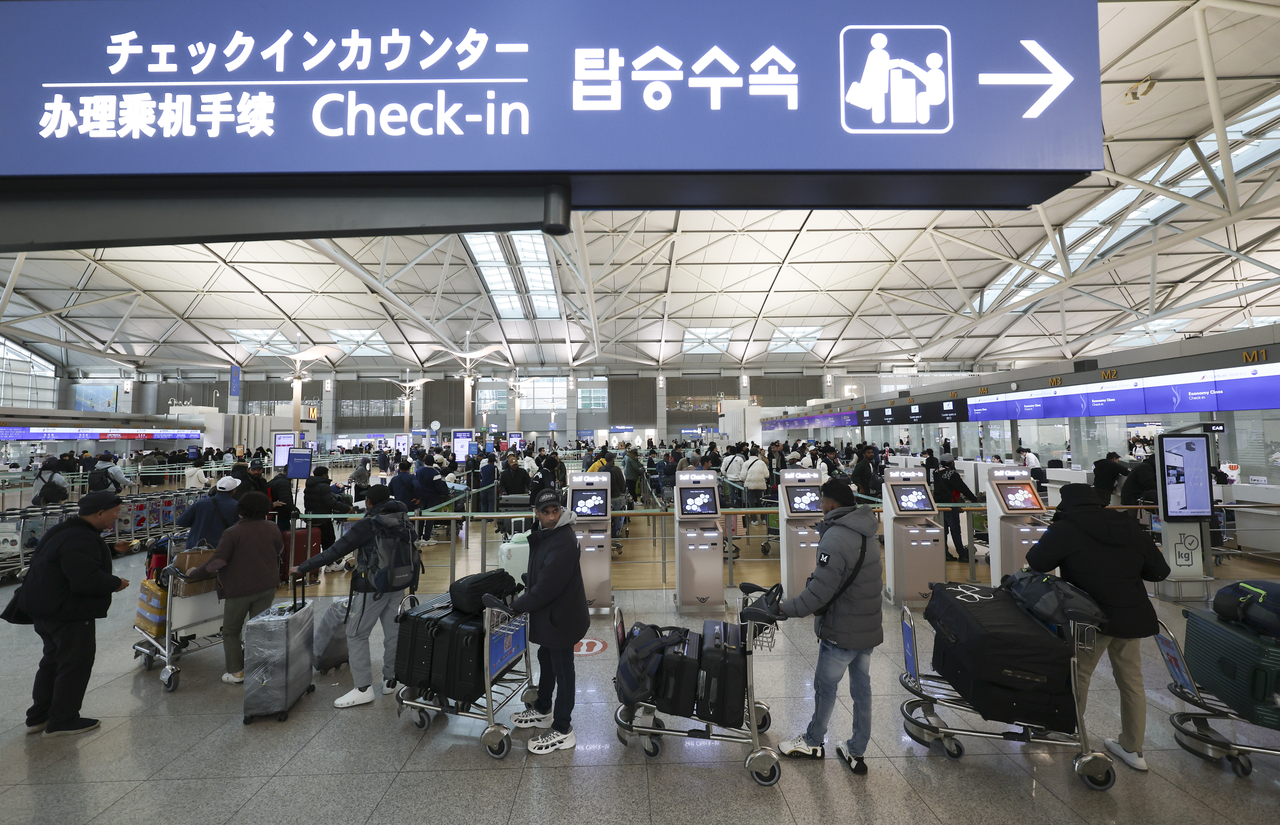
Incheon International Airport Corp. said Tuesday that it has nearly restored revenue to prepandemic levels amid record international passenger traffic, with total revenue projected to hit a new high in the coming year.
According to the corporation, revenue for 2025 is estimated at 2.73 trillion won ($1.85 billion), up 7 percent from 2024 and equivalent to 99.1 percent of its 2019 peak. For next year, the operator projects record revenue of 2.79 trillion won.
Passenger volumes are also set to reach new highs. Total passenger traffic is estimated at 74.04 million this year, while international passenger numbers are projected to rise about 4 percent from a previous high of 70.67 million in 2024. International passenger traffic is forecast to rise another 2 percent to 75.07 million in 2026.
As a new growth engine, IIAC highlighted its expanding overseas operations, which export Korean expertise in airport construction, operations and digital systems.
Its international business generated a record 64.1 billion won in revenue, up 38 percent from a year earlier, driven by seven overseas airport projects, including its first public-private partnership airport development at Uzbekistan’s Urgench Airport.
A central pillar of Incheon’s transformation is the buildout of an artificial intelligence hub designed to integrate AI into aviation operations. The planned complex will include an AI data center, research and development facilities and a business incubation center, supporting the full life cycle of aviation AI solutions from development to commercialization.
“Incheon Airport built the foundation of an AI-driven ecosystem this year and achieved record overseas revenue,” IIAC CEO Lee Hak-jae said. “Next year, we will continue to focus on safe and stable operations, as well as exporting the K-airport model and developing advanced aviation clusters to lead the next phase of airport innovation.”
IIAC is also investing in advanced air mobility infrastructure while expanding renewable energy capacity to meet global carbon-reduction requirements.
Operational efficiency is expected to improve further as airlines are reallocated between terminals. With Asiana Airlines set to move to Terminal 2 in January 2026, following Air Busan and Air Seoul, the share of passengers using Terminal 1 is projected to fall from 66 percent to 49 percent of the total.
minmin@heraldcorp.com