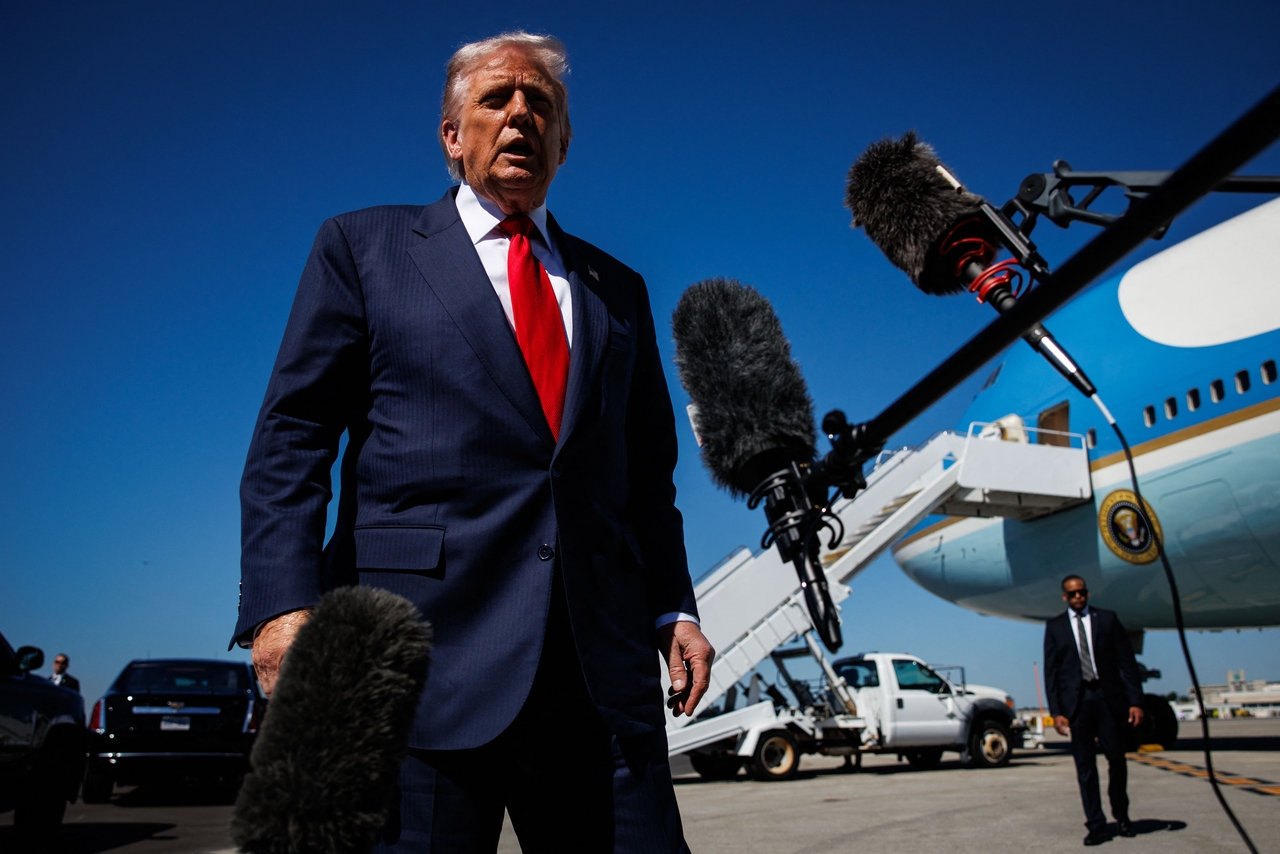
The Trump administration has announced new sanctions on North Korea, tightening pressure after US President Donald Trump’s trip to South Korea ended without a long-sought meeting with North Korean leader Kim Jong-un.
The US Treasury Department on Tuesday announced sanctions on two North Korean financial institutions and eight individuals for helping the regime launder funds obtained through illicit schemes, including cybercrime and overseas IT worker fraud.
“North Korean state-sponsored hackers steal and launder money to fund the regime’s nuclear weapons program,” US Under Secretary of the Treasury for Terrorism and Financial Intelligence John Hurley said in a statement.
Hurley underscored that the "Treasury will continue to pursue the facilitators and enablers behind these schemes to cut off the DPRK’s illicit revenue streams," referring to North Korea by its official name, the Democratic People's Republic of Korea.
The Treasury Department imposed sanctions on Korea Mangyongdae Computer Technology Company, a North Korea-based IT firm with IT workers in China, and on Ryujong Credit Bank, a North Korea-based financial institution that has facilitated sanctions evasion activities by China and North Korea.
North Korean individuals blacklisted include U Yong-su, president of the Korea Mangyongdae Computer Technology Company, as well as bankers Jang Kuk-chol and Ho Jong-son, who facilitated illicit fund transfers, including about $5.3 million in cryptocurrency linked to ransomware and North Korea’s overseas IT worker operations.
The Treasury Department also targeted Ho Yong-chol, Han Hong-gil, Jong Sung-hyok, Choe Chun-pom and Ri Jin-hyok, described as North Korean financial representatives operating in China and Russia.
In a coordinated move, the US State Department said Monday that Washington will seek additional penalties in the coming days through the UN Security Council’s 1718 Sanctions Committee, Reuters reported, citing an unnamed State Department official.
The State Department said it would request sanctions on seven vessels accused of smuggling North Korean coal and iron ore to China — trade typically estimated to generate $200 million to $400 million annually for the Kim regime.
The official notably disclosed that "These nominations are not just bureaucratic exercises."
"They’re about ensuring accountability for UN sanctions violations and stopping exports that directly fund North Korea’s nuclear and ballistic missile programs," the official added.
If the proposal is approved by the UN sanctions committee, the vessels could face asset freezes, port-entry bans and deregistration by their flag states. Approval is unlikely, however, as it requires consensus among the committee's 15 members, including veto-wielding permanent members Russia and China.
Washington’s latest move to impose sanctions on North Korea came after a long-anticipated Trump-Kim meeting failed to materialize.
Trump repeatedly extended public overtures to Kim in hopes of reviving dialogue that has been virtually frozen since their third and last meeting in June 2019, ahead of his two-day trip to Gyeongju, North Gyeongsang Province, for the Asia-Pacific Economic Cooperation summit.
However, hours before Trump arrived in South Korea on Oct. 29, North Korean state media responded to his olive branch by announcing that Pyongyang had test-fired sea-to-surface cruise missiles into its western waters the previous day.
Despite the setback, Trump signaled he remained open to dialogue, telling reporters before departing South Korea on Oct. 30, “We’ll come back, and at some point in the not-too-distant future, we’ll meet with North Korea.”
South Korea’s National Intelligence Service assessed that Kim is likely considering dialogue with Washington “when the right conditions are met,” Rep. Lee Seong-kweun of the main opposition People Power Party told reporters Tuesday after attending a closed-door briefing by the agency.
“Although the North Korea-US summit did not take place, various indications have confirmed that Pyongyang had been preparing for dialogue with the US behind the scenes,” Lee said, citing the NIS briefing.
dagyumji@heraldcorp.com