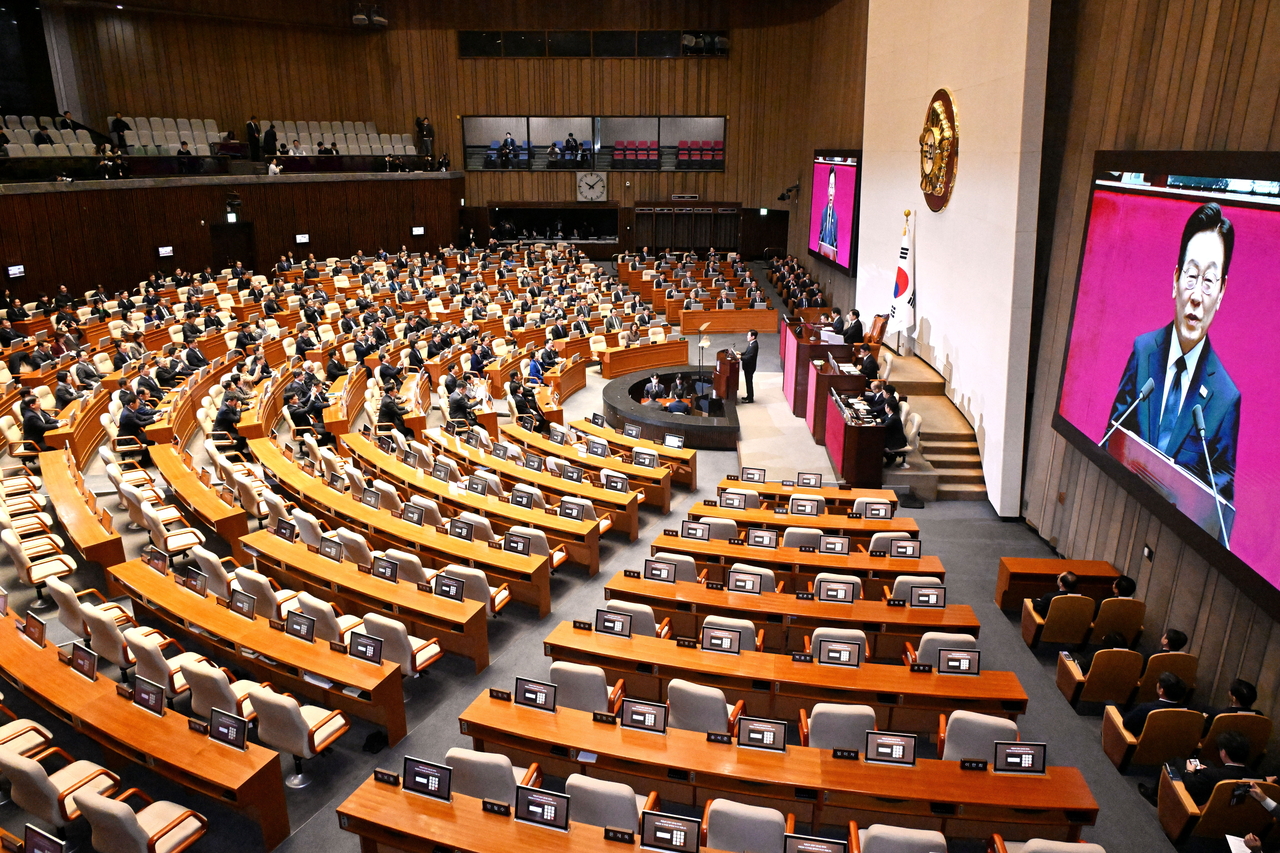
President Lee Jae Myung said Tuesday that South Korea will step up plans to build a self-reliant military by significantly bolstering its defense capabilities, while continuing efforts to resume talks with North Korea.
"We will significantly strengthen our national defense capabilities and make sure to realize our hope for self-reliant defense," Lee told a budget speech, saying "our people's pride" will be undermined if South Korea continues to rely on foreign nations over its defense capabilities.
In particular, Lee said South Korea aims to turn its defense force into a "smart and strong" military by using artificial intelligence technology.
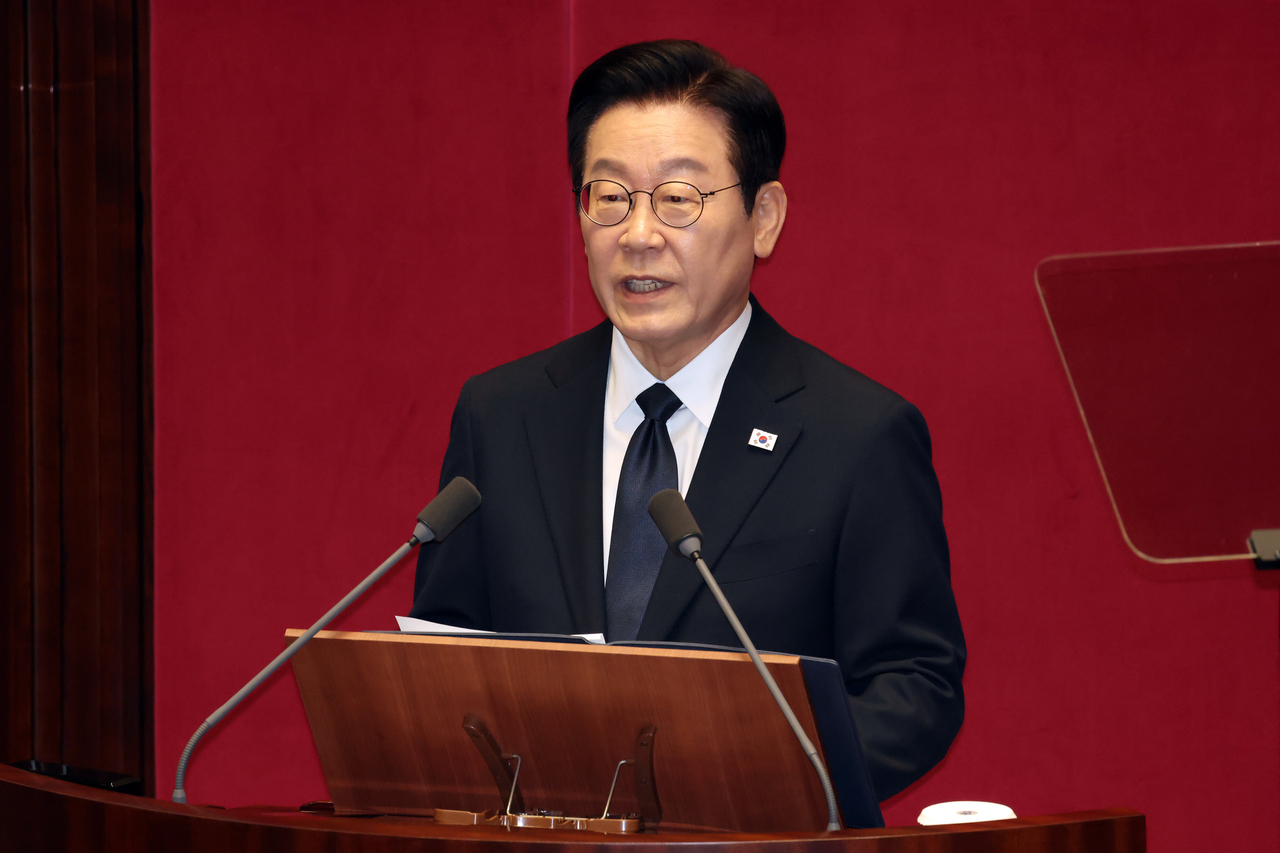
On relations with North Korea, Lee reiterated his commitment to build peace on the Korean Peninsula.
"We will make bold efforts to restore inter-Korean trust and create the conditions for dialogue," he said.
Lee said his government will continue efforts to ease military tension across the border and open a new era through his END initiative, which focuses on "exchanges," "normalization" and "denuclearization."
Since taking office in June, Lee has offered dialogue with North Korea, but Pyongyang has so far remained unresponsive to his overtures.
Last week, Lee asked Trump to allow South Korea to have fuel for nuclear-powered submarines. In return, Trump gave approval to South Korea to build nuclear-powered submarines in a US shipyard owned by South Korea's Hanwha Ocean.
Without mentioning Trump's approval of nuclear-powered submarines, Lee cited "progress" in talks with the US on the supply of fuel for nuclear-powered submarines.
"Progress in consultations on the supply of nuclear fuel for nuclear-powered submarines has strengthened the foundation for self-reliant defense," Lee said.
A tariff deal with the US that was finalized last week has eased economic uncertainties, Lee said.
Lee said South Korea's tariff deal with the US secured tariff levels equivalent to those of competing countries in key export sectors, such as automobiles and semiconductors, establishing a foundation for fair competition on "a level playing field."
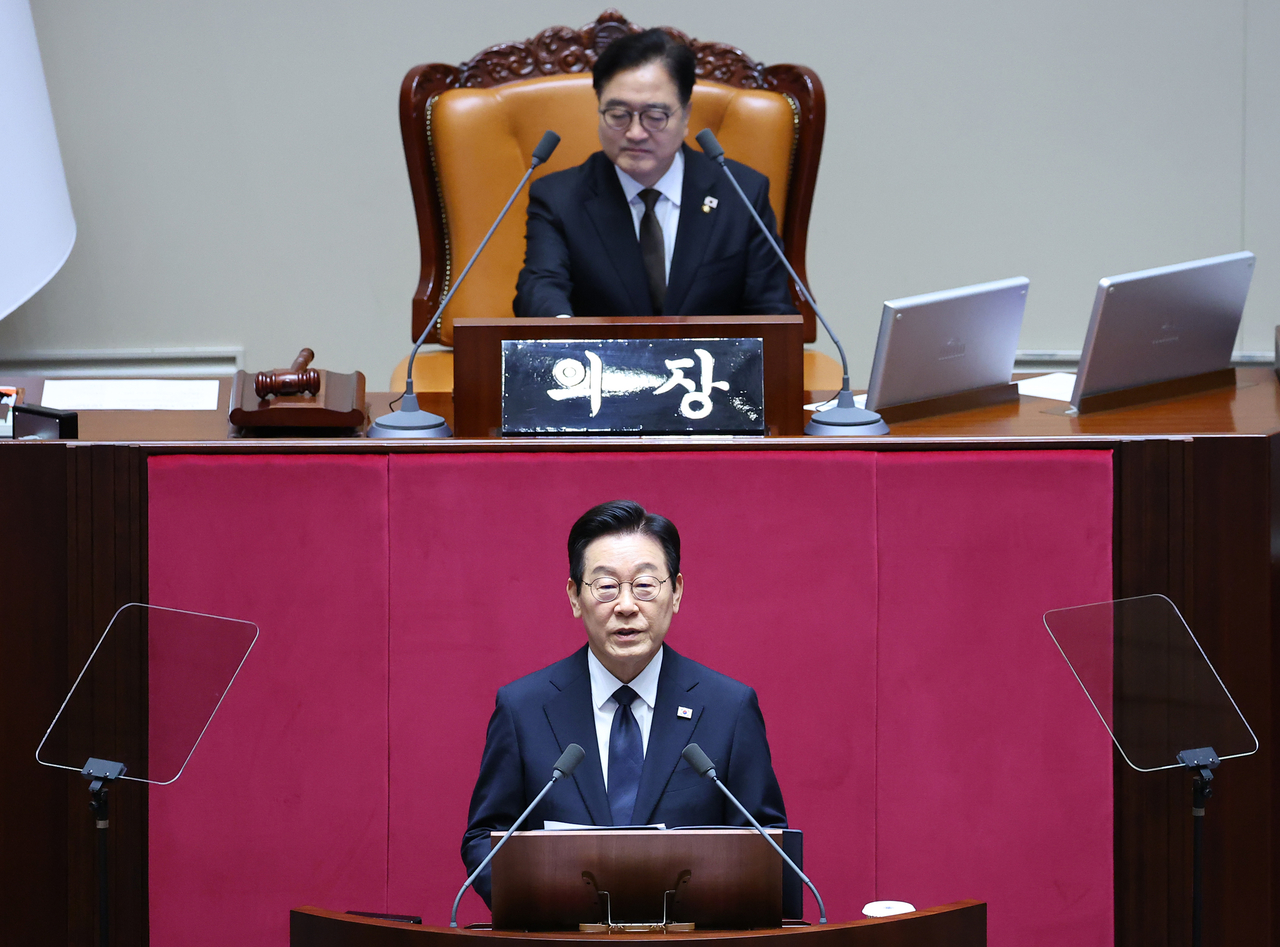
Through his first summit with Chinese President Xi Jinping, Lee said Seoul and Beijing "fully restored" the bilateral relations and agreed to work together as "strategic cooperative partners" on a path of "pragmatism and mutual benefit."
On the sidelines of the summit, South Korea and China signed a currency swap line worth up to 70 trillion won ($48.6 billion) as well as six other memorandums of understandings, including economic agreements and joint efforts to combat transnational crimes.
During the Asia-Pacific Economic Cooperation gathering last week, Lee said all-out diplomatic efforts yielded the best possible outcomes under tough conditions.
"We put in our utmost efforts, even pouring out our heart and soul, to achieve the best possible outcome even under the worst circumstances," Lee said. "Going forward, the government will continue to strengthen the nation's power and elevate its standing through pragmatic diplomacy centered on the national interest."
During the speech for his administration's first annual budget, Lee outlined a 728 trillion-won spending plan for 2026, up 8.1 percent from this year, highlighting full-scale investment in the AI industry.
"(The government) will significantly expand investment to open the era of AI and lay the ground for future growth," he said.
Lee said the government earmarked 10.1 trillion won for AI transformation to help South Korea become one of the world's top three AI powers, sharply up from 3.3 trillion won this year.
Investment in research and development across strategic industries -- including AI, content and defense -- surged 19.3 percent from this year to a record high of 35.3 trillion won.
Lee said the government will purchase an additional 15,000 graphics processing units, key chips used to train and operate AI models, to reach its target of 35,000 units ahead of schedule.
The government plans to create a 150 trillion-won public-private fund over the next five years to nurture strategic industries driving economic growth.
For defense, the government allocated 66.3 trillion won, up 8.2 percent from this year, to upgrade conventional weapon systems into cutting-edge capabilities and accelerate the realization of "self-reliant defense."
"Relying on external force for our defense is a matter that hurts national pride," said Lee, who has pledged to retake the wartime operational control from Washington within his term, which ends in 2030.
Lee asked for bipartisan cooperation to pass the annual budget within the legal deadline, set for Dec. 2.
The main opposition People Power Party boycotted Lee's speech in protest of a special counsel team's decision to seek an arrest warrant for one of its lawmakers involved in former President Yoon Suk Yeol's martial law bid. (Yonhap)