Scholars reiterate claims that capital city of ancient Silla Kingdom was 'starting point' of Silk Road
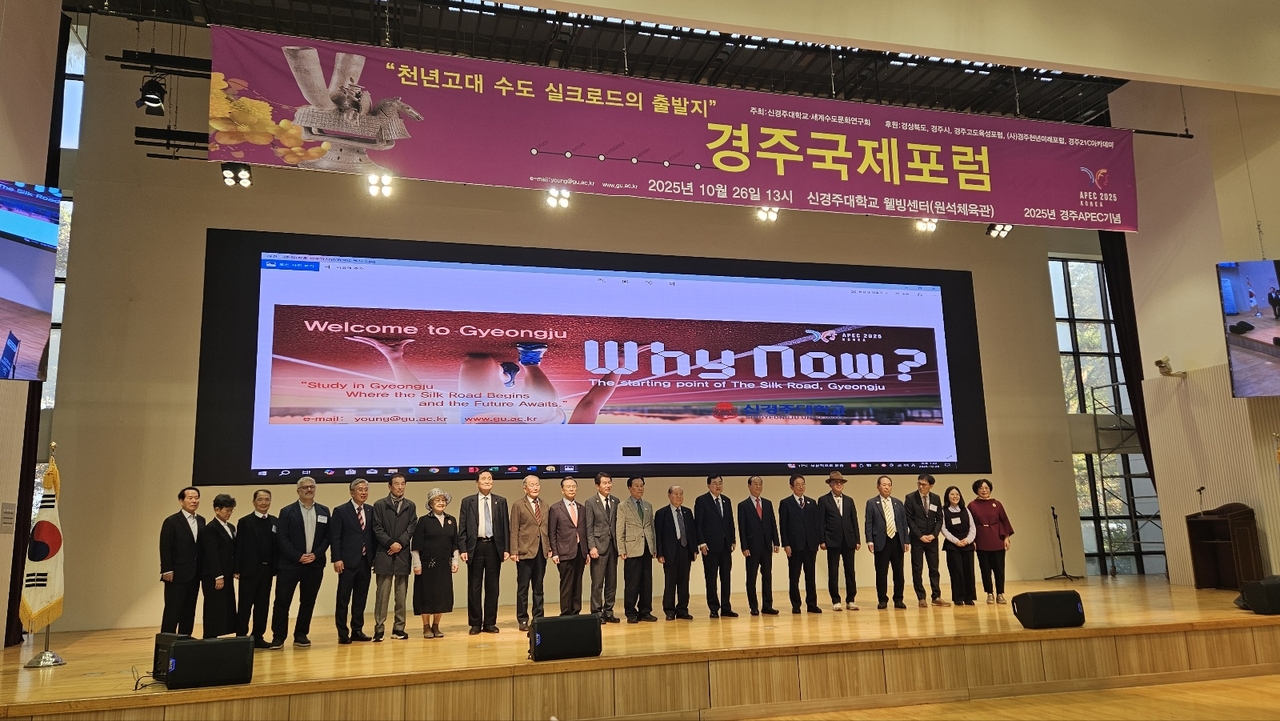
In commemoration of the Asia-Pacific Economic Cooperation summit, which opened Thursday in the southeastern city of Gyeongju, a forum was held Sunday to discuss the city's value as a UNESCO-designated cultural heritage site and its place in the ancient network of economic and cultural exchange between the East and West known as the Silk Road.
Scholars from around the world and local citizens participated in the forum "The Starting Point of the Silk Road, Gyeongju," held at Singyeongju University in Gyeongju, North Gyeongsang Province.
One of the speakers was Marco Malagodi, associate professor at the University of Pavia's department of musicology and cultural heritage, who spoke on the theme of Gyeongju -- then called Seorabeol -- being the starting point on the eastern end of the Silk Road.
He said there is significant evidence that the capital city of the Silla Kingdom (57 BC-AD 936) was part of the Silk Road, pointing to the styles of cultural assets found in Gyeongju, the Chinese city of Xi'an -- then called Chang'an -- Rome, and Istanbul. Malagodi said international exchanges through the Silk Road contributed to Silla's culture.
There have been claims in academic circles that the Silk Road -- previously thought to have stretched from Europe, through the Middle East to Xi'an -- actually extended to Gyeongju. Roman-style glassware and other artifacts from the Silla era have been uncovered in Gyeongju, which is thought to indicate that Silla had directly traded with the West through the Silk Road.
The forum also discussed how Gyeongju and the cultural heritage of Silla are an inspiration to contemporary society. The Gyeongju Historic Areas were inscribed as a UNESCO World Heritage Site in 2000.
The speakers also said Silla's hwabaek system -- a council of nobles -- can be considered a forerunner to democratic decision-making.
"The history and culture of Gyeongju, the capital of Silla for 1,000 years, holds lessons that can enable countries around the world to overcome their difficulties and achieve prosperity. Even in the tribal era, Silla elected its first king through the hwabaek system, a forerunner of democracy," said Singyeongju University's President Kim Il-yun. "We must focus on the history and culture of the ancient capital of Gyeongju, which was the root of a kingdom that lasted a thousand years."
Lee Cheol-woo, the governor of North Gyeongsang Province, stressed that Gyeongju holds many cultural assets and state-designated treasures. He said the forum would serve as an opportunity to promote the cultural heritage of the city to the international community.
The forum was co-hosted by Singyeongju University and the World Capital Culture Research Association, and was endorsed by the city government of Gyeongju and the government of North Gyeongsang Province.
minsikyoon@heraldcorp.com