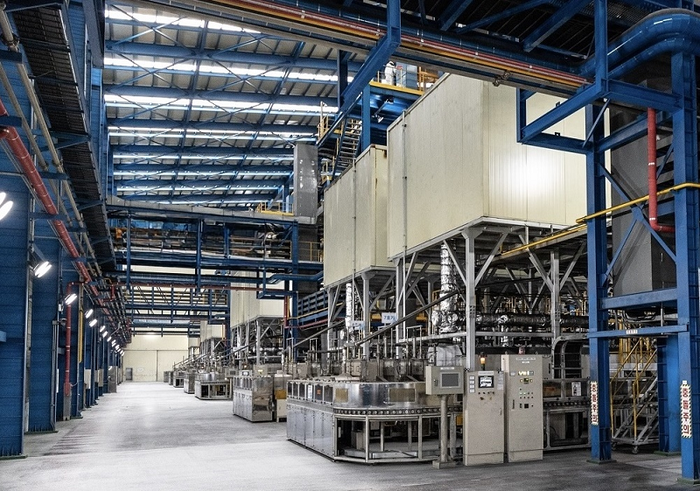
Posco Future M, the battery materials arm of Posco Group, has secured its largest-ever anode materials supply contract, worth 671 billion won ($468.3 million), with a global automaker.
According to Posco Future M’s regulatory filing on Tuesday, the company will supply natural graphite anode materials over four years from October 2027 to September 2031. The contract includes an option to extend through 2037 by mutual agreement, which could raise the total value to 1.7 trillion won. The client’s name remains undisclosed under confidentiality terms.
While battery material firms typically supply anode materials to battery cell manufacturers, a growing number of global automakers are now pursuing direct partnerships with material suppliers to secure upstream resources. This shift is largely driven by supply chain glitches and the US-led push to reduce reliance on Chinese materials.
“There are generally two types of battery material procurement by automakers,” said an industry source familiar with the matter on condition of anonymity.
“One is a ‘consignment supply’ arrangement, where the carmaker directly purchases anode materials and provides them to its battery manufacturer. The other involves using the materials for production within the automaker’s own battery subsidiary.”
For instance, major US automakers — including Tesla, General Motors and Ford Motor Company — have been entering direct supply agreements and forming joint ventures to secure upstream cathode and anode materials for their electric vehicle batteries.
Industry watchers indicated that Posco Group’s efforts to build a China-independent battery material supply chain have become increasingly critical, as Washington imposes steep tariffs on Chinese anode materials and Beijing retaliates with new export controls on batteries and key components.
While Posco Future M currently reprocesses spherical graphite, an intermediate material for producing lithium-ion battery anodes, imported from China at its Sejong plant, the company aims to phase out these Chinese intermediates entirely by 2027.
According to media reports, the newly signed anode material order will be produced at Posco Future M’s spherical graphite processing plant, which is currently under construction in the Saemangeum National Industrial Complex in North Jeolla Province. The facility will use natural graphite sourced from countries in Africa.
Having long faced challenges competing with low-cost Chinese anode materials, sources said the rising demand for non-Chinese alternatives is expected to boost Posco Future M’s sales and profits.
Chinese anode materials are priced at roughly $2 per kilogram, approximately 40-50 percent lower than Posco Future M’s products. The intense price competition has driven the utilization rate at the company’s Sejong plant down from 67 percent in 2022 to around 30 percent in the first half of this year, leading to losses amounting to hundreds of billions of won.
SNE Research, a Seoul-based market tracker, reported that Chinese firms dominated the global anode material market last year, claiming the top 10 positions by shipment volume with a combined market share exceeding 80 percent. Posco Future M placed 11th with a 1.3 percent share, standing as the highest-ranked non-Chinese supplier.
hyejin2@heraldcorp.com