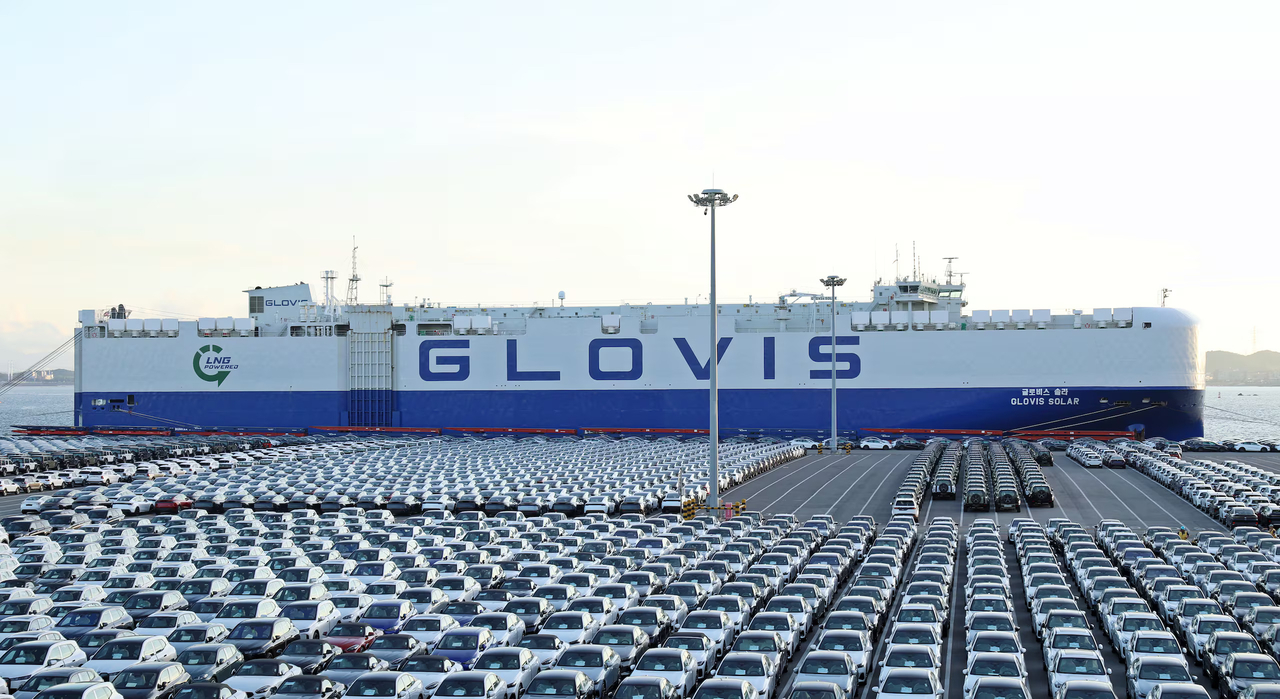
Hyundai Motor and Kia are facing mounting cost pressures in the US market as Washington begins imposing a new port entry fee on foreign-built vehicle carriers, adding to the burden of the 25 percent import tariff.
Starting Tuesday, the US will collect a $46-per-net-ton entry fee on all non-US-built vehicle carriers entering American ports under a Section 301 action announced by the US Trade Representative in April. The measure aims to protect the domestic shipbuilding industry from Chinese competition.
Following a request from Seoul, US authorities agreed to cap the charge at five entries per ship per year, but rejected Korea’s proposal to exempt Chinese-built vessels. Fee collection begins Dec. 10.
The policy directly affects Hyundai Glovis, which transports Hyundai and Kia vehicles from Korea to the US using a fleet of about 30 non-US-built ships. With roughly 160–170 voyages annually, each 18,000-ton vessel could incur up to $4.1 million in additional yearly costs — or about $120 per car — according to industry estimates.
“There are alternatives such as container shipping, but they are impractical for new cars,” said Kim Pil-su, automotive engineering professor at Daelim University. “This signals that the US favors vehicles built domestically.”
Hyundai Glovis said it would seek to minimize the impact by improving loading efficiency and working with other shippers, automakers and government agencies.
The new levy comes as Korean automakers already face a 25 percent US import tariff. Despite a bilateral deal in July to reduce the rate to 15 percent, Washington has yet to implement the change. Korea is continuing talks on a $350 billion investment plan linked to the tariff reduction, while Japan and the EU have already secured 15 percent rates.
Experts warn that Korean automakers will likely have to absorb most of the new costs, given limited room to raise prices in a slowing US market.
“The entry fee applies to ships from all countries except the US, and resistance is limited due to fears of retaliation,” said Lee Hang-gu, senior researcher at the Korea Automotive Technology Institute. “With car prices already high and demand expected to soften, automakers are effectively in a wait-and-see position.”
forestjs@heraldcorp.com