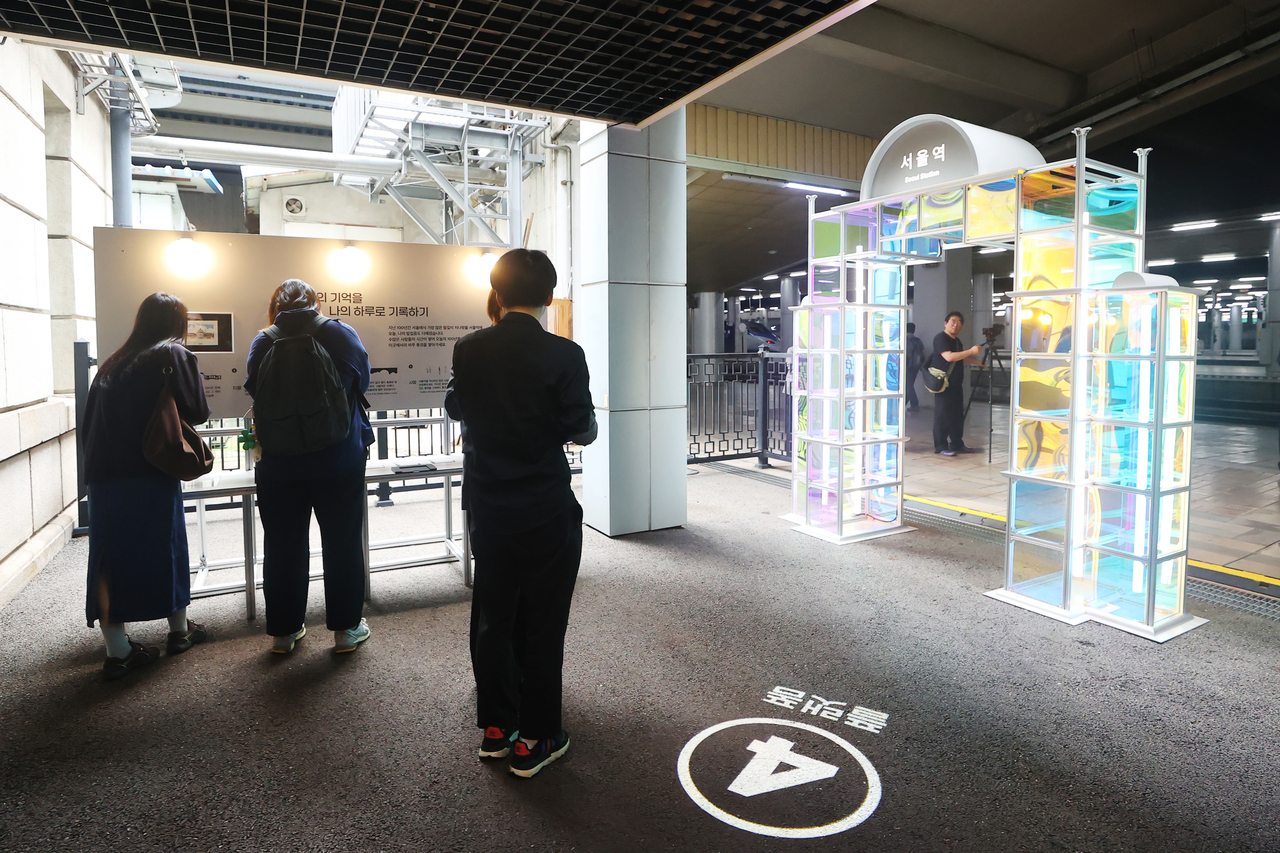
Tucked away in a back corner of the former Seoul Station, a flight of stairs leads to a weathered green wooden door. Beyond it, a neon archway glows, opening into "Platform 4" — a hidden area of the 100-year-old building that had long been closed to the public.
This long-abandoned train platform has been reopened as part of a special exhibition that opened on Sept. 30 to commemorate Seoul Station's centennial, under the theme “Seoul Station’s Past, Present and Future.”
“It was really cool to see how the station developed throughout the years,” said Park, a 21-year-old university student visiting the site on Oct. 2.
A walk into the past
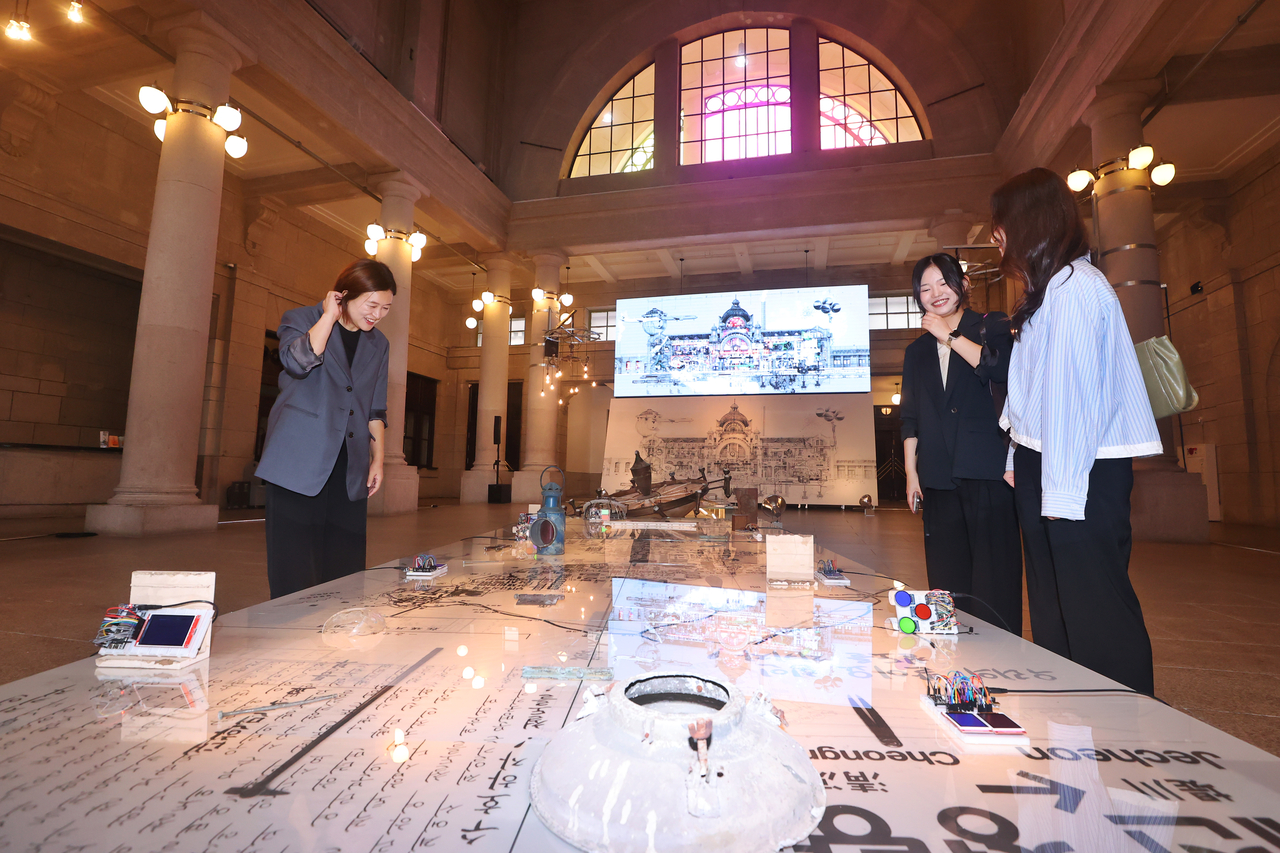
Walking into the building, visitors are met with a tall ceiling and a ticket booth with old handwritten signs.
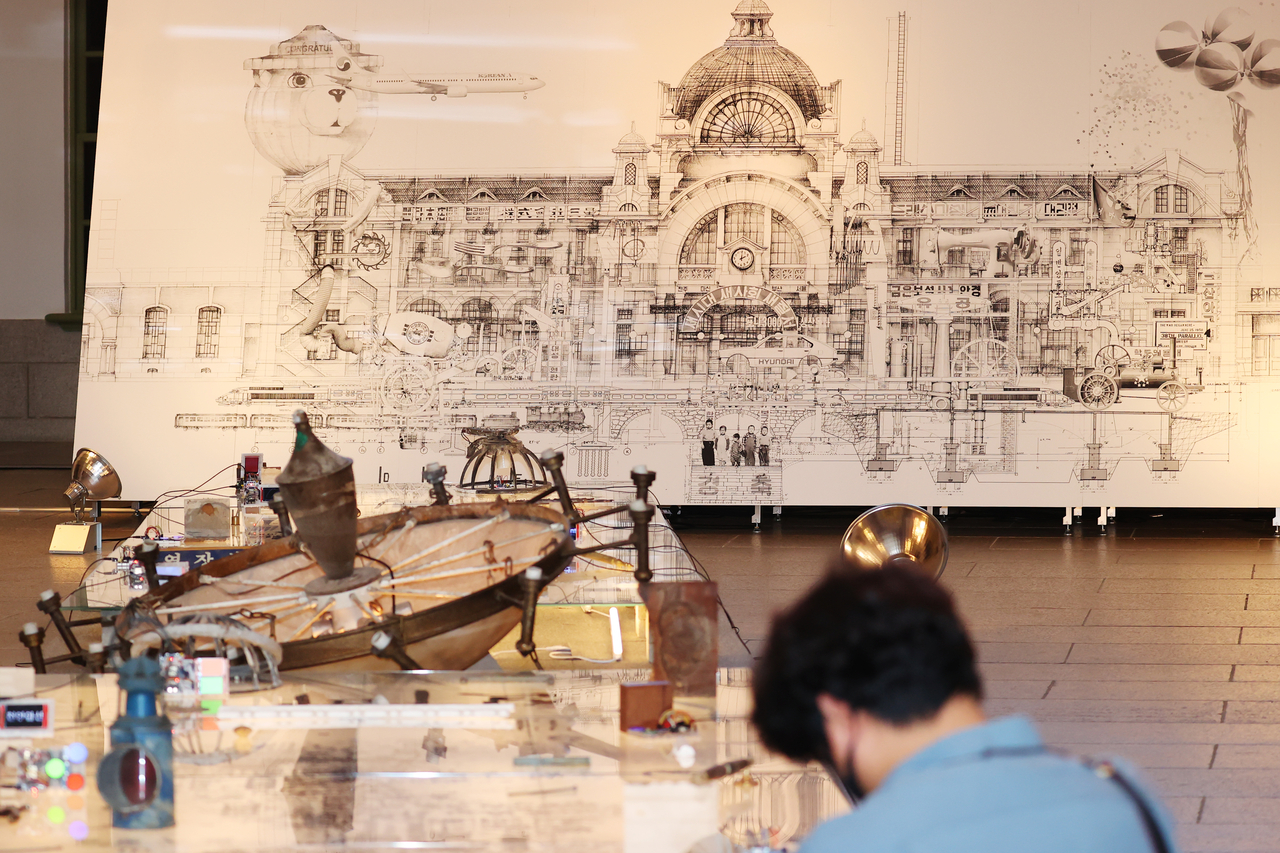
Built in 1925 during the Japanese colonial era, the station, then called “Gyeongseong Station," served as Korea’s main transport hub. The building was designed in a neo-Renaissance style, blending concrete, steel, brick and stone, and features a Byzantine-style central dome. It was initially meant to match Tokyo Station in size, but plans were scaled back due to budget shortages after Japan’s 1923 Kanto earthquake.
Remnants of that era remain. Visitors can step inside rooms once used as barber shops, VIP lounges and Western-style restaurants. Among them is The Grill, which operated for 96 years on the station’s second floor and was one of the first places in Korea to serve Western cuisine. Frequented by artists, poets and Japanese officials, dining there in the 1920s would cost the equivalent of about 150,000 won ($107) today.
The former coach-class waiting room now houses photographs and artworks depicting the station’s early years. In the western hallway, video footage and images trace its role as a landmark after Korea’s liberation in 1945, from vaccination drives in the 1960s to a gathering place in the 1970s where young people drank beer, sang songs and played guitar through the night.
Present and future
The old station was reborn as a cultural venue in 2004, when a new facility was built next door to accommodate Korea’s bullet train, the KTX.
The ongoing centennial exhibition also lets visitors experience the building’s more recent history: The former first and second-class waiting rooms now serve coffee and beer once sold at the station, while the old women’s waiting room features music inspired by the site. The former stationmaster’s office highlights famous figures who passed through its halls.
One striking feature is the basement hallway, unveiled to the public for the first time. Its weathered walls lead to a futuristic neon archway, behind which the sleek KTX platforms to Busan come into view -- a deliberate contrast meant to symbolize the station’s journey from past to future. The Culture Ministry is considering keeping the hallway open in 2026, after the exhibition ends.
The exhibition also showcases the only surviving manuscript of the first Korean dictionary. Compiled in secret by the Korean Language Society in 1929 under colonial rule, the dictionary was seized by Japanese authorities. The manuscript was rediscovered in the station’s storage unit after liberation in 1945.
“The Seoul Station was created by the Japanese, but it was filled and developed by Korea,” said curator Myung Ji-eun. “It has witnessed the twists and turns of Korea’s modern history.”
Kim Young-soo, first vice minister of culture, sports and tourism, hopes the exhibition "helps people recall the architectural and social value of the old Seoul Station, an important heritage that has grown together with Korea’s modern history as a transportation hub.”
The exhibition runs through Nov. 30 and is free of charge.
seungku99@heraldcorp.com