Ruling party, government agree on 110 priority reforms to ease economic penalties, including ending criminal punishment for breach of trust
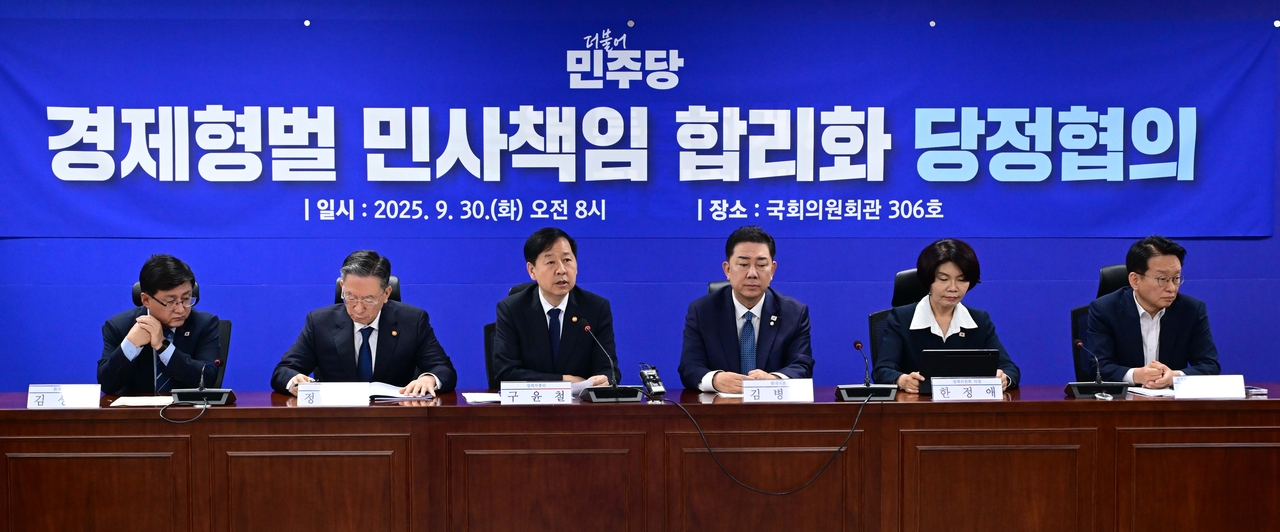
The government and the ruling Democratic Party of Korea on Tuesday agreed to push for abolishing breach of trust as a criminal offense, in a bid to ease excessive legal risks that hinder normal business decisions.
The announcement came during a party-government council at the National Assembly, led by a government task force on rationalizing economic penalties and attended by the finance and justice ministers.
“The breach of trust offense has long been criticized for its vague requirements and broad scope, which undermine normal corporate management,” said Rep. Kwon Chil-seung, head of the task force. “To address this, we plan to pursue abolition under the Criminal Act as the baseline, while preparing reasonable alternatives to prevent any legislative gap.”
The decision is part of the task force’s first-stage plan to streamline penalties for economic crimes. President Lee Jae Myung launched the team in July to ease excessive corporate sanctions and spur investment. The body has since been working toward addressing about 30 percent of the government’s roughly 6,000 economic crime provisions within the coming year.
Breach of trust applies when executives or employees violate their duty of good faith for personal gain or cause losses. South Korea is one of few countries that treats such a breach as a crime, carrying some of the toughest penalties. Under the Criminal Act and Commercial Act, confirmed cases can result in up to 10 years in prison or a fine of 30 million won ($21,400). For cases involving more than 5 billion won, aggravated punishment mandates at least five years in prison.
The government said it will clarify the requirements for breach of trust through expert consultations and narrow the scope of punishment.
Breach of trust is among 110 economic crime provisions the task force said Tuesday it will prioritize in its rationalization push. “These measures are aimed at protecting entrepreneurs who make normal management decisions or fulfill their duty of care,” Kwon said. “We will ensure such business owners are not subject to criminal punishment.”
The reforms seek to ease liability risks for business operators by shifting the focus toward financial accountability, while replacing prison terms or criminal penalties with fines for minor violations or regulatory lapses.
The business community swiftly welcomed the government’s plan.
The Korea Chamber of Commerce and Industry said Tuesday it expects the move to “reduce uncertainty in corporate decision-making and improve predictability," while the Korea Employers Federation praised it as an effort to “reflect businesses’ concerns over excessive penalties restraining corporate activity.”
Korea International Trade Association said the plan would “offer breathing room to normal corporate activities such as investment and hiring” by easing liability risks and protecting well-intentioned business owners.
Business groups also pressed for follow-up measures. “While achieving the quantitative goal of revising 30 percent of economic crime provisions within a year is meaningful, the substance of regulatory reform is just as important,” the KEF said. “We hope this plan serves as a cornerstone for future regulatory reforms.”
The government said it plans to submit a bill during the regular parliamentary session and prepare additional reform measures from October.
jwc@heraldcorp.com