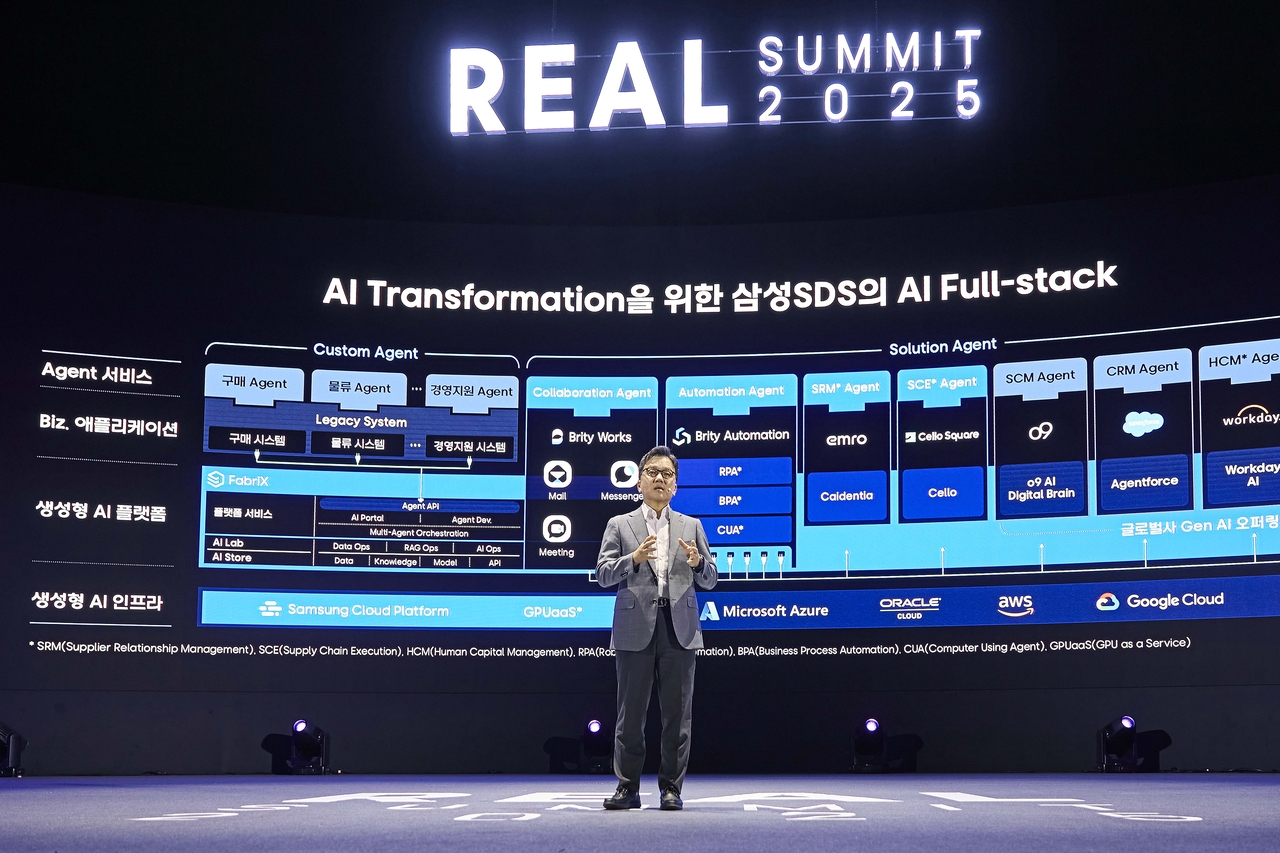
Samsung SDS on Thursday rolled out a “full-stack” artificial intelligence strategy, aiming to become a one-stop shop for companies seeking to integrate AI into their business operations.
Speaking at the company’s annual “Real Summit 2025” event in Seoul, which drew more than 8,000 participants, CEO Lee Jun-hee stressed that the company’s initiative spans from infrastructure to consulting, platforms and solutions, making Samsung SDS an ideal partner for corporate clients pursuing what it calls the AI transformation, or “AX.”
“AI transformation is not simply about adopting a technology, but a journey that requires complete change within a company. Cooperation with a trustworthy IT partner is critical,” Lee said in a keynote speech at the event. “Samsung SDS is the best partner that provides full-stack AI services that drive corporate innovation.”
The company highlighted three flagship offerings, which include its generative AI platform FabriX, Brity Copilot, a collaboration tool that integrates email, messengers, meetings and document management, and Brity Automation, a workflow automation service.
Brity Copilot, in particular, has evolved into what Samsung calls a “personal agent.” Officials demonstrated its features, including an “interpreting agent” that provides real-time translation during video conferences, a “briefing agent” that manages schedules and tasks, and an “answering agent” that responds automatically when users are unavailable.
At a press conference held on the sidelines of the event, Song Hae-goo, the Samsung SDS executive vice president who heads the solution business division, said the simultaneous interpretation service has been expanded from two to seven languages -- including English, Korean, Chinese, Japanese and Vietnamese -- with plans to support 17 languages by November.
Lee also told reporters that Samsung SDS is positively considering joining the Korean government’s ambitious project to build a national AI computing center.
“We are currently reviewing the detailed content of the guidelines,” Lee said. “We believe that Samsung SDS has a role to play in helping the government achieve the national ‘AI G3’ goal. Through this, we will positively review participating.”
The Ministry of Science and ICT on Monday reopened bidding for the project, which aims to build a national AI computing center by 2028 through a public-private partnership. The government aims to secure at least 50,000 high-end graphics processing units for the facility to support AI model training, research and industry adoption.
The relaunch follows two failed attempts earlier this year due to lack of interest from corporate bidders. The government has since revised key requirements to address private sector concerns about ownership structures, mandatory domestic AI chip usage and buyback provisions. Under the new rules, private investors will hold a majority ownership of more than 70 percent in a special purpose company, while the government contributes seed funding and expanded tax incentives.
sahn@heraldcorp.com

![[Graphic News] Seoul ranks 4th among Asia’s most revisited destinations](https://wimg.heraldcorp.com/news/cms/2026/10/01/news-p.v1.20261001.4ac504a054534238aa1997420394b832_T1.gif?type=h&h=800)