Tariffs, tech regulation, $150b shipbuilding deal set for talks
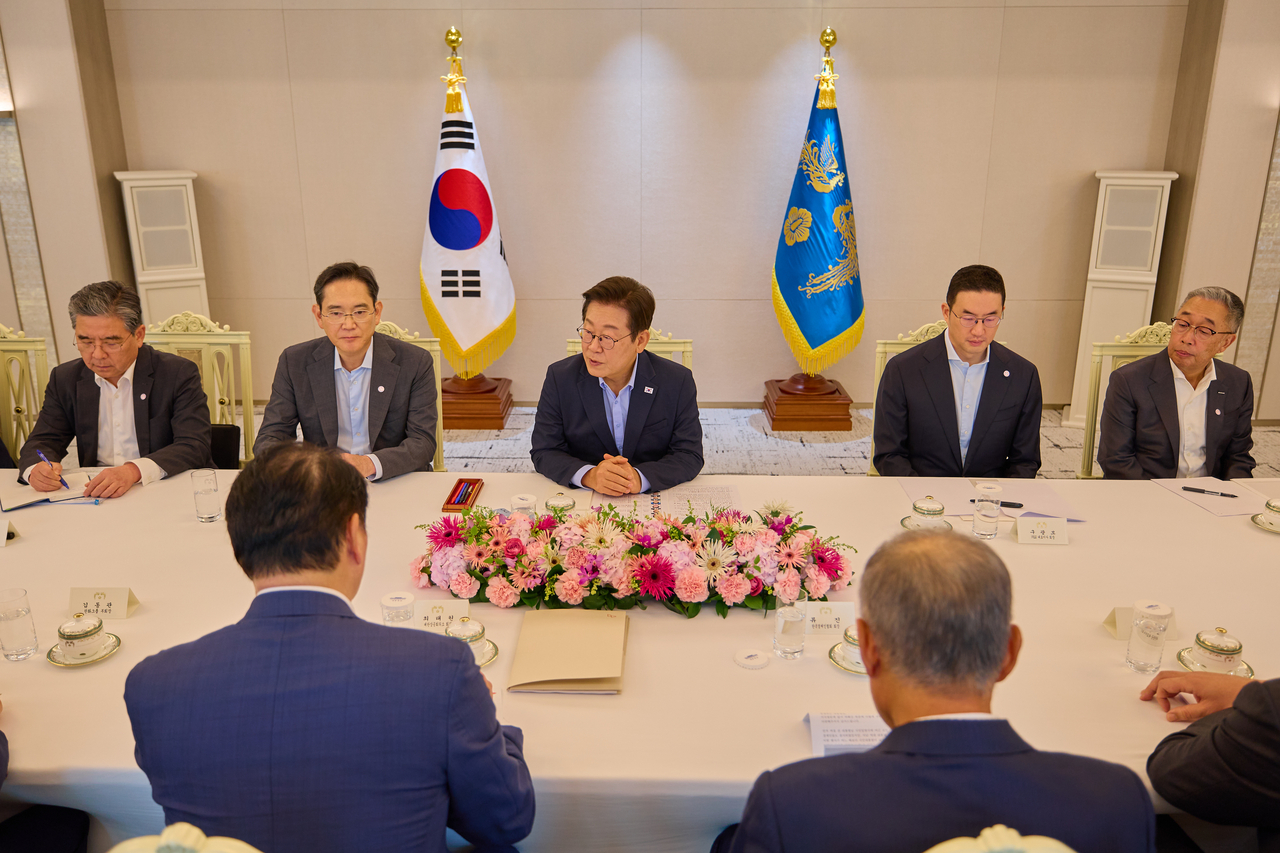
A delegation of 16 leading Korean business executives will accompany President Lee Jae Myung on his first summit with US President Donald Trump, as the two leaders are set to meet in Washington on Monday (US time) to deepen bilateral economic and industrial cooperation.
The business delegation, comprising key figures from Korea's flagship industries, aims to bolster economic ties with the US across various sectors, including semiconductors, shipbuilding, nuclear energy and artificial intelligence, supporting the alliance with tangible investments and industrial partnerships.
According to industry sources on Sunday, among the delegates are Korea Chamber of Commerce and Industry Chairman Chey Tae-won, who also heads SK Group; Ryu Jin, chair of the Federation of Korean Industries; Samsung Electronics Chairman Lee Jae-yong and LG Group Chairman Koo Kwang-mo.
Hyundai Motor Group Executive Chair Chung Euisun, although absent from a pre-visit briefing in Seoul, is expected to join the delegation directly from overseas.
Other participants include Korean Air Chairman Walter Cho, Hanwha Group Vice Chairman Kim Dong-kwan, Doosan Enerbility Chairman Park Gee-won, Celltrion Group Chairman and founder Seo Jung-jin, CJ Group Chair Lee Jae-hyun, GS Group Chair Huh Tae-soo, LS Group Chair Koo Ja-eun, HD Hyundai Vice President Chung Ki-sun, Korea Zinc Chairman Choi Yoon-beom and Naver CEO Choi Soo-yeon. Together, they represent industries spanning heavy manufacturing, advanced materials, digital technology and AI.
Industry observers see the upcoming summit as a decisive moment for Korea’s business diplomacy, especially amid mounting US pressure to localize production and reinforce supply chain security.
“Beyond government-level negotiations, each company must demonstrate commitment to US-based operations to alleviate trade pressure,” said an industry source who requested anonymity.
Historically, Korean business leaders have played a key role during Korea-US summits, leveraging the occasion to engage US lawmakers and executives, unveil investment plans and voice regulatory concerns. The current visit continues that tradition, serving as both a diplomatic mission and a showcase of Korea’s industrial might and strategic alignment with US economic policy.
The upcoming summit is set to place heavy emphasis on economic issues, as tariff negotiations remain unresolved. Seoul is preparing to bring a large-scale investment package to the table, accompanied by a business delegation, to secure tangible outcomes.
A major point of discussion will be the planned joint venture between Korea Hydro & Nuclear Power and Westinghouse, seen as a gateway to the US nuclear market.
With the Trump administration laying out ambitions to expand nuclear capacity to 400 gigawatts by 2050, attention is turning to the so-called “Team KORUS” strategy that would combine Korea’s proven construction capabilities with American technological expertise.
Talks on revising the bilateral nuclear cooperation agreement are also anticipated, with Seoul pushing for progress on spent fuel management and the nuclear fuel cycle.
Another central agenda item is the so-called “MASGA project,” referring to maritime and defense industry cooperation.
President Lee is scheduled to visit Hanwha’s Philadelphia shipyard on Tuesday, underscoring the sector’s significance. Analysts say Washington sees Seoul as a vital partner in countering China’s influence in the global shipbuilding arena, with projections that the two nations could formalize collaboration worth up to $150 billion.
Semiconductors are also expected to dominate discussions. Concerns have risen following reports that Washington may convert subsidies for Intel into equity in the company, raising fears that similar pressure could be applied to foreign players such as Samsung Electronics and TSMC.
The presidential office in Seoul dismissed such speculation, saying, “Korean firms have not received subsidies, and the claim is groundless.”
Still, with President Trump vowing to impose tariffs of up to 100 percent on semiconductor imports, negotiations on investment and supply chain cooperation are likely to become a critical battleground. Broader talks will also extend to batteries, critical minerals, new technologies and overall economic security.
Digital regulations could emerge as another sticking point. US tech industry groups have labeled Korea’s online platform act, restrictions on exporting high-precision maps, cloud security certification requirements and AI-related legislation as barriers to digital trade.
With six major associations, including the US Chamber of Commerce, jointly pressing the matter in a formal letter, observers expect the summit to feature meaningful discussions on regulatory easing.
On automobiles, earlier negotiations failed to cut tariffs to 12.5 percent, leaving room for follow-up measures. In agriculture, Seoul reiterated its firm stance that rice and beef will remain off the table, even as pressure mounts for broader market access.
The Korean government is also preparing countermeasures to help domestic firms cope with high US tariffs. Officials are expected to discuss support programs and long-term strategies to bolster industrial competitiveness in the face of shifting global trade rules.
yeeun@heraldcorp.com