Asian Games reveal Korea’s slipping edge in traditional medal sports such as archery and taekwondo, even as its golds come from a broader range of sports
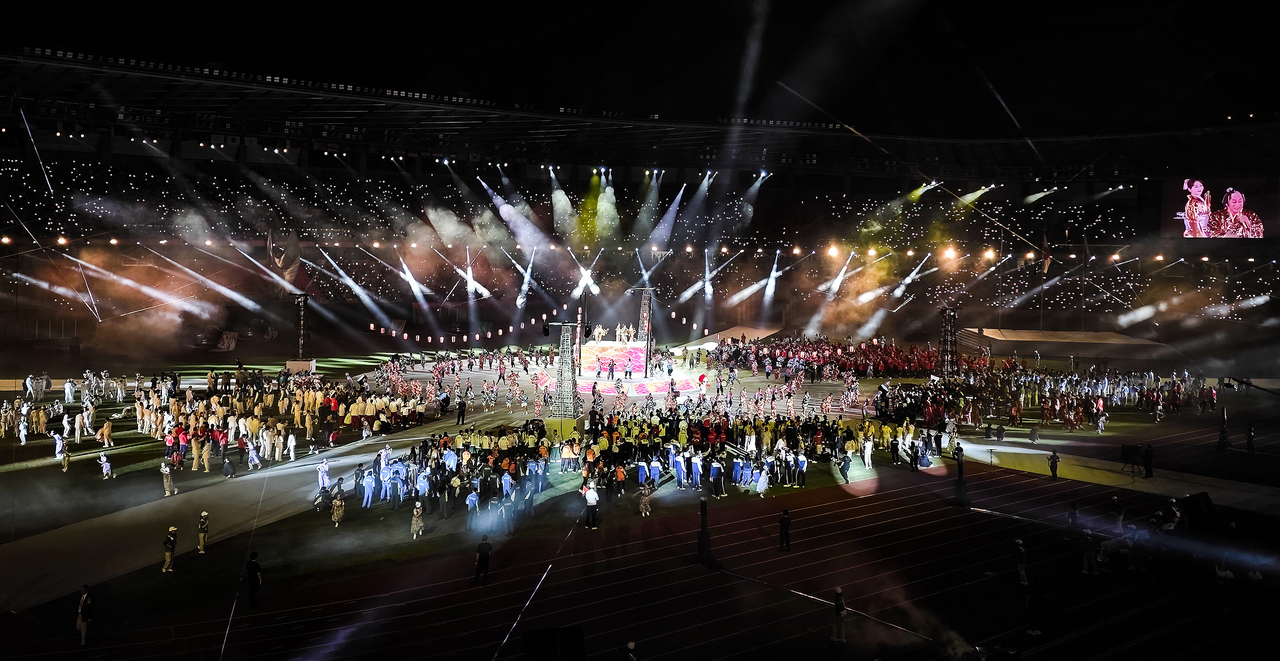
For South Korea, the Aichi-Nagoya Asian Games ended Sunday with a familiar result but a growing sense of unease.
Korea finished third in the medal standings for a third consecutive Games, but its 39 gold medals fell short of the 40 to 45 it had targeted. More strikingly, the gap with Japan — the country it had hoped to close in the medal race — widened to its largest ever.
China dominated with 169 golds, followed by host Japan with 83. Korea finished with 39 golds, 43 silvers and 68 bronzes, while fourth-place India won 21 golds.
The 44-gold gap between Korea and Japan was more than twice the 18-gold margin separating Korea from India. Korea's 39 golds were also its fewest at an Asian Games since 1982, when it won 28.
The result extended a steady decline. Korea won at least 50 gold medals at every Games from Seoul in 1986 through Incheon in 2014, finishing second overall at seven of those eight editions. The tally fell to 49 at the 2018 Jakarta-Palembang Games, 42 at Hangzhou in 2022 and now 39 in Aichi-Nagoya.
The biggest warning signs came from several of Korea's traditional medal-producing sports.
Archery, swimming, shooting, taekwondo and badminton had been assigned some of the country's biggest gold-medal targets. But Korea fell short in all five. Archery produced three golds against a target of five, swimming one against four, shooting and taekwondo three each, and badminton two against three.
Archery, long one of Korea's most reliable sources of gold, offered a particularly disappointing result. Lee Woo-seok won both the men's recurve individual and team titles, while Kim Jong-ho took gold in the men's compound individual event. But the Korean women failed to win a recurve gold for the first time in Asian Games history.
Fencing met its four-gold target, led by Oh Sang-uk's two titles, but Japan won six fencing golds on home soil, ending Korea's bid for a fifth consecutive overall title in the sport.
Other traditional strengths also disappointed. Korea won just three bronze medals in athletics, despite the sport offering more golds than any other at the Games. Table tennis produced neither a gold nor a silver, while judo managed only one gold, through Hur Mi-mi. Taekwondo won three golds, but its performance was less dominant than expected, particularly outside the two poomsae titles.
"It is true that we did not live up to expectations in some sports," Ryu Seung-min, president of the Korean Sport & Olympic Committee, said Sunday in Nagoya.
Ryu said the Games provided an important opportunity to assess where Korean sport stands with the 2028 Los Angeles Olympics approaching, noting the rapid improvement of teams from Central and Southeast Asia.
There were, however, reasons for optimism.
Korea swept the men's and women's 5-on-5 basketball titles and added gold in men's 3-on-3. Baseball won its fifth consecutive Asian Games title, while the men's soccer team claimed its fourth straight gold. The women's handball team returned to the top for the first time in eight years.
An Se-young became the first player to win consecutive Asian Games women's singles badminton titles, while golfer Kim Ju-hyung won Korea's first men's individual gold in 16 years. Esports delivered both of the golds Korea had targeted, while sailing and canoeing each contributed two. Korea also won a gold in teqball, which made its official Asian Games debut.
Korea won gold medals in 22 sports, two more than at Hangzhou. So although the overall gold tally fell, the country's champions came from a broader range of sports.
Ryu said the KSOC would conduct a detailed review of the results, including training systems and the use of sports science.
"We will listen more closely to athletes and coaches as we move forward, and make sure we present a stronger version of Team Korea in LA," he said.
The next Asian Games will be held in Doha in 2030.
milaya@heraldcorp.com