The state-run Korea Development Institute maintained its 0.8 percent growth forecast for South Korea this year, citing a sharp downturn in construction and a smaller-than-expected lift from expanded fiscal spending.
The revised outlook, released Tuesday, follows the KDI’s May projection, when it cut its 2025 growth estimate from 1.6 percent. The think tank also kept its 2026 forecast unchanged at 1.6 percent.
While the economy has moved past last year’s slowdown, growth remains weak, according to the KDI. Gross domestic product expanded 0.6 percent in the second quarter from the first, when the economy contracted 0.1 percent, but output was still 0.5 percent lower than a year earlier.
The biggest drag is construction, with investment now forecast to shrink 8.1 percent this year, steeper than the 4.2 percent decline projected in May and last year’s 3.3 percent fall.
The KDI raised its forecast for private consumption by 0.2 percentage point to 1.3 percent, citing the impact of a 30 trillion won ($21.6 billion) second extra budget and falling interest rates. Facility investment was also lifted 0.1 percentage point to 1.8 percent on sustained upturn in the semiconductor industry.
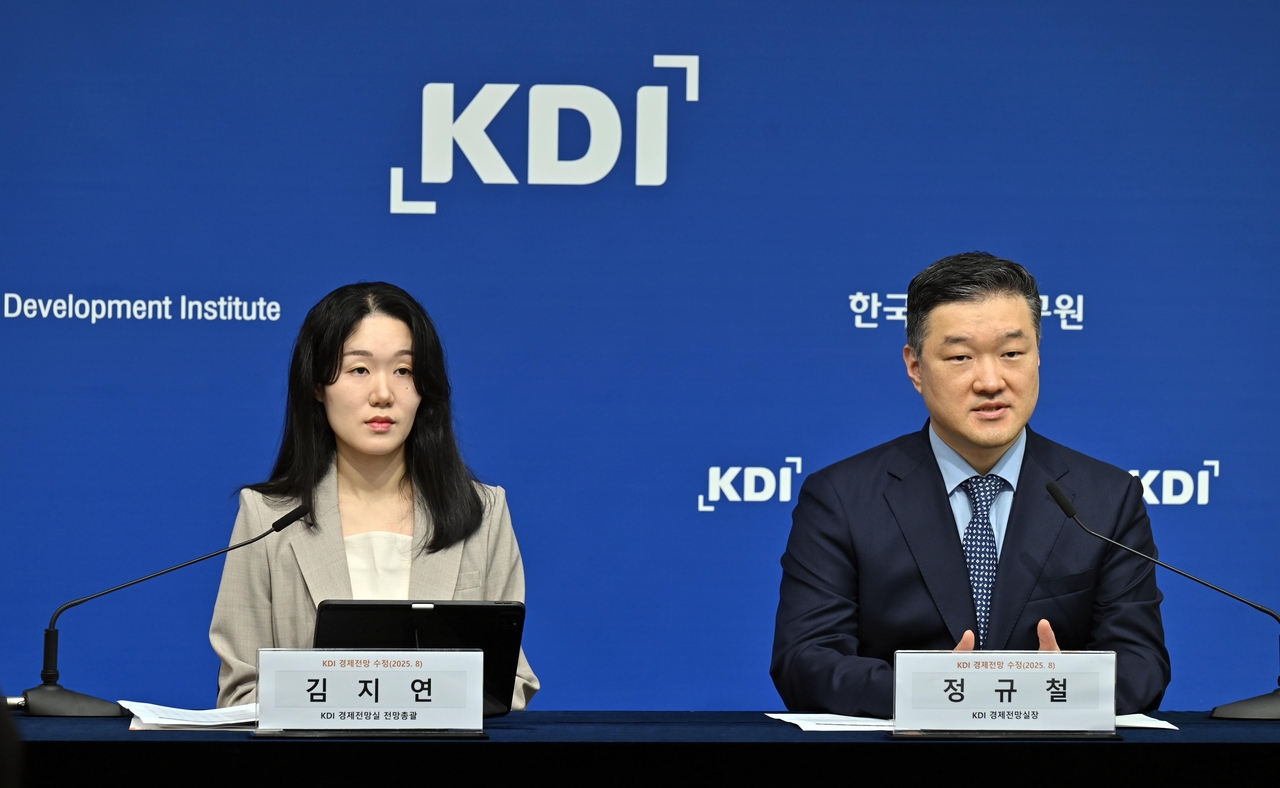
The extra budget is estimated to have added about 0.1 percentage point to annual growth, said Jung Kyu-chul, the KDI’s director for economic outlook. “The size of the budget was much larger than 0.1 percent of GDP, which means not all of it translated into higher consumption,” he said.
Exports are projected to grow 2.1 percent this year, up sharply from 0.3 percent in May, as shipments have so far weathered US-led tariff uncertainties better than expected.
Even so, the KDI sees a marked slowdown ahead as the tariff shock begins to weigh on sectors such as semiconductors and autos from the latter half of this year. Export growth is forecast to plunge from 6.8 percent in 2024 to 2.1 percent in 2025 and 0.6 percent in 2026, with the 2026 figure revised down by 0.2 percentage point from three months ago.
The trade account is expected to remain in surplus, supported by a semiconductor recovery and improved terms of trade. The KDI projects surpluses of $106 billion in 2025 and $91 billion in 2026, raising this year’s forecast by $14 billion on an upgraded outlook for global chip sales.
Inflation is forecast at 2 percent this year and 1.8 percent next year.
The KDI’s lead economist for outlook, Kim Ji-yeon, warned that escalating trade tensions between the US and major economies could further weigh on global growth. She pointed to US tariffs on semiconductor products as a key export risk, noting that the recently announced measures have yet to be finalized and were not factored into the latest forecast.
“Given that Korean semiconductors are used as intermediate goods in markets such as Taiwan and ASEAN (Southeast Asia), higher tariffs in key trading partners could also hurt the economy,” she said.
jwc@heraldcorp.com