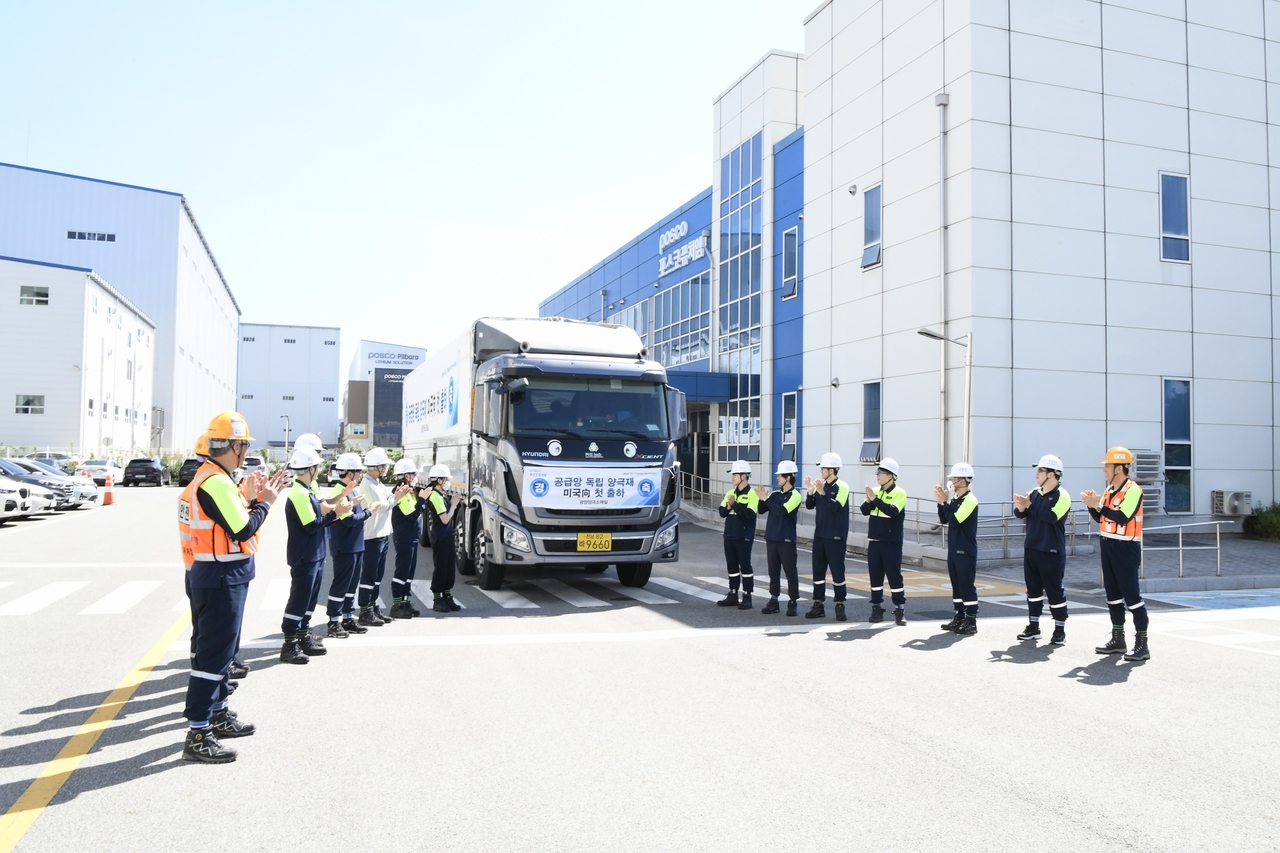
Posco Future M completed its first shipment of Korean-made cathode materials to the US for Ultium Cells — a battery joint venture between LG Energy Solution and General Motors — qualifying the batteries for US electric vehicle energy tax credits.
Cathode materials are a key component of EV batteries, directly influencing the cells’ overall capacity, energy density and safety.
This milestone marks the first time cathode materials, previously heavily reliant on China, have been manufactured entirely with Korean-sourced materials.
High-nickel, cobalt, manganese and aluminum cathode materials are known for high energy density and output. Although details on the supply volume remain undisclosed, the NCMA materials will be used in high-performance EV batteries manufactured by Ultium Cells to target the US, the world’s second-largest EV market after China.
The cathode materials, shipped on July 26, were produced using precursors from a newly completed plant in Gwangyang, South Jeolla Province, which boasts an annual capacity of 45,000 units. These precursors, made from nickel, cobalt and manganese, were then combined with lithium to create the final product. With this initial shipment, Posco Future M also plans to expand production at its Pohang plant in North Gyeongsang Province.
“While these products remain subject to the 15 percent US tariff on Korean imports, the impact can be offset by the Advanced Manufacturing Production Credit under the US Inflation Reduction Act,” said a source familiar with the matter on condition of anonymity.
Under the IRA, which incentivizes US production of key battery and clean energy components, EV battery manufacturers are eligible for an AMPC credit of up to $35 per kilowatt-hour for battery cells and up to $45 per kilowatt-hour for battery modules. The credit is available for production and sale through 2031, having been recently moved up by one year.
The cathodes produced by Posco Future M meet the IRA regulations that require battery components to be manufactured within the US or in a US FTA partner country such as Korea. On the other hand, battery makers using Chinese-made cathodes are ineligible for AMPC incentives, as the recently enacted One Big Beautiful Bill Act classifies China as a “Prohibited Foreign Entity.”
Posco Future M stated, “Our self-sufficient supply chain is expected to provide a significant competitive advantage over competitors, even in the face of shifting geopolitical dynamics.”
In June, Posco Future M, along with Posco Group affiliates, including Posco, Posco HY Clean Metal, Posco Pilbara Lithium Solution and Posco Lithium Solution, established a fully integrated supply chain that spans from raw materials such as lithium and nickel to precursors and cathode materials.
Meanwhile, Posco Future M is also intensifying its efforts to reduce dependence on China, particularly in the graphite supply chain. The company is developing natural graphite anode materials by securing graphite ore from non-Chinese sources, such as African countries, while promoting raw material localization through domestic production of intermediate spherical graphite.
hyejin2@heraldcorp.com