Hanwha Aerospace will be the first private company in Korea to secure full lifecycle capabilities for rocket development, the company said Wednesday.
The nation’s leading defense manufacturer signed a technology transfer agreement with the Korea Aerospace Research Institute, the state-run space agency, to acquire core technologies for the Korea Space Launch Vehicle-II, also known as Nuri.
The transfer includes the rocket’s design and technologies for manufacturing and launch operations. Under the agreement, Hanwha Aerospace also gains rights to produce and launch the Nuri rocket through 2032, the company said.
"This technology transfer is a critical milestone for improving the nation’s space industry capabilities. It provides us with the foundation to enhance the KSLV-II’s technological capabilities and cost-effectiveness," said Son Jae-il, president and CEO of Hanwha Aerospace.
"Our goal is to build a robust and globally competitive commercial launch service, solidifying our position as a leader in the new space era."
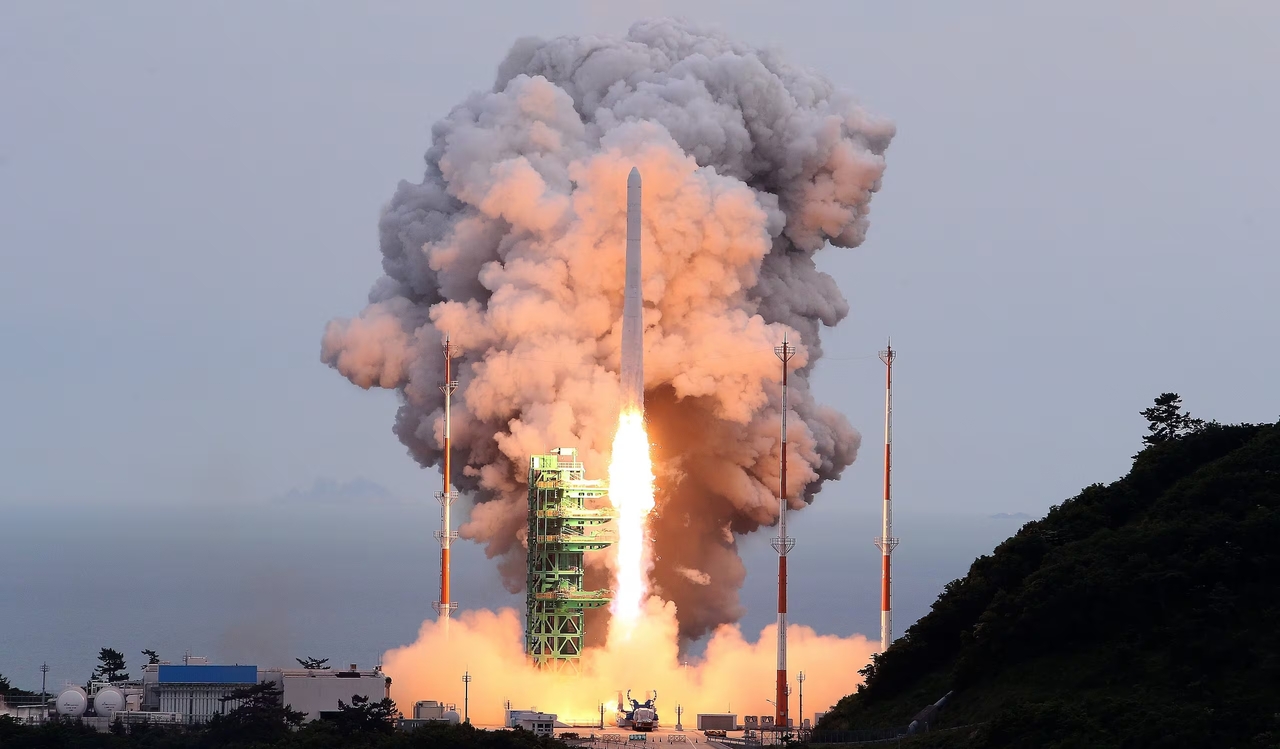
The Nuri rocket, Korea’s first domestically developed launcher, was completed in 2023 through a 14-year project involving over 300 local companies, including Hanwha Aerospace, which developed key components such as liquid rocket engines.
With its successful launch in May 2023, placing a satellite weighing over one metric ton into orbit, Korea became the seventh country worldwide to independently achieve this level of launch capability.
While the KARI led the first three Nuri rocket launches, Hanwha Aerospace is set to take the lead for the remaining three, scheduled for November 2026 and 2027.
Hanwha Aerospace will continue collaborating closely with KARI to ensure a seamless transfer of operational know-how and accumulated experience.
The company is positioning space transportation as a future growth engine and is exploring further involvement in areas such as launch service operations and space exploration industries.
To achieve this, it aims to build a vertically integrated value chain by leveraging its expertise in land, sea and air defense systems — including aircraft engines, armored vehicles, self-propelled howitzers and submarine batteries.
Its subsidiary Hanwha Systems contributes advanced capabilities in radar, data security and process technologies that support Korea's key defense programs like the Cheongung missile systems and the K9 howitzer.
Additionally, Hanwha Aerospace has incorporated satellite manufacturer Satrec Initiative as a key subsidiary within its expanding space portfolio.
forestjs@heraldcorp.com



![[Graphic News] Seoul ranks 4th among Asia’s most revisited destinations](https://wimg.heraldcorp.com/news/cms/2026/10/01/news-p.v1.20261001.4ac504a054534238aa1997420394b832_T1.gif?type=h&h=800)