Korean battery maker eyes edge over Chinese rivals by diversifying cost-effective battery offerings
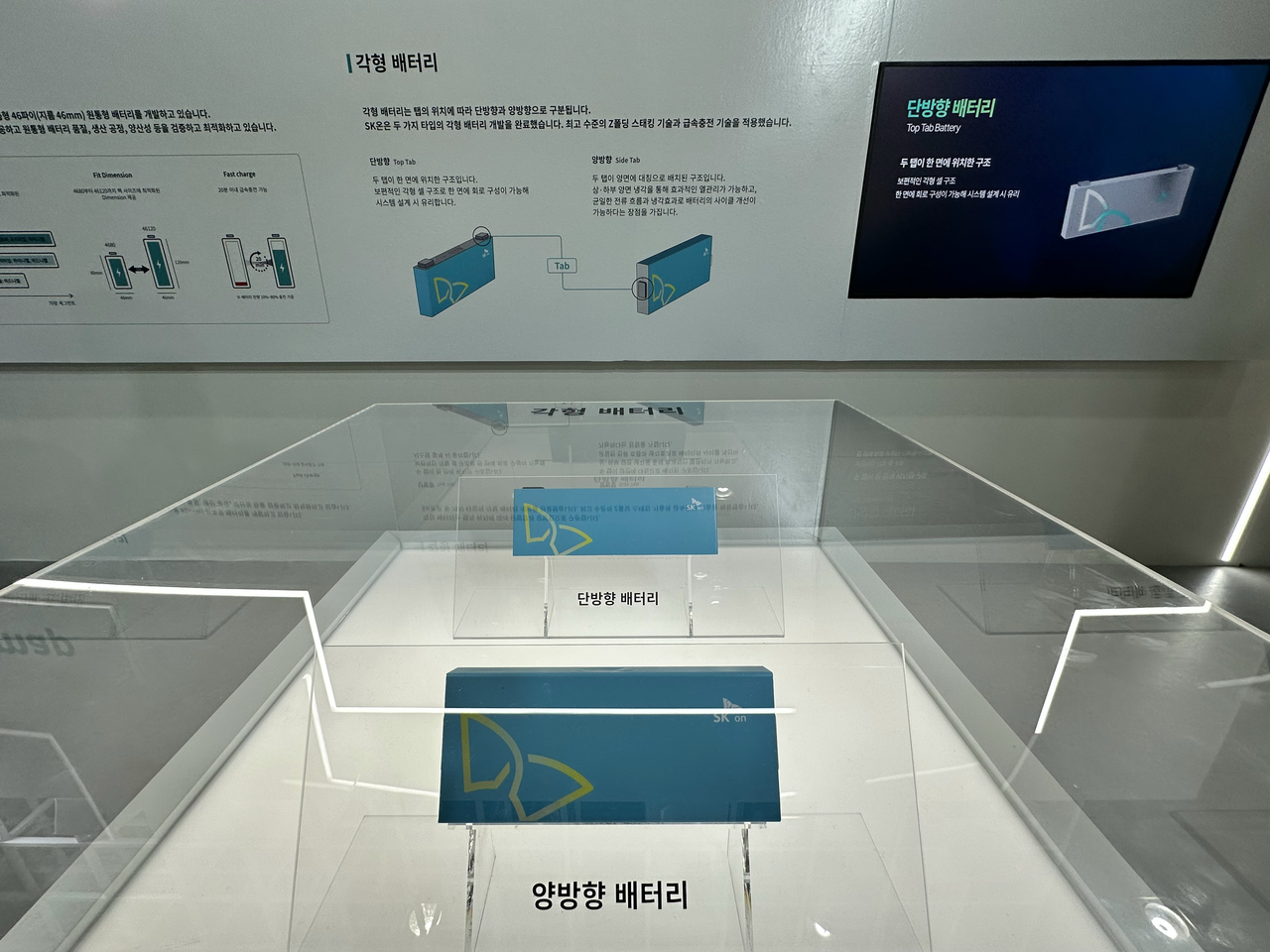
SK On has begun setting up a pilot line for unidirectional prismatic battery cells at its Daejeon research center this week, as demand grows for this more space-efficient battery format in electric vehicles and energy storage systems.
“Unidirectional” or “top terminal” cells refer to a battery design in which current flows through terminals placed on the top, optimizing the use of space and simplifying their integration into EVs.
Prismatic cells can be made rectangular, unlike the more traditional cylindrical cells. This allows for higher energy density, as there is less empty space between the cells when packed together to make batteries.
This initiative marks the completion of SK On’s prismatic battery road map, following its earlier launch of a pilot line in 2023 for “bidirectional” or “side terminal” prismatic cells, which feature terminals on opposite sides to enhance current distribution and thermal efficiency.
“The initial setup of SK On’s unidirectional prismatic battery pilot line — involving equipment delivery, positioning, unpacking, and installation — has started this week,” said an industry source familiar with the matter, speaking on condition of anonymity. “Full-scale construction will begin next week, focusing on integrating utilities such as electrical connections.”
The source added that sample production will commence soon after the line setup is complete, with a mass production schedule to be determined through client negotiations.
The move is part of SK On’s broader push to narrow the gap with domestic rival Samsung SDI, which already mass-produces unidirectional prismatic cells, while also preparing for large-scale production of bidirectional cells.
LG Energy Solution is likewise developing prismatic batteries through a partnership with General Motors in the US and is reportedly building a pilot line at its Ochang plant in North Chungcheong Province. However, the specific type of prismatic cell remains undisclosed.
Demand for prismatic battery cells is accelerating due to their high energy density, enhanced safety, and packaging efficiency — qualities that make them well-suited for both electric vehicles and energy storage systems. According to India-based Market Report Analytics, the global prismatic battery market is expected to grow from approximately $25 billion in 2028 to $40 billion by 2033.
Automakers including Hyundai Motor Group, GM, Volkswagen, and Ford are increasingly adopting prismatic designs for next-generation EVs and hybrid vehicles. Samsung SDI, for example, signed a seven-year deal with Hyundai Motor in 2023 to supply batteries for its European EV lineup between 2026 and 2032. GM is working with LG Energy Solution on similar deployments.
Though SK On has not disclosed specific customers, media reports suggest it may pursue supply deals with China’s Zhejiang Geely Holding Group, following a strategic agreement signed last year. Geely owns global brands such as Geely Auto, Volvo, Polestar, and Lotus.
SK On first unveiled its unidirectional and bidirectional prismatic prototypes at the InterBattery 2025 exhibition in Seoul in March. Industry experts say its expansion into unidirectional designs could help SK On build a more diversified customer base and better compete with Chinese firms such as CATL and CALB.
Those companies have primarily focused on bidirectional formats, which are optimal for cell-to-pack systems that eliminate conventional battery modules. In contrast, unidirectional cells are better suited for modular systems, where battery cells are arranged into packs via intermediate modules — still widely favored in many EV platforms.
hyejin2@heraldcorp.com